
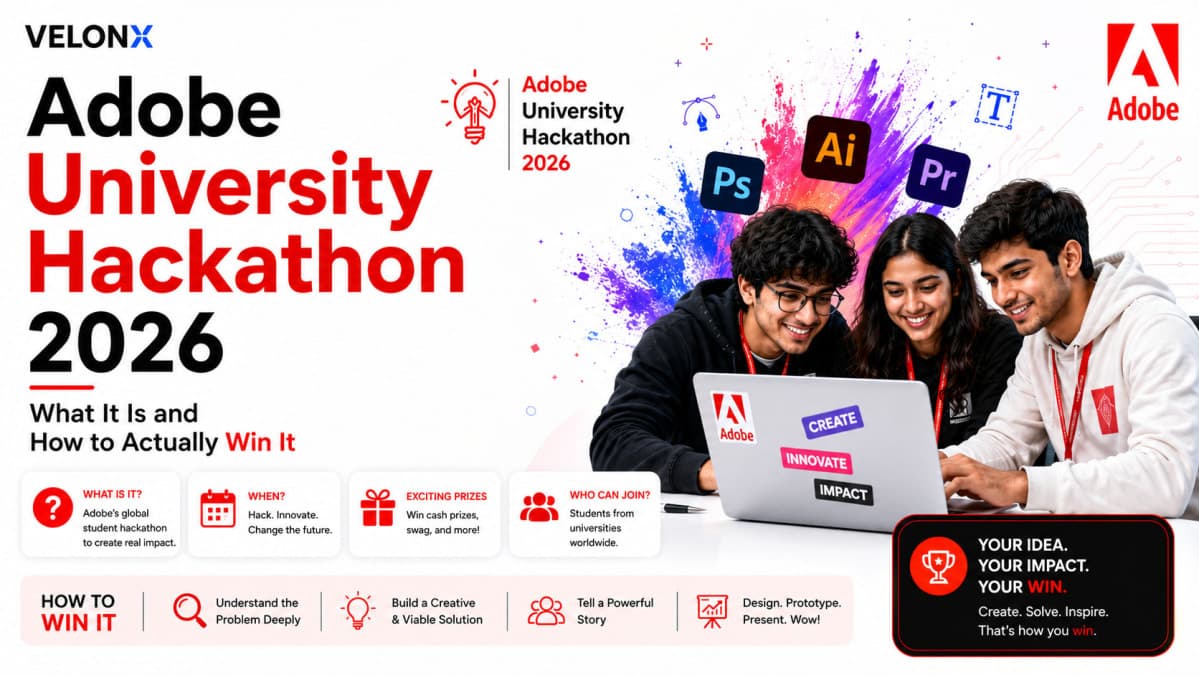
Most students see "Adobe" and "hackathon" in the same sentence and assume it's out of their league. It isn't. Here's the truth: Adobe University Hackathon 2026 is one of the most accessible high-value opportunities on the table right now — a national-level challenge, open to students across India, built around AI, creativity, and problem-solving, with a shot at an actual internship with Adobe India on the line.
This guide breaks down what the hackathon involves, who it's for, and — more importantly — how to prepare for it before the problem statement even drops.
What Is Adobe University Hackathon 2026 and Why It Matters
Adobe University Hackathon 2026 is a nationwide competition hosted on Unstop, open to students from colleges across India — not restricted to a single campus or tier of institution. Adobe has confirmed the theme sits at the intersection of AI, creativity, and problem-solving, though the exact problem statement is being released closer to the event.
Here's why this is worth blocking time for:
It's a resume-defining credit. "Adobe Hackathon Finalist" carries weight with any recruiter, Adobe or not.
It's a direct internship pipeline. Strong performers get a real shot at an internship opportunity with Adobe India — not just a certificate.
It rewards builders, not just coders. Given Adobe's focus on creative tools, design thinking and product sense matter as much as raw code.
It's genuinely open. Unlike closed, single-college hackathons Adobe has run in the past, this one is built for students nationally.
Adobe has a track record of running these well. Earlier Adobe-hosted hackathons for students — including one focused on Adobe Express add-ons — pulled in hundreds of applicants competing for a limited number of team spots, with winning teams walking away with hardware prizes, LinkedIn recommendations, and in some cases a path to publishing real, working products. That's the standard to prepare for.
Who Should Apply
You don't need to be from a tier-1 college or have a hackathon trophy wall to make this worth your time.
You're a strong fit if you're:
A B.Tech/B.E./MCA student (any year, though final and pre-final years typically have the edge)
Comfortable with at least one of: web development, UI/UX design, or applied AI/ML
Someone who can work in a team of 2–4 — solo entries are rarely the format for hackathons at this scale
Willing to prototype fast under a tight deadline, not just plan endlessly
Don't rule yourself out if:
You're from a tier-2 or tier-3 college — Adobe's national-format hackathons are explicitly built to widen the net beyond metro campuses
You've never won a hackathon before — most winning teams in Adobe's past student events were first-timers
Your CGPA isn't stacked — this format tests what you build in 24-48 hours, not your transcript
Pro Tip: Don't wait for full eligibility criteria to lock a team. Start assembling a 2-3 person team now based on complementary skills — one person strong in front-end/design, one in backend or AI integration, one who can pitch. Team formation is the single biggest bottleneck once registration opens.
Step 1: Register Early and Set Up Your Unstop Profile
The hackathon is being run through Unstop, so your Unstop profile essentially functions as your entry point and your credibility signal to the Adobe team reviewing applications.
What to Do Now
Complete your Unstop profile fully — skills, projects, GitHub link, portfolio
Follow the official listing so you get notified the second the problem statement and registration deadlines are announced
Check eligibility fine print carefully once it's published — graduation year and team-size rules can disqualify late
Mistakes to Avoid
Registering with a half-filled profile — reviewers do look at this before shortlisting
Waiting until the deadline to form a team — strong teams form early
Assuming "university hackathon" means it's limited to top colleges — it isn't
Step 2: Build Your AI + Creative Tooling Base Before the Problem Statement Drops
Since Adobe has explicitly flagged AI and creativity as the core themes, the smartest prep you can do right now isn't guessing the problem — it's getting fluent in the tools you'll likely need regardless of what the challenge turns out to be.
Where to Focus
Generative AI integration — get comfortable calling AI APIs (OpenAI, Gemini, or similar) inside a real app, not just in a notebook
Adobe's own developer ecosystem — if the challenge touches Adobe Express, Firefly, or Creative Cloud APIs, familiarity with Adobe's developer documentation will save you hours during the event
Fast prototyping stacks — React or Next.js for frontend, Python/Node for backend; the goal is speed, not novelty
Design fundamentals — Figma basics go a long way when the judging criteria includes "creativity" and "usability," not just technical depth
Skill Area | Why It Matters for This Hackathon | Where to Learn |
|---|---|---|
Generative AI APIs | Core to Adobe's 2026 theme | Adobe Developer docs, Hugging Face, OpenAI docs |
Frontend Prototyping | You'll build and demo fast | React docs, Velonx Projects |
UI/UX Basics | Judged on creativity, not just function | Figma, NNGroup articles |
Pitching/Storytelling | Judges remember narratives, not feature lists | Practice with your team beforehand |
Key Tip: Teams that win hackathons like this rarely have the most complex build — they have the clearest story about who the product is for and why it matters. Practice your 2-minute pitch before you even know the problem statement.
Step 3: Practice Building Under Real Time Pressure
A hackathon isn't a project you polish over weeks — it's a sprint, typically 24-48 hours, where half your team's time goes to debugging things that seemed simple in planning.
Simulate the Conditions
Run a mock 24-hour build with your team on a random small idea — treat it like the real event
Set up your dev environment, boilerplate, and common libraries before hackathon day so you're not losing the first two hours to setup
Assign clear roles going in: who owns frontend, who owns backend/AI, who owns the pitch deck
What Judges at Adobe-Style Hackathons Actually Reward
Past Adobe student hackathons have consistently rewarded teams that:
Solved a real, narrow problem well — not five problems shallowly
Used AI as a tool inside the product, not as the entire pitch
Could clearly explain who the end user is and what pain point disappears because of their build
Had a working demo, even a rough one, over a polished slide deck with no functioning product
Pro Tip: Have your demo ready to run 30 minutes before your slot — Wi-Fi and last-minute bugs kill more good ideas at hackathons than bad code does.
Step 4: Use the Right Support Systems
You don't have to prep for this alone, and trying to is how most students burn out before the actual event.
Find teammates and mentors through your college's coding club or a platform like Velonx Mentors, where you can get matched with people who've been through hackathons before
Track other AI-and-creativity-focused hackathons on Velonx Events to get reps in before the Adobe event
Study past Adobe hackathon writeups and winning project breakdowns — Adobe's developer blog regularly publishes retrospectives from previous student hackathons that show exactly what separated winning teams from the rest
Frequently Asked Questions About Adobe University Hackathon 2026
Is Adobe University Hackathon 2026 open to all colleges in India?
Yes. Unlike some of Adobe's earlier campus-specific hackathons, this is structured as a national-level event hosted on Unstop, open to students from colleges across the country, not limited to a single university.
What is the problem statement for Adobe University Hackathon 2026?
Adobe has confirmed the hackathon centers on AI, creativity, and problem-solving, but the specific problem statement has not been released yet. Keep your Unstop profile updated and follow the listing to get notified when it drops.
Do I need prior hackathon experience to apply?
No. Adobe's past student hackathons have consistently rewarded first-time participants who brought a clear, focused idea over experienced teams with overly complex builds. What matters more is your ability to build and pitch fast as a team.
What do winners actually get?
Based on Adobe's past student hackathon formats, rewards have included prizes, mentorship, recognition from the Adobe team, and — the headline draw for this event — a stated chance at an internship opportunity with Adobe India for standout performers.
Can I participate without a strong coding background?
You can, if your team covers the gap. Adobe's hackathons weigh creativity and problem definition alongside technical execution, so a team with one strong builder and one strong designer/communicator can still be competitive.
How do I find teammates if my college doesn't have an active tech community?
Use platforms built for this — Velonx Community and Unstop's own team-formation discussion boards are both built specifically to connect solo participants with hackathon teams outside their own campus network.
Conclusion: Don't Wait for the Problem Statement to Start Preparing
Here's the bottom line: the students who do well at Adobe University Hackathon 2026 won't be the ones who start prepping the day the problem statement is released — they'll be the ones who used the wait time to build their team, sharpen their tools, and rehearse working under pressure.
Start with what you can control today:
Complete and polish your Unstop profile
Lock in a 2-3 person team with complementary skills
Get hands-on with AI APIs and fast-prototyping tools
Run one mock 24-hour build sprint before the real thing
Follow the official listing so you're not late to register
Every hackathon you don't win still sharpens the team, the pitch, and the build speed you'll need for the one you do. Adobe University Hackathon 2026 is a genuinely open door — the only real barrier is whether you walk through it prepared.