
Most engineering students spend four years in college and walk out with a degree, a mediocre DSA sheet, and zero clue what went wrong when companies handed them rejection emails. Here's the uncomfortable truth: ₹10 LPA isn't a lottery win — it's the result of a deliberate, year-by-year plan that most students never follow.
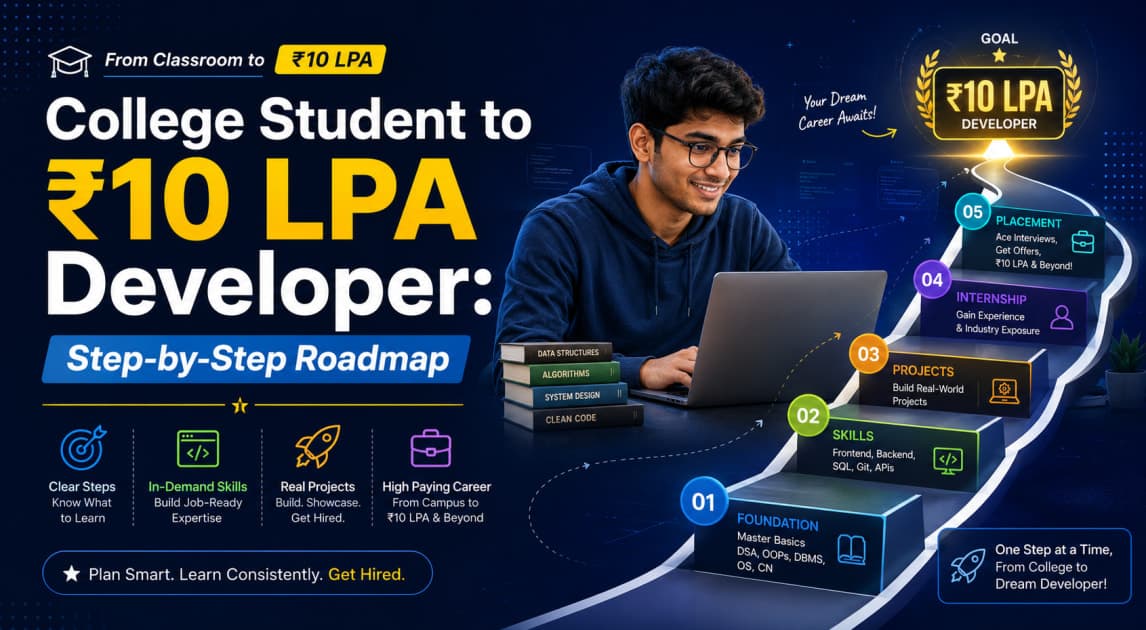
This guide gives you the exact college student to ₹10 LPA developer roadmap for India — broken down year by year, with real projects, internship strategies, networking moves, and the interview prep that actually gets offers.
What Does ₹10 LPA Mean and Is It Realistic for Freshers?
Let's get something out of the way first. A ₹10 LPA package as a fresher is not a pipe dream — but it is a stretch goal that only lands when the preparation is intentional.
Here's what's true about the current Indian tech job market:
Product companies (Razorpay, Swiggy, CRED, Meesho, Groww) routinely offer ₹8–15 LPA to freshers with strong CS fundamentals and projects
MNC tech roles at Google, Microsoft, Amazon India, and Flipkart go ₹15–40 LPA for freshers — but require exceptional DSA prep
Service companies (TCS, Infosys, Wipro) offer ₹3.5–7 LPA for mass hiring; getting above ₹10 LPA from them means clearing digital/elite roles
Startups pay ₹6–12 LPA for fresher developers if you can ship real code
According to LinkedIn India Talent Trends, developers with a strong GitHub portfolio and at least one internship under their belt command 40–60% higher starting salaries than those without. That's the gap this roadmap bridges.
Year 1: Build the Foundation (1st Year — June to May)
Year 1 is the year most students waste on Netflix, cricket, and "settling in." Don't be that person.
This year is about exactly one thing: building technical fundamentals that won't embarrass you later.
What to Learn
Programming basics: Python or C++ (pick one — go deep, not wide)
DSA Level 1: Arrays, strings, linked lists, basic recursion
Web fundamentals: HTML, CSS, JavaScript basics — even if you want to go into backend or ML, this helps
Tools: Git, GitHub, VS Code — non-negotiable from Day 1
Platforms to Use
Goal | Platform |
|---|---|
DSA fundamentals | GeeksforGeeks, LeetCode (Easy problems) |
Free structured courses | NPTEL (Programming in Python / C++) |
Git basics | GitHub's own learning lab |
Peer competitions | HackerRank badge challenges |
Year 1 Milestone: What "Done" Looks Like
By the end of Year 1, you should have:
Solved 100+ LeetCode Easy problems
A GitHub account with at least 3 repositories (even small beginner projects)
Completed one NPTEL or Coursera course with a certificate
Pro Tip: Don't wait for your college to teach you Git. Learn it in Week 1 of college and use it for every assignment. Employers can literally see your commit history — make it look like someone who gives a damn.
Year 2: Go Deeper + Get Your First Internship (2nd Year)
Year 2 is when things get real. You have enough fundamentals to build something meaningful, and you have enough time before placements to experiment without pressure.
This year has two jobs: go deep on one technical area and get your first internship — even unpaid.
Technical Focus for Year 2
Pick a lane and go deep. Don't try to do everything.
Full Stack Development: React + Node.js + MongoDB or PostgreSQL
Backend Engineering: Java with Spring Boot or Python with Django/FastAPI
Data Science/ML: Python + NumPy + Pandas + Scikit-learn + a good Kaggle project
Android/iOS Development: Flutter or Kotlin/Swift
Cloud + DevOps (riskier but high demand): AWS basics + Docker
The biggest mistake students make in Year 2 is doing "one module of everything." Employers don't want generalists at the fresher level. They want someone who can actually build something in a specific stack.
Building Projects That Matter
A "project" is not a tutorial you followed on YouTube. Employers can tell. A real project is something you struggled through, broke, fixed, and deployed.
Here's what a strong Year 2 project looks like:
Problem: Solve a real or realistic problem (college bus tracker, expense splitter, recipe recommender)
Stack: Use real tools (not just HTML/CSS — include a database, API, or ML model)
Deployed: Live on Vercel, Render, or AWS Free Tier — not just on your laptop
GitHub: Clean README, proper commits, no "first commit adds everything" nonsense
Target: 2–3 solid projects by end of Year 2.
Getting Your First Internship
Don't wait for your college's "internship drive." That's for people who want to settle for whatever comes.
Apply on Internshala and LinkedIn from the first week of Year 2
DM founders of small startups on LinkedIn with your GitHub and a specific pitch
Check Unstop (D2C) for hackathons — many companies convert winners to interns
Apply to Google Summer of Code or LFX Mentorship if you're into open source
The goal is any internship — paid or unpaid — that gives you real codebase experience. A 2-month unpaid internship at a startup is worth more on your resume than 3 certificates from Coursera.
Pro Tip: Email startups directly. Find the CTO or engineering lead on LinkedIn, write 4–5 sentences about what you can build for them, and attach your GitHub. 10% of people who do this consistently get a response. 90% of students never try.
Year 3: Internship to Full-Time Pipeline + Strong Projects (3rd Year)
Year 3 is the inflection point. This is where the gap between students who land ₹10 LPA offers and those who settle for ₹3.5 LPA starts to show clearly.
Your focus this year: get a paid internship (ideally at a product company), build one flagship project, and start DSA prep seriously.
Target Internships in Year 3
Company Type | Where to Apply | Target Stipend |
|---|---|---|
Product startups (Series A–C) | LinkedIn, Cutshort.io, AngelList/Wellfound | ₹15,000–40,000/month |
Mid-size tech companies | Naukri, Internshala | ₹10,000–25,000/month |
MNC internship programmes | Company careers pages (apply Oct–Nov for summer) | ₹50,000–80,000/month |
Open-source (GSoC, LFX) | $1,500–$3,300 stipend |
Freshers who complete a paid internship at a product company and convert it to a PPO (Pre-Placement Offer) often skip the entire placement season drama. That PPO route to ₹10 LPA is real and more common than people think.
Build One Flagship Project
This is the project you'll talk about in every interview for the next 12 months. It needs to be:
Complex enough to discuss architecture decisions
Deployed and live (not "works on my machine")
Unique enough that the interviewer hasn't seen 50 identical versions
Great flagship project ideas:
A real-time collaborative tool (like Notion, but for a niche use case)
A recommendation engine with actual data
A full DevOps pipeline for a working web app (CI/CD, Docker, deployed on cloud)
An API-driven SaaS tool that actually has users (even 10 users counts)
Pro Tip: Add your project to velonx.in/projects — it gets visibility with recruiters and mentors who actively scout talent there.
Ramp Up DSA (Finally Seriously)
For ₹10 LPA+ roles, you will face coding rounds. There's no way around this.
By end of Year 3, you should have:
Solved 150–200 LeetCode problems (60% Easy, 40% Medium)
Covered: arrays, strings, hashmaps, trees, graphs, recursion, DP (basic)
Completed at least 2 mock interviews (use Pramp or Interviewing.io)
Year 4: Placement Mode — The Final Push (4th Year)
This is the year that matters most. Everything you built in Years 1–3 is your ammunition. Year 4 is about executing with precision.
The Year 4 Placement Calendar
Period | Focus |
|---|---|
July–August | Resume polish, LinkedIn optimization, apply for dream companies early |
September–October | Peak DSA grind (100+ problems in 2 months) |
November–December | Campus placements begin — mock interviews every week |
January–March | Off-campus applications, referral hunting, startup applications |
April–May | Negotiate, compare, decide |
Resume Principles That Get Shortlisted
Your resume has 6–10 seconds. Here's what works:
1 page only. No exceptions.
Lead with your strongest internship or project — not your education
Every bullet = Action + What You Built + Result ("Built REST API for X, reduced latency by 40%")
Remove everything that doesn't prove you can code: "Participated in cultural fest" is not a bullet point
Include your GitHub and a deployed project link — right at the top
Avoid these common resume killers:
Listing "MS Word, MS Excel" as skills
Writing "responsible for" instead of action verbs
Skills section that lists 20 things you can barely explain
Networking: The Skill Nobody Teaches You
Here's the truth most students don't want to hear: a large percentage of ₹10 LPA+ hires happen through referrals, not job portals.
You don't need to be fake or cringe to network. You just need to be consistent.
How to Network as a Student Developer
LinkedIn — Do This Every Week:
Comment thoughtfully on posts from developers at your target companies (not "great post!" — add a real perspective)
Post once a week about what you're building or learning — real posts get you DMs from recruiters
Connect with engineers 2–5 years senior at companies you want — send a note with context, not a blank request
Communities to Join:
Discord servers for your tech stack (JavaScript India, Python India communities)
velonx.in/community — connects students directly with working professionals and mentors
Hackathons on velonx.in/events and Devfolio — you'll meet teammates who later become referral contacts
The Referral Play:
Find someone working at your target company on LinkedIn
Engage with their content for 2–3 weeks before asking anything
Then DM: "I've applied for [role] — your experience at [company] matches what I'm targeting. Would you be open to a 15-minute call?" — about 15–20% of people say yes
Pro Tip: One strong referral is worth 30 cold applications. A referred candidate is 4x more likely to get an interview. Spend 30 minutes per week on this — it compounds.
Interview Preparation: What Actually Gets You Offers
Most students prepare for interviews the wrong way — grinding LeetCode without understanding what interviewers actually look for.
Here's the framework that works:
Round 1: Online Assessment (OA)
Timed DSA problems (usually 2–3 questions, 90 minutes)
Practice on LeetCode's contest mode, CodeChef Long Challenges, or HackerRank's actual company tests
Speed matters — aim to solve Easy in under 15 minutes, Medium in 25–30
Round 2: Technical Interview (Core CS)
Be ready for:
OOP concepts — explain with your own project as example
OS basics — process vs thread, deadlock, memory management
DBMS — normalization, SQL queries, indexing
Computer Networks — HTTP, TCP/IP, DNS (especially for backend/fullstack roles)
System Design basics (for senior fresher roles or FAANG): URL shortener, rate limiter, basic LLD
Use GeeksforGeeks for OS/DBMS/Networks quick revision. Use velonx.in/mentors to practice mock technical interviews with seniors who've cleared the same rounds.
Round 3: Project/HR Interview
This is where most students lose offers they should have won.
Talk about your project like an engineer, not a student. "I used React because of its component model and state management — not because it was trending."
Prepare 2–3 project failure stories where you debugged something hard — interviewers love this
Research the company before the HR round — know their product, recent launches, and tech stack
For salary negotiation: always give a range (₹9–12 LPA if you're targeting 10), and always know the market rate
Frequently Asked Questions About the College to ₹10 LPA Developer Roadmap
Can a student from a tier-2 or tier-3 college realistically get ₹10 LPA?
Yes — and this happens more often than people think. Companies like Razorpay, Swiggy, and Zerodha hire from non-IIT/NIT colleges. The filter is your GitHub profile, your internship, and how you perform in the technical round — not your college's ranking. Many of Freshworks' early engineering hires came from state engineering colleges.
How many LeetCode problems do I need to solve to clear ₹10 LPA interviews?
For most product companies in the ₹8–12 LPA range, 200–300 problems (a strong mix of Easy and Medium) is sufficient. For FAANG/top-tier MNCs at ₹20 LPA+, you need 400+ with Hard problems included. Don't optimize for quantity — understand patterns: sliding window, two pointers, BFS/DFS, DP.
Is a CGPA below 7 a dealbreaker for ₹10 LPA jobs?
Most product companies and startups don't have strict CGPA cutoffs — they screen on projects and coding rounds. Mass recruiters like TCS, Infosys, and Wipro do apply 60–65% cutoffs for on-campus drives. If your CGPA is low, go harder on off-campus applications where your portfolio speaks louder.
When should I start applying for internships?
Start in Year 2 — ideally the second semester. For big tech summer internships (Amazon, Microsoft, Google India), applications open in September–November for the following May–July slot. For startups, Internshala and LinkedIn are year-round. Don't wait until Year 3.
What's the best tech stack to learn for maximum salary as a fresher?
Backend roles (Node.js, Go, Java Spring Boot) and full-stack roles (React + Node, or Next.js) consistently see ₹10–18 LPA offers at product companies. Data/ML roles with Python and strong model-building experience also hit ₹10 LPA. Cloud and DevOps (AWS, Kubernetes) is growing fast. Pick one, go deep, build something deployed.
Do I need to know System Design for fresher roles?
For most fresher roles at ₹8–12 LPA, basic LLD (Low Level Design) — classes, interfaces, design patterns — is enough. High Level Design (HLD) is usually tested at 2–3 years experience. Start with LLD in Year 4 and use resources like Gaurav Sen's YouTube channel or "Head First Design Patterns" as a primer.
Conclusion: The Roadmap Is Simple — Execution Is the Hard Part
Here's the bottom line: there is no secret formula to go from a college student to a ₹10 LPA developer. There's only consistent, intentional effort spread across four years — with projects, internships, and interview prep that compound on each other.
Start with what you can control today:
Open LeetCode and solve 5 Easy problems this week — commit to 20/month from now
Create your GitHub and push any small project you're working on (even if it's messy)
Apply to 3 internships on Internshala or LinkedIn — right now, regardless of what year you're in
Follow 5 developers at your target company on LinkedIn and engage with their content
Join a community at velonx.in/community where peers hold each other accountable
Explore mentors at velonx.in/mentors who've already cleared the interviews you're preparing for
Every developer who cleared a ₹10 LPA interview once sat exactly where you are now — unsure, slightly overwhelmed, and wondering if they had what it takes. The ones who made it didn't have better luck. They just started earlier and stayed consistent longer.
Your rejection letters are not dead ends. They're a debugging log. Fix the error, recompile, try again.