
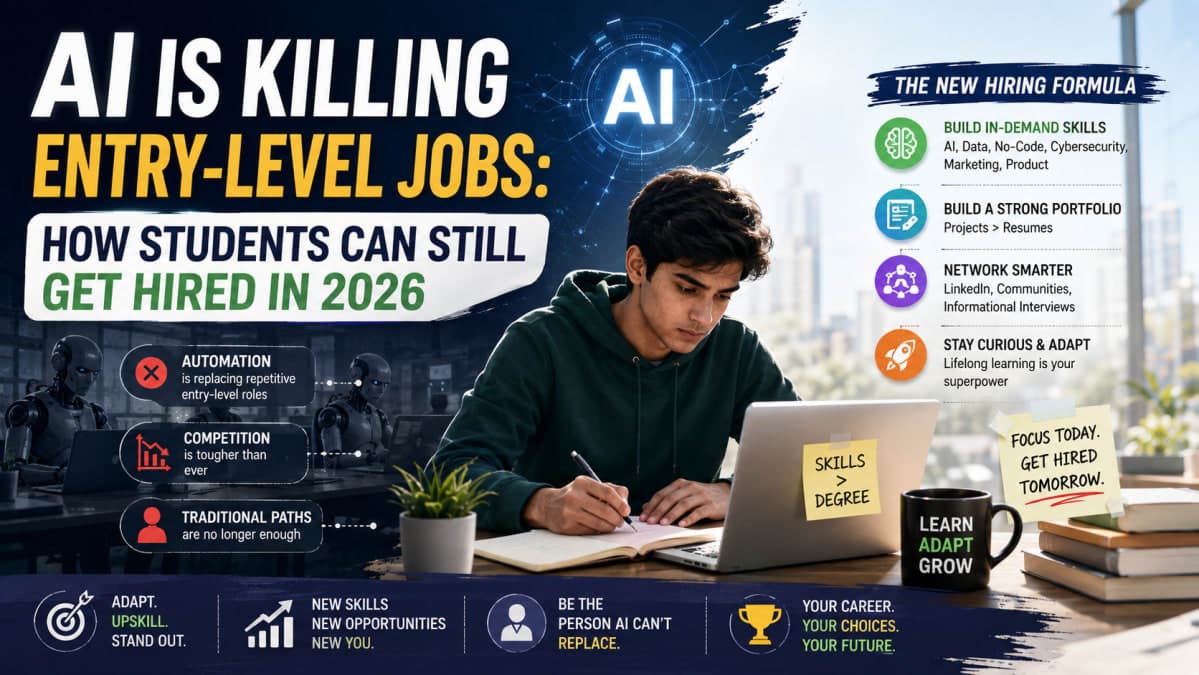
Did you just spend four years in college only to find every "entry-level" listing asking for 2–3 years of experience? You're not imagining it. Entry-level job postings in the US have dropped 35% since 2023, and in India, NASSCOM data shows tech workforce growth has slowed to just 2.3% in FY26 even as the industry keeps expanding. Here's the truth: AI hasn't killed the entry-level career — it has killed the entry-level job description. Companies still need people who can do the work; they just won't pay someone to learn it on the clock anymore. This guide walks you through exactly how to get work experience when AI is taking entry-level jobs, so you can show up already "job-ready" instead of waiting for a ladder that isn't coming back.
What's Actually Happening to Entry-Level Jobs (And Why It Matters)
AI hasn't replaced junior employees — it replaced junior tasks. The debugging, testing, first-draft coding, document review, and basic data-crunching that used to be a fresher's on-ramp are now the exact things AI agents do well. That's the part employers stopped needing to pay someone to learn.
Here's why this is worth taking seriously right now, not "eventually":
Fresher hiring intent in India is falling. The India Skills Report shows fresher hires dropped to an average of 14% of all new hiring in 2025, down from 18.8% the year before.
Entry-level IT roles have already shrunk. A 2025 EY analysis estimates entry-level IT roles in India have declined 20–25% due to automation in testing, basic coding, and maintenance work.
This isn't only an India problem. Stanford Digital Economy Lab research found employment for 22–25-year-olds in AI-exposed roles fell 13% since late 2022 in the US, with software developers in that age group down closer to 20%.
Even big recruiters are pulling back. TCS, historically India's largest fresher recruiter, has signaled it plans to onboard around 25,000 freshers in FY27 — down sharply from 44,000 the year before.
The bar for "entry-level" has quietly moved. Employers aren't hiring fewer people because there's less work. They're hiring fewer people because AI closed the gap between "someone who just graduated" and "someone who can contribute day one" — and now expect freshers to arrive already on the right side of that gap.
None of this means the door is shut. It means the door has moved, and most students are still knocking on the old one.
Step 1: Build Proof, Not Promises
A resume that lists "proficient in Python" is a claim. A GitHub repo with a working project is proof. In an AI-saturated hiring market, recruiters assume anyone can generate code, a report, or a design with a chatbot — so the only thing that differentiates you is evidence you can actually own outcomes.
What to Include
3 real projects, not tutorial clones — each mapped to the specific role you're targeting (e.g., a data pipeline project for a Data Analyst role, a REST API with tests for an SDE role)
A clean README on every project explaining the problem, your approach, and trade-offs you made
At least one deployed, clickable demo — recruiters skim; a live link gets opened, a zip file doesn't
Mistakes to Avoid
Following a YouTube tutorial and pushing the exact same code everyone else has
Projects with no commit history (it signals you built it in one sitting, possibly with AI doing all the work)
No documentation explaining your reasoning — the "why" is what proves judgment
Pro Tip: Recruiters increasingly ask "walk me through a decision you made in this project" — build projects you can defend under questioning, not just projects that look good on a slide.
Step 2: Make AI Your Advantage, Not Your Crutch
The recruiters quoted in recent industry reporting are blunt about this: freshers who can only prompt a chatbot for finished answers aren't worth training. Freshers who can direct AI tools to do real work, and can explain and verify the output, are worth hiring at a premium.
Learn to Operate, Not Just Chat
Move beyond ChatGPT-style Q&A. Get comfortable with agentic coding tools (Claude Code, GitHub Copilot, Cursor) that let you build, test, and ship — this is the skill gap employers are actually screening for in 2026, not raw coding speed.
Document Your AI Workflow
When you use AI in a project, note it. "Used Claude Code to scaffold the API, then rewrote the auth logic and wrote the test suite myself" is a stronger line than pretending you wrote every character — and it shows you know how to supervise AI output, which is exactly the skill replacing "junior task execution."
Pro Tip: In interviews, when asked about a project, proactively explain which parts you used AI for and which parts required your judgment. It preempts the "did you actually build this?" doubt before it's asked.
Step 3: Manufacture Your Own "Entry-Level" Experience
If the traditional internship pipeline is shrinking, stop waiting for it and build your own version of it. This is the single biggest mindset shift Velonx sees separate students who get hired from students who stay stuck.
Take on micro-freelance gigs on Internshala or Upwork — even unpaid or low-paid, small real-client work beats another course certificate
Contribute to open-source repos relevant to your target stack — a merged PR is a stronger signal than a GPA
Cold-DM small founders or startups offering a scoped, free trial project (a landing page, a data dashboard, an automation script) in exchange for a testimonial
Compete in hackathons on Unstop or HackerEarth — even a non-winning entry becomes a resume project with a deadline and a team
Volunteer inside your college's tech fest, coding club, or startup cell and take ownership of one deliverable, not just "helped organize"
Route | What It Proves | Realistic Time Investment |
|---|---|---|
Open-source contribution | You can read others' code and collaborate | 2–4 weeks for a solid first PR |
Freelance micro-gig | You can handle a real client and a deadline | 1–3 weeks per gig |
Hackathon | You can build under pressure with a team | 24–48 hours + prep |
Personal SaaS/side project | You can own something end-to-end | 4–8 weeks |
Startup cold-outreach project | You can create value with zero structure | 2–6 weeks |
Key Tip: Pick two routes, not all five. Depth on two real outcomes beats a scattered resume of five half-finished attempts.
Step 4: Prove the One Thing AI Still Can't Fake — Judgment
AI is good at producing options. It is not good at owning a decision when the requirements are ambiguous, the stakeholders disagree, or something breaks in production. Employers are explicitly saying this is the new premium skill.
Practice debugging code you didn't write — this is closer to real job conditions than solving a clean LeetCode problem
Take a project from "it works on my laptop" to "it's live and someone else can use it" — deployment, error handling, and edge cases are where judgment shows up
Get comfortable explaining trade-offs out loud: "I chose X over Y because..." This single habit is what separates a portfolio piece from a job-ready skill
Pro Tip: In your next mock interview or actual interview, ask yourself if you can defend every technical choice in your project for 10 minutes straight. If you can't, that project isn't ready to be your headline piece.
Step 5: Network Like It's Part of the Job — Because It Is Now
Data backs this up plainly: graduates who worked during college (internships, part-time roles, freelance gigs) landed entry jobs at roughly double the rate of those who didn't — 82% versus 41%, according to a 2026 ZipRecruiter graduate survey. Experience compounds, and so does who you know while you're building it.
Optimize your LinkedIn like a landing page — headline should state your target role and one proof point, not "Aspiring Software Engineer | Learner"
Reach out to alumni from your college who are 1–3 years ahead of you — they remember the struggle and are the most likely to refer you
Find a mentor who can sanity-check your project choices before you spend weeks on the wrong thing — Velonx's mentor network exists for exactly this
Show up consistently in your college's tech community — recruiters increasingly source from active community members before job boards
Step 6: Target Roles Where Freshers Are Still Actually Getting Hired
Not every domain is shrinking equally. Skills-first hiring is real: around 73% of Indian employers said they planned to hire freshers in the first half of 2026 — but they're screening on projects and portfolios, not just degrees.
Role | Realistic Entry Point | Fresher Salary Range (India) |
|---|---|---|
QA / Test Engineer | Learnable fast, builds product understanding | ₹3.5–6 LPA |
Data Analyst | Provable with one strong real dataset project | ₹4–7 LPA |
Cloud Support Associate | AWS/Azure certification + one deployed project | ₹4–8 LPA |
Junior DevOps Engineer | CI/CD project on GitHub is strong proof | ₹5–9 LPA |
AI/ML Associate | Requires a genuine project, not just a course cert | ₹8–15 LPA |
Key Tip: AI/ML roles pay the most, but they're also the most competitive. If you're early in your prep, a QA or Data Analyst role is a faster, realistic door into a company — you can move internally toward AI/ML work once you're in.
Browse live openings that fit these tracks on the Velonx career board, and check projects for portfolio ideas mapped to each of these roles.
Frequently Asked Questions About Getting Hired When AI Is Taking Entry-Level Jobs
Can I get hired without any internship experience?
Yes, but you need a substitute for it. A recruiter isn't looking for the word "internship" on your resume — they're looking for evidence you've handled real ambiguity and ownership. Two or three strong self-initiated projects, a merged open-source PR, or a freelance gig can function as that substitute.
Is AI actually going to eliminate all entry-level jobs?
No. Research consistently shows a shift, not a wipeout — routine, easily-automated tasks are shrinking while roles requiring judgment, deployment, and cross-functional work are holding steady or growing. NASSCOM's own leadership has said AI is more likely to accelerate India's tech industry than eliminate it long-term, even while acknowledging near-term hiring slowdowns.
What's the best time to start building a portfolio?
As early as your second year, if possible. Portfolio work compounds — a project you build in Year 2 can be improved and deployed by Year 4, giving you a multi-year story instead of a rushed, one-week pre-placement scramble.
Do I need to learn AI tools even if I'm not applying for a tech role?
Yes. AI literacy is now treated the way spreadsheet literacy was 15 years ago — a baseline expectation, not a specialization. Even non-technical freshers who can use AI tools effectively to speed up research, writing, or analysis stand out against peers who can't.
How do I find companies that will take on a fresher with no formal experience?
Start smaller than you think. Early-stage startups, agencies, and small businesses are far more willing to take a chance on a fresher with a strong project than large enterprises are. Cold outreach with a specific, scoped offer ("I'll build you a working dashboard for free — I just want the experience and a reference") gets a far better response rate than a generic job application.
What happens if I graduate and still don't have a job?
It's more common than it feels when you're in it, and it's not a dead end. Keep building and shipping projects publicly — a visible six-month track record after graduation, showing consistent skill-building, is still a strong signal to employers. Use the gap to go deeper on one specialization rather than spreading thin across many.
Conclusion: Stop Waiting for the Old Ladder to Come Back
Here's the bottom line: the entry-level job you were promised by the old system — get hired first, learn on the job second — isn't coming back the way it used to work. The new deal is: prove you can already do the job, then get hired for it.
Start with what you can control today:
Pick one role from Step 6 and reverse-engineer the one project that would prove you can do it
Ship that project publicly this week — even an unfinished version, deployed and documented, beats a perfect one sitting on your laptop
Send three cold outreach messages to small founders or alumni offering a scoped trial project
Learn to operate an AI coding or research tool properly, not just chat with it
Book time with a mentor to sanity-check your portfolio before you spend another month building the wrong thing
Every rejection right now is data about the gap between what you've built and what the market wants — not a verdict on whether you're employable. Close that gap on purpose, and you won't need the old entry-level ladder. You'll have built your own.