
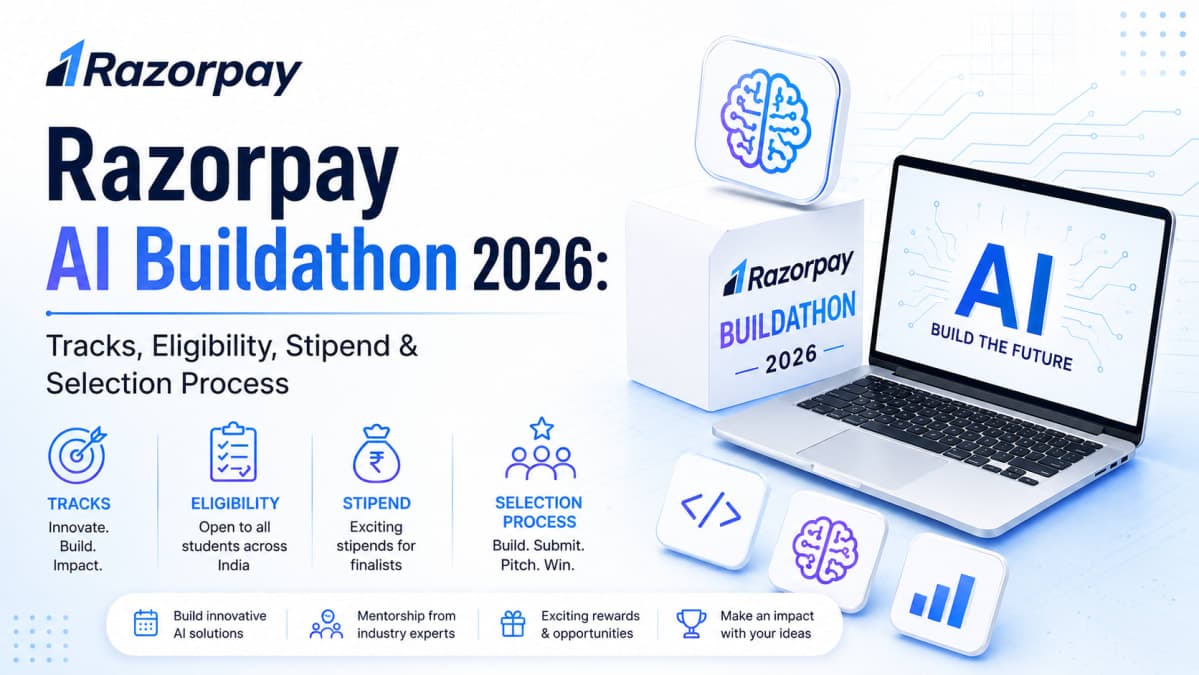
Most internship hiring still starts with a resume screen, an aptitude test, and a group discussion round that has nothing to do with the actual job. The Razorpay AI Buildathon 2026 throws that playbook out. Instead of shortlisting on CGPA or college tier, Razorpay is hiring its next batch of AI Builder Interns purely on what candidates build, ship, and can defend in front of a panel.
If you're an engineering student who has been experimenting with AI agents, RAG pipelines, or automation tools on the side, this is one of the more meritocratic ways to land a paid internship at a large Indian fintech company in 2026. Here's everything you need to know before you apply — what the tracks are, how the stipend and duration work, who's eligible, and how the selection process is structured.
What Is the Razorpay AI Buildathon?
The Razorpay AI Buildathon is a student-only hiring program designed to discover and recruit Razorpay's next AI Builder Interns. Razorpay's own tagline for the program sums up the philosophy in three words: "Build. Show. Get hired."
There's no resume shortlist and no aptitude test standing between you and the interview room. Instead, you pick a track, build a working project around it, and put it in front of a panel. If your project and your understanding of it hold up, you move forward — regardless of which college you're from or what your resume looks like on paper.
For students at Tier-2 and Tier-3 engineering colleges, this matters more than it might seem at first glance. Traditional campus hiring pipelines are usually gated by college tier and CGPA cutoffs long before your actual skills get evaluated. A build-first format flips that — your GitHub repo becomes your resume.
Why This Format Is Different From a Regular Hackathon
It's easy to lump this in with the dozens of weekend hackathons running across India right now, but the Razorpay AI Buildathon is structured differently in a few important ways:
Regular Hackathon | Razorpay AI Buildathon |
|---|---|
Prizes are usually cash or swag | Outcome is a paid internship offer |
Judged mostly on demo day performance | Judged on architecture, code quality, and your ability to explain your build |
Open to all skill levels and colleges | Student-only, positioned as a hiring funnel |
Screening often includes resume/CGPA filters | No resume screening at any stage |
One-off event, no ongoing relationship | Leads into a 6- or 12-month paid role |
This is closer to how AI-native product teams evaluate engineers internally — through real code and system design conversations — than to a typical campus placement drive.
Stipend, Duration & Location
Here's the practical information you'll want before deciding whether to apply:
Detail | Information |
|---|---|
Role | AI Builder Intern |
Stipend | ₹75,000 per month |
Duration | 6 or 12 months |
Work mode | In-person |
Location | Bangalore |
Eligibility | Currently enrolled students only |
Application deadline | September 5, 2026 |
Screening method | No resume screening, no aptitude test, no group discussion |
Apply at | razorpay.com/buildathon |
A ₹75,000/month stipend for a student internship is well above the typical range most Tier-2/3 engineering students see in campus placements, which makes the selection bar correspondingly high — this isn't a volume-hiring drive, it's a small, high-intent cohort.
The 5 Tracks You Can Choose From
Razorpay has structured the buildathon around five tracks. You pick one and build your project within that problem space — you're not expected to solve all of them.
Track | What It's Likely About |
|---|---|
AI Growth & Agentic Commerce | Using AI agents to drive growth loops, personalization, or commerce workflows |
AI Risk Manager | Building AI systems that detect, flag, or manage risk and fraud patterns |
AI Revenue Recovery | AI-driven approaches to recovering failed payments, churn, or revenue leakage |
AI Finance Controller | Automating financial controls, reconciliation, or reporting with AI |
Open Track | Any AI-native product or system idea outside the above four |
Since Razorpay is a payments and business banking company, the first four tracks map closely to real problems inside their product stack — growth, risk, collections, and finance operations. If you don't have a strong idea within those four, the Open Track exists specifically so you're not boxed in. Pick whichever track lets you build your strongest, most complete project — a well-executed Open Track submission will beat a half-built entry in a "core" track every time.
Selection Process: From Build to Offer
The process is short and skips most of the friction you'd expect from a large company's hiring funnel. Based on how Razorpay has described it, here's the sequence:
Apply and pick a track — Choose one of the five tracks listed above based on where your interests and skills line up.
Build something real — Create a working AI project tied to your chosen track. This isn't a slide deck exercise; you're expected to ship functional code.
Push to a public GitHub repo — Your code needs to be visible and reviewable, not just a local prototype.
Deliver a 5-minute pitch — Explain what you built, why it matters, and what problem it solves — concisely.
Walk through your architecture — Be ready to explain your technical decisions: why you chose a particular stack, database, model, or design pattern.
Panel interview — A final conversation with Razorpay's panel, likely digging into both your project and your broader thinking as a builder.
There's no aptitude test and no group discussion anywhere in this chain. Every stage is either something you build or something you defend — which means the projects that stand the best chance are the ones with a clear problem statement, a working demo, and a builder who deeply understands their own architecture rather than one who can just describe the concept.
Who Should Apply
This program is explicitly for students only, which keeps it distinct from Razorpay's regular internship and full-time hiring tracks. Based on the format, you're likely to do well here if:
You've already built and shipped small AI/ML or full-stack projects — even solo weekend builds count
You're comfortable working with LLM APIs, vector databases, agent frameworks, or automation tools
You can explain your architecture decisions clearly, not just describe what your project "does"
You're open to an in-person internship in Bangalore for 6–12 months
You'd rather be evaluated on a working build than a resume line
If you're still early in your AI/ML journey and don't have a shippable project yet, treat the September 5 deadline as a target to build toward rather than a wall — even a scoped-down but complete project beats an ambitious but half-finished one.
Timeline & Important Dates
Milestone | Date / Status |
|---|---|
Applications open | Live now |
Applications close | September 5, 2026 |
Track selection | At the time of application |
Build, pitch & panel rounds | Post-application (exact dates announced to shortlisted applicants) |
Razorpay hasn't published a full public timeline beyond the application deadline, so keep checking the official Buildathon page for round-wise dates once applications close.
How to Prepare: Practical Tips to Stand Out
A build-first selection process rewards different prep than a resume-first one. A few things worth focusing on before you apply:
Pick a track you can actually finish. A complete, working project in a narrower scope will outperform an ambitious but incomplete one in every one of these formats.
Optimize your GitHub repo, not just your code. A clear README, sensible commit history, and a documented setup process signal that you build like a professional, not just a student doing an assignment.
Rehearse your 5-minute pitch out loud. Panels evaluating dozens of student projects respond to clarity — lead with the problem, then your solution, then a quick demo.
Know your architecture cold. Be ready to justify every major decision: why this vector store, why this model, why this framework over another. This is usually where weaker submissions get exposed.
Show, don't just tell, the AI-native part. If your project touches agents, RAG, or LLM orchestration, make sure that's the part of the demo you spend the most time on — it's the whole point of the track.
Why Build-First Hiring Is Gaining Ground in India
The Razorpay AI Buildathon isn't happening in isolation. Across India's tech ecosystem in 2026, more companies are running builder-first events instead of traditional resume-and-aptitude-test pipelines to find AI talent. Razorpay itself has backed multiple such formats recently, including student and developer buildathons run in partnership with other AI-focused organizers, all built around the same core idea: judge builders by what they ship, not by what their resume claims.
There's a practical reason this trend is accelerating. AI-native roles — agent engineers, applied ML builders, AI product generalists — didn't exist as defined job titles five years ago, which means there's no standardized coursework or certification that reliably predicts who's good at them. A resume can't tell a hiring team whether a candidate can actually design a retrieval pipeline, debug an agent's tool-calling logic, or ship a working product end-to-end. A public GitHub repo can.
For students, this shift is worth paying attention to beyond just this one program. If you're at a Tier-2 or Tier-3 college and have felt boxed out of premium hiring pipelines because of where you studied, build-first formats are the closest thing to a level playing field currently available. The tradeoff is that you can't cram for them the week before — you need an actual body of work, built over weeks or months, sitting in your GitHub profile before the application window even opens. That's the real reason to start building now, even if you're eyeing a different program with a later deadline.
Frequently Asked Questions
Is the Razorpay AI Buildathon open to all students? It's positioned as student-only, but Razorpay hasn't published detailed eligibility restrictions around year of study or specific branches. Check the official page for the latest eligibility criteria before applying.
Do I need a team to apply? Razorpay's public communication about the buildathon doesn't specify team size requirements. Confirm this on the official application page before you start building.
What happens if I don't get shortlisted? Since screening is based entirely on your build and pitch rather than a resume, unsuccessful applicants still walk away with a shipped project for their portfolio — which is useful for other internship applications, including through off-campus drives and hiring programs tracked separately.
Is the stipend the same for the 6-month and 12-month options? Based on available information, the ₹75,000/month stipend applies to the AI Builder Intern role regardless of the 6- or 12-month duration, though the exact terms should be confirmed during the selection process.
Can I apply if I've already interned elsewhere? There's no publicly stated restriction against students who've completed other internships. The program's emphasis is on what you can build now, not your past internship history.
Final Word
The Razorpay AI Buildathon is one of the clearer signals yet that AI-native hiring in India is moving away from resumes and toward demonstrated builds — and that shift works in favor of students who've been quietly shipping projects without a brand-name college on their resume. If you've got an AI project idea sitting in a half-finished GitHub repo, September 5 is a good enough reason to finish it.
Applications are open now at razorpay.com/buildathon. Pick your track, build something real, and let your code do the talking.