
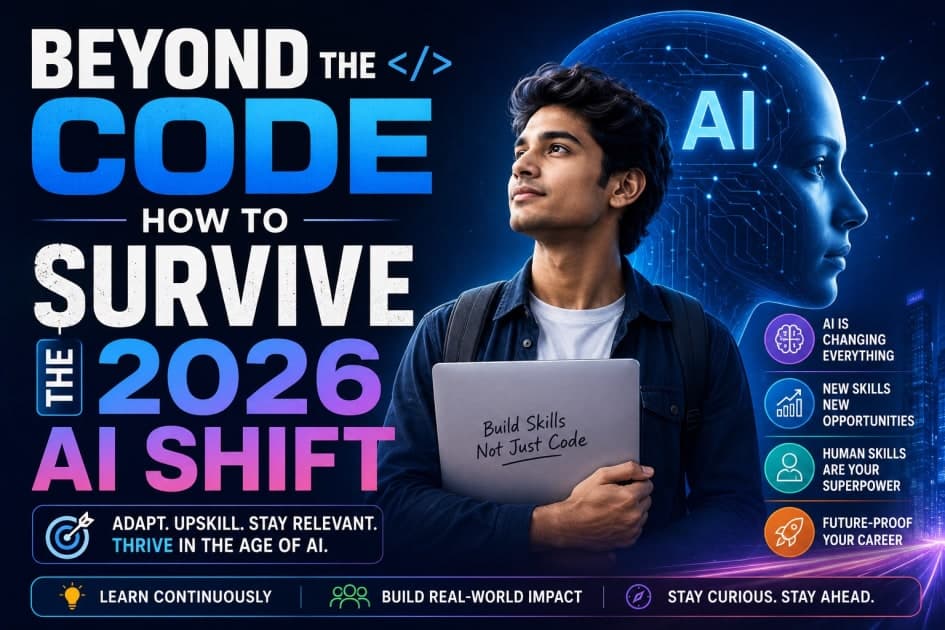
If your entire focus is still centered around “writing code,” you may be preparing for a version of the tech industry that is rapidly disappearing.
In 2026, software development has evolved far beyond simple AI-assisted autocomplete tools. The industry is now entering the era of AI-orchestrated development — where autonomous AI agents can plan, generate, modify, and execute large portions of software workflows independently.
For students, this changes the definition of what it means to be “industry-ready.”
The grind is no longer just about memorizing syntax or solving endless boilerplate problems. The developers who stand out today are the ones who understand systems, workflows, AI infrastructure, and real-world problem solving.
1. The Shift From Coder to Architect
Modern AI tools like GitHub Copilot and Cursor can now:
Generate complete components
Refactor multiple files simultaneously
Configure repositories
Explain unfamiliar codebases
Automate repetitive engineering tasks
This means your value as a developer is no longer measured only by how quickly you can type code.
Instead, the most valuable skill in 2026 is system design and architectural thinking.
Students should focus on understanding:
How APIs communicate
How databases integrate with applications
How AI models interact with external systems
How scalable architectures are designed
Because if you cannot explain how the system works, you cannot effectively guide the AI building it.
The role of the engineer is shifting from “manual coder” to “technical architect.”
2. The Rise of Agentic AI Workflows
The industry has already moved beyond basic chatbots.
In 2026, one of the biggest trends is Agentic AI — intelligent systems capable of:
Planning tasks
Using tools autonomously
Accessing APIs and databases
Executing multi-step workflows
Making contextual decisions
These AI agents are being used in:
Automation systems
Developer tools
Customer support
Research workflows
Enterprise productivity platforms
For students, this means learning how to build AI-powered workflows rather than simple interfaces.
The Most Important Skills to Learn
Python
Python remains the foundation for AI engineering, automation, backend systems, and machine learning workflows.
API Integration
Modern applications rely heavily on APIs. Understanding how systems communicate is now essential.
AI Guardrails and Evaluation
Building an AI wrapper is no longer enough.
Developers now need to understand:
Prompt reliability
Output validation
Safety guardrails
Evaluation loops
AI behavior monitoring
Companies are increasingly prioritizing engineers who can build trustworthy AI systems rather than just flashy demos.
3. Why Hackathons Matter More Than Ever
In the AI era, portfolios and practical projects often matter more than theoretical knowledge alone.
Hackathons have become one of the fastest ways for students to:
Build real products
Work under pressure
Learn emerging technologies
Network with recruiters and startups
Demonstrate practical skills publicly
Many modern hackathons now focus heavily on AI, automation, and intelligent systems.
For students, participating in these competitions is no longer just extracurricular activity — it’s career acceleration.
4. The 2026 Tech Stack Every Student Should Know
If you want to graduate with skills aligned to the modern tech industry, these areas are becoming increasingly important.
Cloud-Based AI Development Environments
Traditional local-only workflows are being replaced by cloud-first, AI-powered development environments.
Modern developers increasingly work inside:
Cloud IDEs
Collaborative AI coding platforms
Browser-based development systems
Understanding cloud-native workflows is becoming a baseline expectation.
Retrieval-Augmented Generation (RAG)
Retrieval-Augmented Generation, commonly known as RAG, is one of the most important concepts in practical AI development.
RAG allows AI systems to:
Access private or proprietary data
Retrieve external knowledge dynamically
Generate more accurate and contextual responses
Many modern AI applications rely on RAG pipelines combined with vector databases and search systems.
Students entering AI engineering should understand how these architectures work.
AI Governance and Security
As AI systems become more powerful, ethics and security are becoming core engineering responsibilities.
Developers now need awareness of:
Prompt injection attacks
AI safety risks
Data privacy
Model transparency
Responsible AI deployment
Companies increasingly expect engineers to think beyond functionality and consider long-term impact and reliability.
The Real Role of AI in Engineering
AI is not replacing software engineers.
It is replacing repetitive engineering work.
The developers who succeed in 2026 will be the ones who:
Spend less time debugging syntax
Spend more time solving meaningful problems
Understand systems deeply
Use AI as a productivity multiplier
Focus on creativity, architecture, and execution
The future belongs to engineers who can combine human judgment with AI acceleration.
Because in the modern tech industry, the real competitive advantage is no longer just knowing how to code.
It’s knowing what to build — and how to make intelligent systems build it faster.