
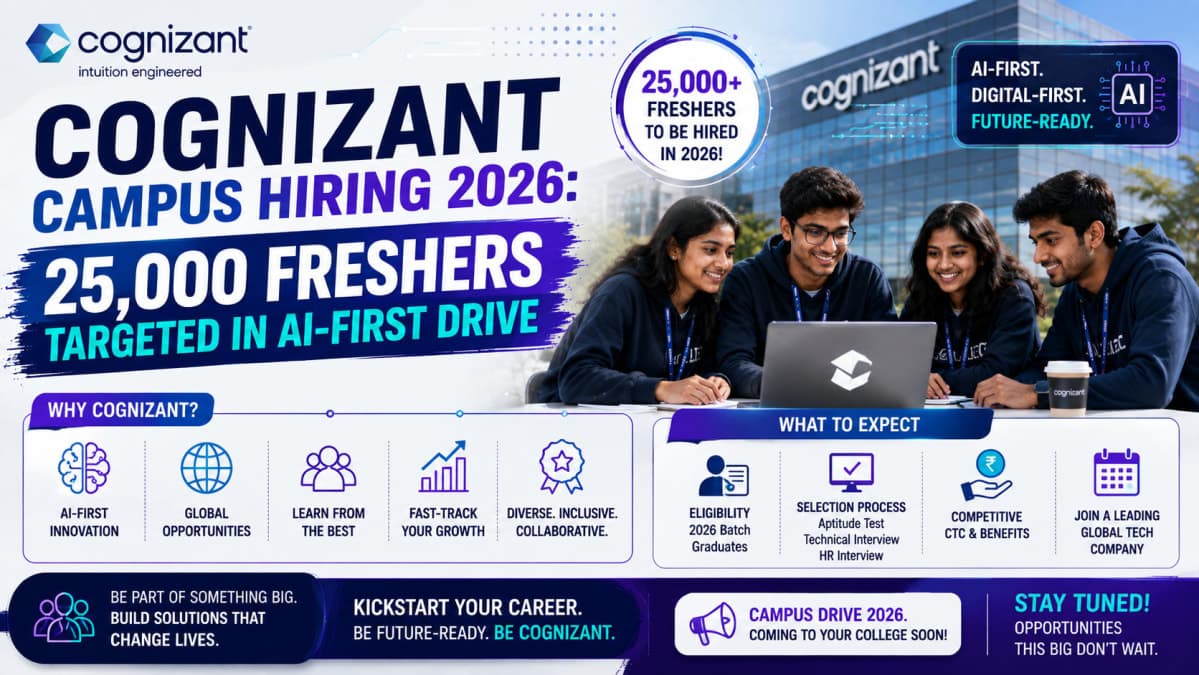
Scrolling through LinkedIn and seeing another "hiring freeze" post? Wondering if AI already ate every entry-level tech job before you even graduated? Here's the truth: Cognizant just announced one of the biggest fresher hiring drives in Indian IT history — up to 25,000 seats for the 2026 batch, and AI is the reason they're hiring more, not less. This guide breaks down exactly how Cognizant campus hiring 2026 works: the GenC tracks, real salary numbers, eligibility rules, the selection process, and what you should be doing this week to get shortlisted.
What Is Cognizant's 25,000-Fresher Hiring Drive, and Why It Matters
Cognizant campus hiring 2026 refers to the company's plan to onboard between 24,000 and 25,000 fresh graduates over the year — roughly a 20% jump from the close to 20,000 freshers it brought on in 2025. That's not a rounding correction. That's Cognizant scaling its entry-level intake at a time when several IT majors are being cautious with junior hiring.
Here's why this drive matters more than a typical placement season:
It's a bet on AI-augmented freshers, not against them. Company leadership has spoken about a "broader pyramid" strategy — using AI tools to push more complex work down to junior engineers, so a large entry-level bench becomes viable without hurting delivery speed.
It signals real project absorption, not just recruitment. Of the freshers hired in 2025, the large majority were already placed on live client projects within the year, with the rest in structured training — a sign the intake isn't sitting idle.
It's backed by AI platform partnerships. Cognizant has talked publicly about working with multiple major AI providers to reshape how junior talent gets productive faster, which directly shapes what skills recruiters are screening for in 2026.
It comes during a genuine industry debate. While AI job-loss fears dominate tech headlines, Cognizant's numbers point the other way for this hiring cycle — at least at the entry level.
Pro Tip: Don't treat this as "IT hiring is booming again, relax." Treat it as "the bar for Day-1 AI fluency just went up." Cognizant isn't hiring 25,000 typists — it's hiring 25,000 people it expects to use AI tools productively within weeks of joining.
For broader industry hiring trends, NASSCOM's talent reports are worth a skim before your interview — recruiters like candidates who can talk industry context, not just their own resume.
GenC, GenC Elevate, and GenC Next: Which Track Should You Pick
Cognizant hires freshers through its flagship GenC (Generate · Collaborate) program. In 2026, this splits into tracks based on your coding strength, and the track you land in decides your role — and your salary.
Your resume is the first filter here, but the track is the real decision point. Pick wrong and you either underprepare for a coding-heavy round or underprice yourself for a role you were qualified for.
Track | Best For | Focus Areas | Typical Salary (LPA) |
|---|---|---|---|
GenC | Non-coding-heavy freshers | Aptitude, verbal ability, basic IT concepts | ₹4 – 4.5 LPA |
GenC Elevate | Freshers with moderate technical exposure | Aptitude + foundational tech skills | ₹4.5 – 5.5 LPA |
GenC Next | Strong coders, DSA-ready candidates | Data structures, algorithms, full-stack/dev skills | ₹6.75 – 12 LPA |
Key Tip: If you can comfortably solve easy-to-medium problems on LeetCode or GeeksforGeeks, always register for GenC Next. The salary gap between GenC and GenC Next often exceeds ₹2.5 LPA — that's worth a few extra weeks of DSA practice.
Mistakes to Avoid When Choosing a Track
Picking GenC "to play safe" when you can actually code — you're leaving money on the table
Registering for GenC Next with zero DSA prep and getting eliminated in round one
Ignoring the skill-cluster options during registration — some clusters map better to your resume than others
Cognizant Campus Hiring 2026 Eligibility Criteria
Before you spend a weekend prepping, make sure you're actually eligible. Cognizant has been consistently strict about this — a missed backlog or a CGPA that's 0.1 short can get an application auto-rejected.
Batch: 2025 pass-outs and 2026 graduating students
Minimum academic score: 60% or 6.0 CGPA consistently through your academic record (10th, 12th, and degree, depending on the specific drive)
Backlogs: No active backlogs at the time of onboarding — cleared backlogs by joining date are usually fine
Degree types: BE/B.Tech/ME/M.Tech for technical roles; BCA, B.Sc, BA, B.Com, BBA, BVoc, and BMS are eligible for select non-engineering tracks
Skills expected: Basic programming familiarity, logical reasoning, and spoken English communication — you don't need to be a competitive coder for the GenC track
Common Disqualifiers Students Miss
Applying with a live backlog and assuming it'll clear "before joining" without documentation
Applying under the wrong degree category (engineering vs non-engineering tracks have different filters)
Multiple applications under different email IDs — this usually flags your profile instead of improving your odds
Step-by-Step: Cognizant Selection Process 2026
Running a hiring drive at this scale means the process is standardized and automation-heavy. Here's what to expect, in order.
Registration — Apply through careers.cognizant.com for off-campus drives, or your college's Superset link for on-campus drives. Upload an ATS-friendly resume, a professional photo, and keep your mark sheets and PAN card ready.
Aptitude & Reasoning + Coding Assessment — Usually conducted via AMCAT or a similar platform. GenC candidates face aptitude and verbal sections; GenC Next candidates get an added DSA/coding round.
Communication Assessment — Tests spoken English and comprehension, often through a recorded or AI-evaluated round.
Technical + HR Interview — Covers your resume, basic technical concepts for your chosen skill cluster, and culture-fit questions. Mentioning specific AI tools you've used (ChatGPT, GitHub Copilot, Claude, or similar) genuinely helps here, given Cognizant's AI-first positioning.
Pro Tip: Recruiters screening 25,000+ candidates rely heavily on automated shortlisting tools. A resume with vague lines like "hardworking and dedicated" gets filtered out before a human ever sees it. Use specific numbers and tools instead — "Built a Python script that automated X, reducing manual effort by Y%" beats any adjective.
How to Prepare: A Realistic 30-Day Plan
You don't need six months. You need a focused month with the right resources, especially if GenC Next is your target.
Days | Focus Area | Resource to Use |
|---|---|---|
1–7 | Aptitude & logical reasoning basics | IndiaBix, PrepInsta, CampusGate |
8–18 | DSA fundamentals (arrays, strings, basic trees) | LeetCode (Easy–Medium), GeeksforGeeks |
19–24 | Mock coding tests + communication practice | HackerRank, CodeChef, English mock interviews |
25–30 | Resume polish + mock HR/technical interviews | Peer mock interviews, Velonx mentors |
Where to Practice Beyond the Table
Coding: LeetCode, GeeksforGeeks, HackerRank, CodeChef
Aptitude: IndiaBix, PrepInsta
Structured learning: NPTEL, Coursera, and free AWS/Microsoft Learn modules if you're targeting cloud-adjacent roles
Real project experience: Building even one small AI-assisted project — an automation script, a small full-stack app, or a data project — gives you something concrete to discuss beyond textbook answers. Browse live student projects for ideas you can build in a weekend.
If your college hasn't confirmed a Cognizant visit yet, don't wait — you can register directly for the off-campus drive when it opens, and track other current openings on the Velonx job board in parallel.
Frequently Asked Questions About Cognizant Campus Hiring 2026
Can I get into Cognizant GenC Next without a computer science degree?
Yes. Cognizant evaluates GenC Next primarily on your coding and DSA performance in the assessment, not your degree stream. Non-CS graduates with solid self-taught programming skills regularly clear this track — your test score matters more than your branch.
Is the 60% CGPA rule strict, or can backlog students still apply?
Cognizant applies the 60%/6.0 CGPA rule fairly consistently across drives, and it typically requires no active backlogs at the time of onboarding, not at the time of application. If your backlog clears before your joining date, you're usually still eligible — but don't assume this without checking your specific drive's notification.
What's the difference between on-campus and off-campus GenC registration?
On-campus registration happens through your college placement cell and Cognizant's Superset portal, usually with fewer applicants competing at your specific college. Off-campus registration is open to any eligible graduate through careers.cognizant.com, but competition volume is far higher and success rates are typically lower.
Does Cognizant require freshers to sign a service bond?
No. Cognizant's official GenC program follows a no-bonds policy for its fresher hires. You aren't required to pay a penalty or serve a locked-in tenure to leave the company after joining.
How long does the process take from the first test to the offer letter?
Based on recent cycles, the process typically takes around 3 to 5 weeks from your first assessment to receiving a Letter of Intent, though this can vary depending on the specific drive and how many rounds your track includes.
Do I need to know Generative AI tools to get hired?
You don't need to be an AI expert, but given Cognizant's AI-first delivery push, being able to speak intelligently about how you've used AI tools — for coding, debugging, or a class project — gives you a real edge in interviews over candidates who can't.
Conclusion: 25,000 Seats Are Open — Your Prep Starts Today
Here's the bottom line: Cognizant isn't hiring 25,000 freshers out of charity — it's betting that AI-equipped junior talent can do more, faster, and it needs people who are ready for that from Day 1.
Start with what you can control this week:
Check your CGPA and backlog status against the eligibility criteria right now, not the night before applying
Decide honestly whether you're a GenC or GenC Next candidate based on your current coding level
Register on careers.cognizant.com or through your college's Superset link the day the drive opens
Run the 30-day prep plan above, prioritizing DSA if you're targeting GenC Next
Rebuild your resume around specific, measurable achievements — not adjectives
Practice explaining one AI tool you've genuinely used in a project
Every rejected application is data, not a verdict on your ability. The freshers who get into Cognizant's 2026 batch aren't the ones who never got filtered out early — they're the ones who kept refining their prep after every round that didn't go their way. Start today, and the next drive announcement won't catch you unprepared.