
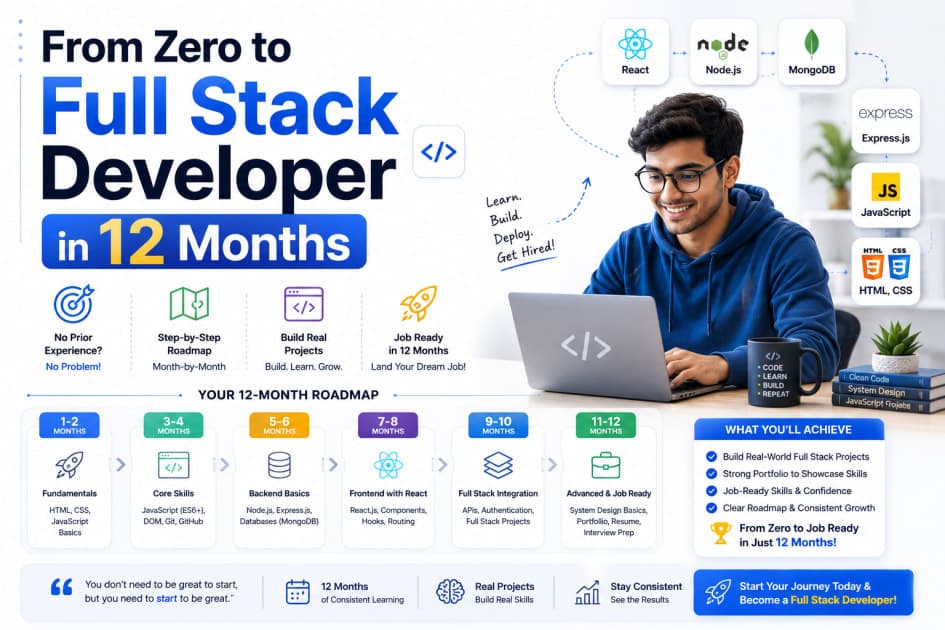
Did you open five different YouTube playlists last month and finish none of them? Or maybe you've got seventeen browser tabs open right now — HTML, React, Node, DSA — and no idea which one to close first. Here's the truth: most people don't fail at becoming a full stack developer because they're not smart enough. They fail because they never had a real plan.
Learning how to become a full stack developer in 12 months isn't about consuming more content. It's about following one sequence, building real things, and stopping the tab-hoarding. Whether you're a final-year student, a fresher with a gap year, or someone switching from a non-CS background, this guide gives you the exact month-by-month path — from "I don't know what a server is" to "I have three deployed projects and I'm applying to jobs."
What Full Stack Development Actually Means (And Why It's Worth 12 Months)
Full stack development means you can build both the front end (what users see) and the back end (what runs behind the scenes — databases, servers, APIs) of a web application. You're not just styling a button; you're also deciding how that button's click gets stored in a database.
Here's why this specific skill set is worth your next year:
Startups hire full stack developers first: Early-stage companies like Razorpay, Groww, and Meesho don't have budget for five specialists — they want one person who can ship a feature end to end.
It's the fastest path to a product-based job: Recruiters at companies like Swiggy, Zomato, and PhonePe consistently prioritize candidates who can talk about a complete system, not just one layer.
The salary ceiling is higher: Full stack roles at Indian product companies typically start at ₹6–10 LPA for freshers and cross ₹15–20 LPA within 2–3 years with the right project depth.
You stop being dependent on a team to build something: You can launch your own SaaS idea, freelance project, or startup MVP solo.
According to LinkedIn India's Talent Trends reports, full stack developer roles have consistently ranked among the top 5 most in-demand tech skills in India for the past several hiring cycles.
Step 1: Months 1–2 — Build the Foundation (HTML, CSS, JavaScript)
Every full stack developer's biggest mistake is skipping fundamentals to "get to React faster." Don't. A shaky JavaScript foundation will slow you down for the rest of the year.
What to Cover
HTML & CSS: Semantic tags, Flexbox, Grid, responsive design (mobile-first)
JavaScript fundamentals: Variables, functions, arrays, objects, DOM manipulation, ES6+ syntax (arrow functions, destructuring, promises)
Asynchronous JS:
fetch, async/await, working with APIsGit & GitHub: Branching, commits, pull requests — you'll use this daily for the rest of your career
Mistakes to Avoid
Jumping straight to a framework before you can build a to-do list in vanilla JS
Watching tutorials without typing the code yourself
Skipping Git because "I'll learn it later" — you won't, and it'll bite you in Month 6
Pro Tip: Rebuild one small project (like a calculator or a weather app) three separate times without looking at the tutorial. That's when the syntax actually sticks — not on the first watch-through.
Step 2: Months 3–5 — Front-End Framework (React)
Once JavaScript feels natural, move to React. It's the most in-demand front-end framework across Indian product companies and startups alike.
What to Include
Core React: Components, props, state, hooks (
useState,useEffect)Routing: React Router for multi-page apps
State management: Context API first, then a lightweight tool like Zustand (skip Redux until you actually need it)
Styling: Tailwind CSS — it's the fastest way to build clean UI without fighting custom CSS
A Realistic 30-Day Plan Inside This Phase
Week 1–2: Core concepts + build 2 small component-based apps
Week 3: Connect a front end to a public API (weather, movies, jokes API)
Week 4: Build one complete front-end project — a portfolio site or a UI clone (Netflix, Spotify, Amazon product page)
Pro Tip: Clone a real product's UI instead of building generic "todo app #47." Recruiters have seen a thousand todo apps. A clean Spotify UI clone signals you can read and reproduce real design systems.
Step 3: Months 6–8 — Back-End Development (Node.js, Express, Databases)
This is where most self-taught developers plateau — and where you'll separate yourself from the crowd if you push through.
What to Include
Layer | Tools to Learn |
|---|---|
Runtime | Node.js |
Framework | Express.js |
Database (SQL) | PostgreSQL or MySQL |
Database (NoSQL) | MongoDB |
Auth | JWT-based authentication, bcrypt for password hashing |
API Design | RESTful APIs, basic understanding of GraphQL |
Key Tip
Pick MongoDB if you want to move fast and build the MERN stack (MongoDB, Express, React, Node) — it's the most commonly referenced stack in Indian full stack job postings. Pick PostgreSQL if you want to stand out with stronger fundamentals, since most experienced engineers actually prefer SQL databases for production systems.
Pro Tip: Build your own authentication system from scratch at least once — login, signup, protected routes, JWT tokens. Recruiters ask about this in almost every full stack interview, and "I used Firebase Auth" is not the same answer as "I built it myself."
Step 4: Months 9–10 — Build 2–3 Full Stack Projects That Get You Hired
By now you have all the pieces. This phase is about assembling them into projects that prove it — not more tutorials.
What Makes a Resume-Worthy Project
Solves a real problem (not a generic clone with zero original thinking)
Has a working back end — database, authentication, and at least one non-trivial feature (payments, real-time updates, file uploads)
Is deployed — a project sitting in a local folder doesn't count
Has a clean GitHub README explaining the tech stack, features, and how to run it
Project Ideas That Actually Impress Recruiters
A job board or internship tracker (relevant to your own job search — recruiters love this)
A expense tracker with authentication and data visualization
A mini e-commerce app with cart, checkout, and a payment gateway (Razorpay or Stripe test mode)
A real-time chat app using WebSockets
Pro Tip: Add one feature that's slightly harder than expected — real-time updates with Socket.io, or Razorpay's test payment integration. That one "extra" feature is usually what interviewers ask about first, because it's rare among fresher portfolios.
Step 5: Month 11 — Deployment, DevOps Basics, and Polish
A full stack developer who can't deploy their own app isn't really full stack yet.
What to Learn
Hosting: Deploy the front end on Vercel or Netlify, back end on Render or Railway
Databases in production: MongoDB Atlas or a managed Postgres instance
Basic CI/CD: GitHub Actions for automated testing and deployment
Environment variables & security: Never hardcode API keys — this comes up in interviews constantly
Checklist Before Month 12
[ ] All 2–3 projects deployed with live links
[ ] GitHub profile cleaned up — pinned repos, consistent commit history
[ ] LinkedIn and resume updated with project links, not just "worked on full stack projects"
[ ] Basic DSA revision — arrays, strings, hashmaps (companies still test this even for full stack roles)
Step 6: Month 12 — Job Search Strategy
Building the skills is only half the job. Getting hired requires a separate strategy.
Where to Apply
Off-campus openings: LinkedIn, Naukri.com, Internshala, Unstop, Wellfound for startup roles
Referrals: Reach out to alumni or connections at target companies — referred candidates get shortlisted at significantly higher rates than cold applications
Coding platforms: Keep solving on LeetCode and GeeksforGeeks — most product companies still run a DSA round even for full stack roles
Full Stack Developer Salary Expectations in India (2026)
Experience Level | Typical Salary Range |
|---|---|
Fresher (0–1 yr) | ₹4–8 LPA at service companies, ₹8–14 LPA at product startups |
1–2 years | ₹8–15 LPA |
3+ years | ₹15–28 LPA |
Key Tip: Use this table to set realistic expectations for your first offer — don't reject a ₹6 LPA startup role that offers real ownership over a ₹9 LPA service-company role with zero learning. Your second job pays far more than your first.
Frequently Asked Questions About Becoming a Full Stack Developer
Can I become a full stack developer in 12 months with no coding background?
Yes, if you commit to consistent daily practice — realistically 3–4 hours a day. Twelve months is enough time to go from zero to job-ready if you follow a sequential roadmap instead of jumping between random tutorials.
Is MERN stack still relevant in 2026?
Yes. MERN (MongoDB, Express, React, Node.js) remains one of the most commonly requested stacks in Indian job postings, especially at startups. Learning it well gives you a strong foundation to later pick up other stacks like Next.js or a different database.
Do I need a CS degree to get hired as a full stack developer?
No. A strong project portfolio and the ability to explain your technical decisions in interviews matter more to most product-based companies than your degree background. Many hired full stack developers come from tier-2 and tier-3 colleges, or non-CS branches entirely.
Should I learn DSA if I'm focusing on full stack development?
Yes, at least the basics. Many companies — including startups — still include a DSA round in their interview process, even for full stack roles. You don't need competitive-programming-level depth, but arrays, strings, hashmaps, and basic problem-solving are expected.
What's the biggest mistake beginners make in this 12-month journey?
Tutorial-hopping without building original projects. Watching content feels like progress, but hiring managers only care about what you can build and explain independently. Spend at least 40% of your 12 months actually building, not watching.
Is it too late to start if I'm in my final year with no projects yet?
No. A focused 6-month sprint through this roadmap — compressing the front-end and back-end phases — can still get you interview-ready before placement season. Start now instead of waiting for the "right time."
Conclusion: Your 12 Months Start With One Line of Code Today
Here's the bottom line: nobody becomes a full stack developer by finding the perfect roadmap — they become one by finishing what they start.
Start with what you can control today:
Pick one JavaScript fundamentals resource and commit to it for the next 2 weeks — no switching
Create your GitHub account and make your first commit today, even if it's just a "Hello World"
Block 3 hours daily on your calendar for the next 12 months — treat it like a non-negotiable class
Join a community of other learners on Velonx Community so you're not doing this alone
Check Velonx Projects for project ideas and peer feedback as you build
Every unfinished tutorial is data. Every project you actually ship — even the ugly ones — sharpens your skills more than the next perfect course ever will. Twelve months from today, you'll either have three deployed projects and a job offer, or you'll still be looking for the "right" playlist to start. That choice is entirely yours.