
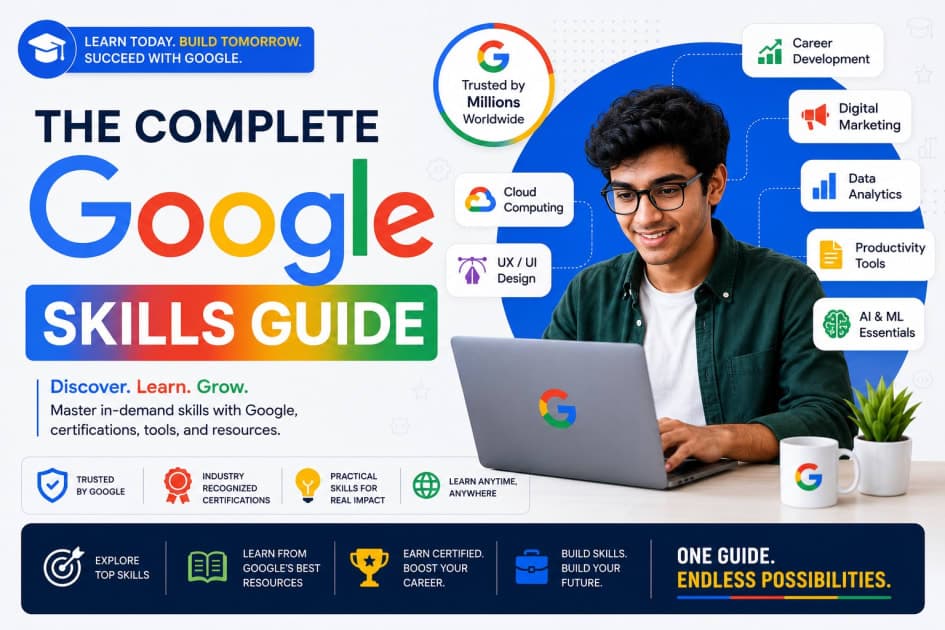
Google doesn't just build search engines and smartphones — it runs one of the largest free learning ecosystems on the internet. With over 450 free certificates and badges available across its platforms and a hiring consortium of 150+ employers who actively review applications from certificate holders, Google Skills is one of the most practical and accessible paths into tech-adjacent careers available in 2026.
But the ecosystem is confusing if you don't know the map. There's skills.google, Grow with Google, Google Skillshop, Google Cloud Skills Boost, and more — each with different audiences, credentials, and career outcomes. This Google Skills guide cuts through all of it: what each platform does, which certificates are worth your time, and exactly how to use them to move forward in your career.
What Is Google Skills? (The Full Ecosystem)
skills.google is Google's central learning hub — the starting point for navigating everything. From there, it branches into several distinct platforms, each serving a different purpose:
Platform | Best For | Credential Type |
|---|---|---|
Grow with Google (Coursera) | Career changers, beginners | Professional Certificates |
Google Skillshop | Marketers, advertisers | Product Certifications |
Google Cloud Skills Boost | Cloud & AI learners | Skill Badges + Cloud Certs |
Google Developer | Android/Flutter developers | Developer Badges |
Google Play Academy | App publishers | Play Store Certificates |
Think of skills.google as the front door. The rooms behind it serve very different needs. A career changer targeting data analytics lives in Grow with Google. A digital marketer proving platform fluency lives in Skillshop. A cloud engineer building toward an Associate Cloud Engineer exam lives in Cloud Skills Boost.
Track 1: Google Career Certificates (Grow with Google)
Platform: grow.google / Coursera
Cost: $49/month (Coursera subscription — typically 3–6 months to complete)
Credential: Shareable professional certificate
No prior experience required
Google Career Certificates are the flagship product of the Google Skills ecosystem — and the ones with the clearest career ROI. Over 2.3 million learners have enrolled since the program launched, and Google's own data shows 75% of US graduates report a positive career outcome — a new job, promotion, or raise — within six months of completion.
The certificates most worth your time in 2026:
1. Google AI Professional Certificate ⭐ (Newest)
The newest addition to the lineup and arguably the most timely. Built around hands-on AI labs, it teaches practical AI fluency using Google's tools — Gemini, NotebookLM, and more — for real-world tasks like research, writing, and data analysis. Completing it unlocks 3 months of Google AI Pro. Ideal for anyone who wants to use AI effectively at work, not just talk about it.
2. Google Cybersecurity Certificate
Consistently ranked the highest-ROI certificate in the portfolio. Cybersecurity analysts at the entry level earn between $70,000 and $99,400 annually — and the Google Cybersecurity Certificate covers threat detection, incident response, Python basics, SIEM tools, and AI-assisted threat analysis. Under $300 in course fees to access a $70K+ career track is a favorable ratio. Pair it with CompTIA Security+ prep for maximum hiring impact.
3. Google Data Analytics Certificate
Teaches Excel, SQL, Tableau, and R through real-world projects. Data analytics is one of the highest-volume hiring tracks in the Google ecosystem, and the certificate holds up well in job descriptions on LinkedIn, Indeed, and Glassdoor. Important caveat: the certificate alone isn't enough anymore — portfolio projects do the heavy lifting. Treat it as a structured learning path, then build on top of it.
4. Google IT Support Certificate
One of the original Google Career Certificates and still one of the most employer-recognized. Covers networking, operating systems, security basics, and customer service for technical support roles. Strong for people entering tech from non-tech backgrounds.
5. Google Project Management Certificate
Particularly strong for teachers, healthcare administrators, office managers, and operations professionals who already manage projects informally and want a formal credential. Covers Agile, Scrum, project planning tools, and stakeholder communication in a way that maps directly to job descriptions.
6. Google Digital Marketing & E-commerce Certificate
Covers Google Ads, Google Analytics, social media, email campaigns, and e-commerce strategies. The most relevant for freelancers, agency applicants, and anyone targeting startup marketing roles. Best combined with Skillshop certifications (see below) to show platform-specific fluency.
7. Google UX Design Certificate
Teaches research, wireframing, prototyping in Figma, and usability testing. Requires more portfolio investment than other tracks — UX roles are heavily portfolio-driven, and the certificate signals intent, not ability. Strong foundation, but you'll need real case studies to land interviews.
Track 2: Google Skillshop (Free Product Certifications)
Platform: skillshop.withgoogle.com
Cost: Free
Credential: Free certificate of completion (valid 1 year)
Google Skillshop is where digital marketers and advertisers prove platform fluency. It's entirely free, and the credentials carry real weight with employers and clients who want to see verified Google platform expertise.
Most valuable Skillshop certifications in 2026:
Google Ads Search Certification — The baseline for anyone running paid search campaigns. Required by most agencies.
Google Analytics 4 Certification — Proves you can navigate GA4, which replaced Universal Analytics in 2023. Employers notice the gap when it's missing.
Google Ads Display Certification — For display and programmatic advertising roles.
Google My Business — Relevant for local SEO and small business digital marketing work.
YouTube Content Ownership — For media companies, MCNs, and YouTube channel managers.
Skillshop certifications expire after one year, which keeps them current and prevents them from becoming stale resume items. Renewing annually takes 1–2 hours and signals that you stay current on platform changes.
Track 3: Google Cloud Skills Boost (Cloud & AI)
Platform: cloudskillsboost.google
Cost: Free to browse; labs cost credits (GEAR program gives 35 free monthly credits)
Credential: Skill Badges + Completion Badges
Google Cloud Skills Boost is the training ground for Google Cloud Platform (GCP) skills and one of the best resources for hands-on AI and ML learning in 2026. Understanding the difference between its two credential types matters:
Completion Badge: Awarded for finishing course content. Lower signal, easier to earn.
Skill Badge: Requires passing a timed, unguided challenge lab. Harder and significantly more valuable on a resume — it proves you can apply the skills, not just watch videos.
High-value paths on Cloud Skills Boost:
Generative AI Fundamentals — A short, accurate intro to GenAI concepts, highly rated for 2026. Good first stop before paid cloud courses.
Google Cloud for Beginners — Foundation for anyone targeting cloud roles without prior GCP experience.
Machine Learning Engineer Learning Path — Longer, more demanding, leads toward the Professional ML Engineer certification.
Google Cloud Certifications (the paid exams, prep materials are free):
Certification | Level | Exam Cost | Target Role |
|---|---|---|---|
Cloud Digital Leader | Foundational | $200 | Non-technical roles in cloud-adjacent work |
Associate Cloud Engineer | Associate | $200 | Entry-level cloud ops and deployment |
Professional Data Engineer | Professional | $200 | Data pipelines, BigQuery, ML deployment |
Professional Cloud Architect | Professional | $200 | Enterprise cloud architecture |
Professional ML Engineer | Professional | $200 | Production ML systems |
For anyone targeting cloud engineering roles, the Associate Cloud Engineer is the recommended first paid certification — well-recognized, accessible with 3–6 months of prep, and a clear stepping stone to professional-level exams.
Which Google Skill Should You Learn First?
Use this decision tree based on your goal:
"I want to change careers into tech — I have no experience" → Start with Google IT Support or Google Cybersecurity Certificate on Grow with Google. Both are beginner-accessible and lead to the strongest entry-level job outcomes.
"I work in marketing and want to prove platform skills" → Start with Google Analytics 4 Certification on Skillshop — free, respected, and immediately testable on the job. Add Google Ads Search Certification next.
"I want to get into data analytics or data science" → Start with Google Data Analytics Certificate, then layer SQL practice and a personal project. The certificate structures your learning; the project gets you interviews.
"I want to work in cloud or AI" → Start with the Generative AI Fundamentals path on Cloud Skills Boost (free), then commit to the Associate Cloud Engineer path and prep for the exam.
"I just want to learn AI for my current job" → The new Google AI Professional Certificate is built exactly for this. Pair it with Grow with Google's free AI Essentials course for a faster start.
How to Actually Use Google Certificates to Get Hired
Completing a certificate is step one. Here's what separates the 75% who report positive outcomes from those who don't:
1. Add it to LinkedIn properly. List it under Licenses & Certifications with the issue date, credential ID, and the Credly badge link. Recruiters search by certification name.
2. Frame it like a job entry on your resume. Don't just drop it in a "Certifications" section. List the program, timeframe, and two to three bullet points on projects completed and tools used.
3. Build something. For data analytics, UX, and cybersecurity especially, the certificate is the floor — a portfolio project is the ceiling. Even one real-world project you built after completing the course outweighs the credential itself.
4. Use the Google Hiring Consortium. Google's 150+ employer consortium is the program's most underused feature. Upload your certificate to the consortium job board — it creates a warm lead with employers specifically looking for certificate holders. This outperforms cold applications through LinkedIn Easy Apply.
5. Pair certificates strategically. Google Cybersecurity pairs well with CompTIA Security+. Google Data Analytics pairs well with a Tableau Public portfolio. Google Digital Marketing pairs with GA4 Skillshop certification. Stacking related credentials multiplies the signal each one sends.
Frequently Asked Questions
Q: Is Google Skills (skills.google) free? Most of it is. Google Skillshop and Google Cloud Skills Boost offer free course content. Google Career Certificates on Coursera cost $49/month, with most learners finishing in 3–6 months (total cost: under $300). Financial aid is available through Coursera. Google also periodically offers scholarships through local partnerships.
Q: Are Google Career Certificates recognized by employers? Yes — particularly the Data Analytics, Cybersecurity, IT Support, and Project Management tracks. Over 150 companies in Google's hiring consortium actively review applications from certificate holders. Outside the consortium, employer recognition varies by industry, but the certificates are generally well-regarded as entry-level credentials.
Q: How long do Google certifications take to complete? Skillshop certifications take 1–8 hours. Google Career Certificates typically take 3–6 months at 4–8 hours per week. Google Cloud certifications require 3–6 months of prep for the Associate level, longer for professional exams.
Q: Do Google certificates expire? Google Skillshop certifications expire after 12 months and require renewal. Google Career Certificates don't expire, but the underlying tools evolve, so staying current matters. Google Cloud certifications are valid for 2 years.
Q: What's the difference between a Skill Badge and a Certificate on Google Skills? A Skill Badge on Google Cloud Skills Boost requires completing a timed, unguided challenge lab — it's harder and more valuable as proof of practical ability. A completion certificate is awarded for finishing video-based course content. For resumes and hiring, Skill Badges carry more weight.
Conclusion
The Google Skills ecosystem is one of the most comprehensive free and low-cost learning platforms available in 2026 — but navigating it without a map means wasting time on credentials that don't move the needle. The career certificates with the strongest hiring track record are Cybersecurity, Data Analytics, IT Support, and Project Management. The Skillshop certifications are non-negotiable for anyone in digital marketing. Cloud Skills Boost is the right starting point for anyone targeting GCP or AI roles.
The common thread: use certificates as structured learning paths, then build proof of work on top of them. The Google Skills guide you've just read gives you the map. The next step is picking the track that matches where you want to go.
Start here: Visit skills.google to explore current certificates and skill badges. If you're unsure where to begin, the free Google AI Essentials course on Grow with Google takes under 10 hours and gives you a practical foundation for the most in-demand skill of 2026.