
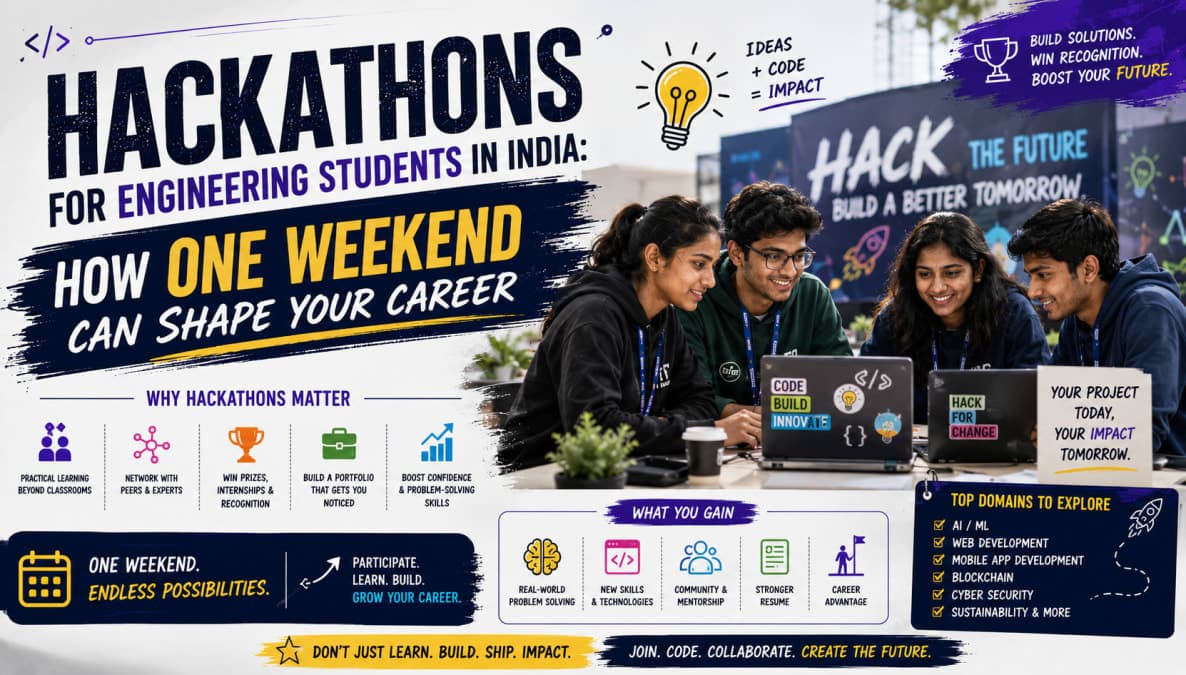
Did you skip your last hackathon because you thought your CGPA wasn't good enough, or your team wasn't "skilled enough" to win? Here's the truth: recruiters at Razorpay, Flipkart, and Amazon don't care where you ranked — they care whether you showed up, built something real, and shipped it under pressure. Hackathons for engineering students in India are one of the fastest ways to build real skills, get noticed by recruiters, and land your first internship or job offer. This guide breaks down why hackathons matter, which ones are actually worth your time, and exactly how to prepare so your next hackathon moves your career forward instead of just eating your weekend.
What Are Hackathons and Why They Matter in Your Engineering Journey
A hackathon is a time-boxed event — usually 24 to 48 hours — where you build a working prototype or solution to a problem statement, either solo or in a team. No semester-long deadlines, no professor grading on a curve. Just you, a clock, and a problem to solve.
Here's why hackathons are worth your time as an engineering student:
Real project experience: Unlike classroom assignments, hackathon projects are built under deadline pressure that actually resembles a real job
Resume differentiation: For freshers with no internship, a hackathon project is proof you can build something without being told exactly how
Direct recruiter access: Corporate hackathons like Flipkart GRiD and Amazon HackOn often come with an interview shortcut or PPO track attached
Networking that compounds: Hackathon teams often mix students from different colleges — a good teammate today can become a referral tomorrow
Prizes and PPOs: Winning teams at product-company hackathons have walked away with pre-placement offers at strong CTCs, on top of cash prizes
Recruiters at NASSCOM member companies consistently flag hands-on project experience as one of the biggest differentiators between two freshers with similar CGPAs. If you're relying only on your final-year project to prove you can build things, you're leaving your strongest proof point unused. Browse upcoming hackathons and events to see what's live right now.
Step 1: Know the Different Types of Hackathons You Can Enter
Not all hackathons are built the same, and picking the wrong one first can crush your confidence before you've even learned the ropes.
National-Level and Government Hackathons
Smart India Hackathon (SIH) is the flagship — a ministry-backed event where teams of six tackle real problem statements from government departments and PSUs, starting at the college nodal round and building up to a national grand finale.
Corporate and Product Company Hackathons
Flipkart GRiD — targets engineering students with a strong hiring pipeline for top performers
Walmart Sparkathon — retail-tech problem statements, often with internship offers for finalists
Amazon HackOn — open innovation challenges with direct recruiter visibility
Google Solution Challenge — global, community-impact focused, great for students who want international exposure
Platform-Hosted Online Hackathons
Platforms like HackerEarth, Devfolio, and Unstop host hackathons year-round. Low barrier to entry, flexible timing, and a great place to build your first team without national-level pressure.
College-Level and Internal Hackathons
The best starting point. Lower stakes, familiar faces, and a chance to figure out how you personally work under a deadline before anyone outside your campus is watching.
Mistakes to Avoid
Jumping straight into SIH or a corporate hackathon as your very first event
Picking a hackathon based only on prize money instead of what you'll actually learn
Registering without reading the problem statement themes or eligibility criteria
Pro Tip: Start with a college-level or Unstop-hosted online hackathon before attempting SIH — you want your first 24-hour sprint to teach you how you work under pressure, not humiliate you in front of a national panel.
Step 2: The Skills Hackathons Actually Build (That Recruiters Test For)
A hackathon isn't really about the final demo. It's a 30-hour stress test of skills that no classroom project can replicate.
Technical Skills You're Forced to Learn
Rapid prototyping — building an MVP instead of a "perfect" polished app
Working with unfamiliar APIs or a new tech stack with zero ramp-up time
Live Git collaboration, including resolving merge conflicts under a ticking clock
Basic deployment and hosting (Vercel, Render, Firebase) so your build actually runs live
Soft Skills That Matter More Than Your Code
Pitching an idea to judges in under three minutes, with zero rambling
Dividing tasks across a team of strangers, fast, based on actual strengths
Handling the moment your build breaks two hours before the demo — and fixing it anyway
Once you've shipped something you're proud of, don't let it sit in a forgotten GitHub repo. Add it to your student project portfolio so recruiters can actually find it.
Pro Tip: Judges remember the pitch, not the code. Practice your three-minute demo out loud at least five times before you present — most teams lose points because they ran out of time mid-explanation, not because their idea was weak.
Step 3: How to Pick the Right Hackathon for You
Hackathon Type | Best For |
|---|---|
College-level hackathon | First-timers building their initial team experience |
Unstop / HackerEarth online hackathons | Beginners who want low-pressure, remote-friendly practice |
Smart India Hackathon (SIH) | Students seeking national exposure and government-scale problem statements |
Corporate hackathons (Flipkart GRiD, Amazon HackOn) | Final-year students targeting PPOs at product companies |
International hackathons (MLH-affiliated events) | Students building a resume for global roles or higher studies |
Key Tip: If you've never built anything under a hard deadline before, don't start with SIH or a corporate hackathon. Start small, fail cheap, and level up from there.
Step 4: A Realistic Plan to Perform Well at Your First Hackathon
Winning is a bonus. Performing well enough to walk away with a working project and real learning is the actual goal for your first few events.
Two weeks before: Form a team of 3–4 with complementary skills — not four backend developers who all want to build the API
One week before: Skim last year's problem statements and winning projects from the same hackathon series to spot patterns
Day 0: Set up your repo, dev environment, and a shared doc before the problem statements even drop
First hour of the event: Lock a scope you can realistically finish — cut features ruthlessly, and don't be precious about it
Midpoint: Get one complete, ugly, end-to-end flow working before you touch styling or polish
Final stretch: Stop coding. Start rehearsing your pitch and assigning who says what
Phase | Timeframe | What to Do |
|---|---|---|
Team formation | 2 weeks before | Lock in 3–4 teammates with different skill sets |
Research | 1 week before | Study past problem statements and winning submissions |
Setup | Day 0, before start | Prepare boilerplate repo, environment, and shared doc |
Build (MVP) | First 60% of hack time | Ship one complete working flow, skip the polish |
Buffer | Next 20% of time | Fix bugs, test the live demo end-to-end |
Pitch prep | Final 2–3 hours | Rehearse a 3-minute demo, assign speaking roles |
Stuck on how to structure your pitch or pick a problem statement? A quick session with a mentor before the event can save you hours of second-guessing during it.
Step 5: Common Mistakes That Cost Students the Win
Overscoping — trying to build five features instead of shipping one that actually works
No dedicated presenter — everyone talks over each other, and nobody owns the pitch
Ignoring the problem statement — building something impressive but off-brief, which judges will flag immediately
Skipping sleep entirely — judgment tanks by hour 30, and that's exactly when late-stage bugs creep in
Never testing the demo live — showing judges a broken build because you only tested on your own laptop
Pro Tip: Do a full dry run of your demo on the actual venue Wi-Fi or a fresh browser tab an hour before presenting. Half of all "it worked five minutes ago" disasters come down to an environment issue nobody checked in advance.
Frequently Asked Questions About Hackathons for Engineering Students
Do I need to know advanced coding to participate in a hackathon?
No. Most beginner-friendly hackathons on Unstop or HackerEarth welcome first-year students. Teams usually need at least one person comfortable building an MVP, but you can contribute through UI design, research, or pitching even with basic coding skills.
Can hackathons really help me get a job or internship?
Yes. Corporate hackathons like Flipkart GRiD and Amazon HackOn often shortlist strong performers directly for interviews or PPOs, sometimes skipping the standard application process entirely.
How many people should be on a hackathon team?
Most hackathons cap teams at 4–6 members. A tighter team of 3–4 — with one person who can code, one who can design, and one who can pitch — usually outperforms a larger team of generalists.
What if my project doesn't work by the deadline?
A partially working demo you can explain honestly beats a fake pre-recorded video. Judges respect teams who show what works, explain what doesn't, and describe exactly how they'd fix it.
Is Smart India Hackathon (SIH) worth it for a fresher?
It's worth entering, but go through your college's internal round first. SIH draws intense competition, so it's best attempted after you've completed at least one smaller hackathon.
Do hackathon wins matter more than internships on a resume?
They complement each other rather than replace one another. A hackathon win proves initiative and fast execution; an internship proves sustained work. If you're a fresher with no internship yet, lead with your strongest hackathon project.
Conclusion: Your Next Hackathon Could Be the Turning Point
Here's the bottom line: hackathons for engineering students in India aren't just weekend events — they're compressed, high-signal proof of what you can actually build when the clock is running.
Start with what you can control today:
Pick one beginner-friendly hackathon on Unstop or HackerEarth happening in the next 30 days and register
Message 2–3 classmates today to lock in your team before spots fill up
Skim last year's winning projects for your target hackathon
Set up a shared repo and doc tonight — not the morning of the event
Add your best past project to your portfolio so it's ready to show recruiters
Explore the Velonx community to find teammates and swap notes with students who've already been through one
Every hackathon you don't win still teaches you something the classroom never will. Every bug you fix at 3 a.m. is data, not defeat — and the next recruiter reading your resume will notice the difference. When you're ready to turn that experience into an offer, browse open roles on Velonx and put what you built to work.