
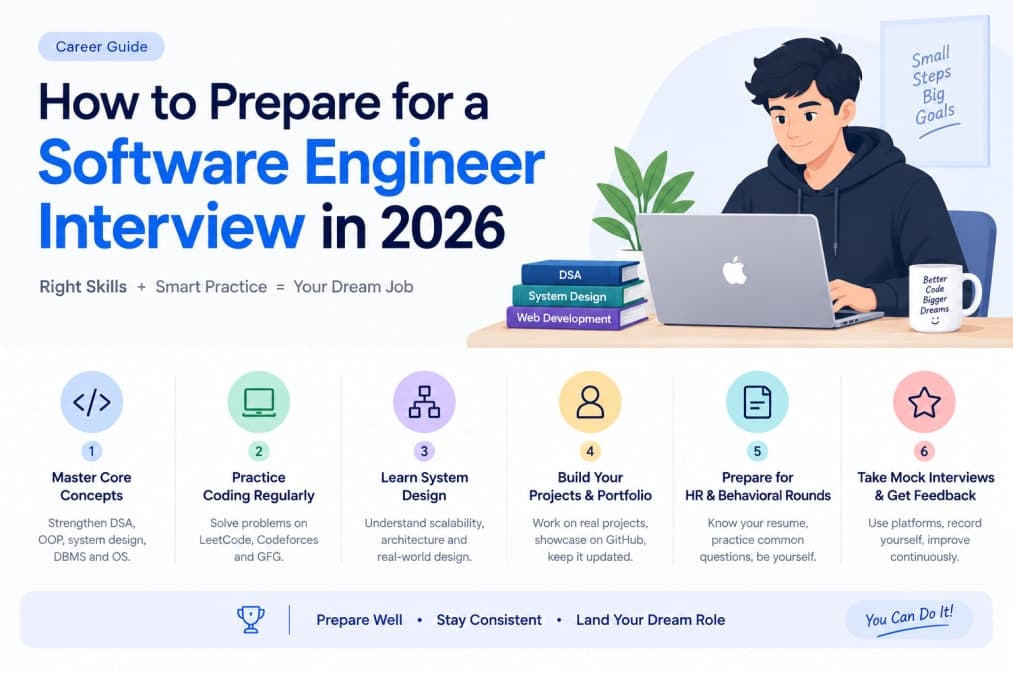
Google's CEO said in April 2026 that 75% of all new code at Google is now AI-generated and approved by engineers. So do you still need to learn binary trees? Yes, mostly. But the interview itself is changing, and if you prepare the 2022 way, you'll walk in half-ready. Exponent
The good news: the fundamentals still decide who gets hired, and the new parts are learnable. This guide shows you how to prepare for a software engineer interview in 2026, from DSA and projects to AI-assisted rounds and HR, with a 4-week plan you can start today.
What Changed in Software Engineer Interviews in 2026
Interview loops have shifted at the biggest companies, and it helps to know exactly where.
AI-assisted rounds are real, but narrow. Google is piloting a round where candidates use Gemini to work through an existing codebase, aimed at junior and mid-level roles on selected US teams, with the standard algorithm rounds unchanged and still AI-free. Amigo
Interviewers grade how you use the AI. They look at prompt engineering, output validation, and debugging skills, not just whether the code runs. Exponent
Meta got there first. Its AI-enabled format replaces one of two coding interviews, while the other stays a standard no-AI round. Medium
Hiring leaders are struggling to assess candidates. A Karat survey reported by one 2026 guide found that 71 percent of engineering leaders say AI makes technical skills harder to assess. That's why more rounds now test judgement, not just output. AI Tech Connect
Here's the reality check for India: most Indian campus drives and service-company loops haven't changed much. Many still follow the classic pattern of an online assessment, technical rounds, and HR. Most Infosys fresher candidates face three rounds: an online aptitude/coding assessment, a technical interview, and an HR interview. Infosys
Pro Tip: Before any round starts, ask your recruiter or interviewer: "Is this round AI-off, or am I expected to use an assistant?" Asking signals that you understand the 2026 format. AI Tech Connect
Step 1: Know Your Target Before You Prepare
You can't prepare for "a software engineer interview." You can only prepare for a specific company type. India has three broad tiers:
Employer type | Examples | What they screen hardest |
|---|---|---|
Product companies & startups | Razorpay, Zerodha, Swiggy, Atlassian | DSA, problem-solving |
Global capability centres (GCCs) | Walmart, Google, Microsoft, Goldman-type setups | DSA + fundamentals + projects |
IT services | TCS, Infosys, Accenture, Wipro | Aptitude, basics, communication |
This split follows product companies paying the most and screening hardest on algorithms, GCCs hiring strong freshers at scale, and IT services hiring in high volume with a gentler bar. Onjob
Timelines differ too. Campus drives often complete in 2–4 weeks, while product company loops typically run 4–8 weeks from application to offer. InterviewEra
Key Tip: Read your invitation email line by line. The invitation and recruiter guidance outrank any generic roadmap, this one included. DevsUnite
Step 2: Nail DSA Without Burning Out
DSA still matters, especially for anything beyond mass-hiring drives. A review of 50 postings found that at Google, Meta, Amazon, Apple, and Microsoft, DSA remains the primary filter, with at least two dedicated coding rounds. Another guide adds that the emphasis is on patterns and reasoning, not trivia. MediumThita
What to Cover (in this order)
Arrays, strings, and hash maps. This is where most easy and medium questions live.
Two pointers, sliding window, binary search. The patterns that repeat.
Recursion, trees, and graphs (BFS/DFS). Common in product company rounds.
Heaps and basic dynamic programming. Enough to solve mediums, not to compete on Codeforces.
Big-O reasoning. Explain your complexity out loud every time.
Mastering about 30 patterns you can explain aloud beats memorising 200 shallow answers. Practise on LeetCode or GeeksforGeeks. InterviewEra
Mistakes to Avoid
Grinding 500 problems without reviewing the ones you got wrong
Reading solutions before spending 20 minutes stuck
Solving silently, when interviewers want to hear your thinking
Pro Tip: After every problem, write one line: "The pattern was ___, and I missed it because ___." That log is worth more than the problem count.
Step 3: Don't Skip the Fundamentals
Freshers lose offers here more than anywhere else. Panels test OOPs, DBMS, and OS even when the job title says "full stack" or "backend." InterviewEra
Revise this checklist:
OOPs: the four pillars, plus the difference between abstraction and encapsulation in your own words
DBMS and SQL: joins, indexing, normalization, transactions
Operating systems: processes vs threads, deadlocks, scheduling
Networking basics: what happens when you type a URL in a browser
One language, deeply: Python, Java, or JavaScript
Service-company drives also add aptitude. Use IndiaBix or PrepInsta for that.
Step 4: Prepare for AI-Assisted and Code-Reading Rounds
This is the 2026 skill most candidates haven't rehearsed. The format: you're handed an existing multi-file codebase and asked to read it, fix bugs, add a feature, and optimise performance with an AI assistant available. Amigo
Companies didn't add AI to make interviews easier. One 2026 breakdown notes that candidates who treat the assistant as a source of free answers are the ones getting passed over. Substack
How to Practise
Read unfamiliar code weekly. Pick a small open-source repo on GitHub and trace one feature end to end.
Use AI, then audit it. Ask an assistant for a solution, then find at least one flaw before you accept it.
Write specific prompts. "Fix this" is weak. "This function fails when the input list is empty. Suggest a fix that keeps O(n) time" is strong.
Narrate your review. Say aloud what you're checking and why.
Weak habit | Strong habit |
|---|---|
Paste the AI's answer and submit | Read it, test edge cases, then decide |
Vague prompts | Prompts with constraints and context |
Silent typing | Explaining trade-offs as you go |
Key Tip: Take-homes are changing too. Teams now shrink them to short timed tasks, or pair them with a live walkthrough where you defend and extend your own code. If you use AI on a take-home, be ready to explain every line. AI Tech Connect
Step 4.5: Learn Basic Design (Yes, Even as a Fresher)
Expect at least a taste of design. One India roadmap says to expect a DSA round, a project deep-dive, and basic system-design questions even for juniors. Onjob
For freshers, this usually means low-level design: problems like a parking lot, Splitwise, or a rate limiter that test OOP, class boundaries, and API thinking. High-level design with caching, queues, and databases comes later in your career, but knowing the basics makes you stand out. Moyoinnovations
Start with: what's a class diagram, what's an API, when do you need a cache, and how does a database index help.
Step 5: Make Your Projects Interview-Proof
The project walkthrough is where you can beat candidates with better DSA. Interviewers will probe every line on your resume.
Prepare a 2-minute story for each project:
The problem: who needed it and why
Your role: what you personally built
One hard bug: what broke and how you fixed it
One trade-off: why you chose X over Y
What you'd change: shows maturity
Build two deployed projects instead of five half-finished ones. Browse Velonx Projects to join a team build, and use Velonx Mentors to get your project reviewed before interviews.
Pro Tip: If you used AI to write part of a project, say so and explain how you verified it. Interviewers respect honesty far more than a shaky bluff.
Step 6: Prepare for Behavioural and HR Rounds
Technical rejections get the attention, but weak behavioural answers eliminate strong coders. Use the STAR framework: Situation, Task, Action, Result. Moyoinnovations
Prepare stories for:
A time you were stuck and how you got unstuck
A team disagreement
A project that failed
Something you learned quickly under pressure
Practise out loud. Written answers sound different from spoken ones.
Your 4-Week Software Engineer Interview Prep Plan
Fresher prep works best as four separate tracks: screening, coding, project walkthrough, and behavioural answers. Here's how to spread them across four weeks: DevsUnite
Week | Focus | Daily target |
|---|---|---|
1 | Arrays, strings, hash maps + OOPs/DBMS revision | 2 problems + 1 hr fundamentals |
2 | Trees, graphs, binary search + OS/networking | 2 problems + 1 hr fundamentals |
3 | Code reading, AI-assisted practice, low-level design | 1 problem + 1 repo trace |
4 | Timed mocks, project stories, STAR answers | 1 mock interview daily |
Key Tip: Run at least three timed mock interviews with another person before the real thing. Join the Velonx Community to find practice partners, and check Velonx Events for mock interview sessions and hackathons.
Frequently Asked Questions About Software Engineer Interview Prep in 2026
Is DSA still required for software engineer interviews in 2026?
Yes, for most competitive roles. Big tech, top product companies, and many startups still use at least one DSA-focused round. You don't need to be a competitive programmer, but you do need fluency in the core patterns.
Can I use AI in a software engineer interview?
Only when the interviewer says so. Google and Meta are piloting AI-assisted rounds, but the standard algorithm rounds are still AI-free. Ask before each round instead of assuming.
How long does it take to prepare for a software engineer interview?
For most freshers, 4 to 8 weeks of consistent daily practice is realistic if you already know one language. Start earlier if your basics are shaky.
Do freshers need to learn system design?
You need the basics. Expect low-level design and simple API or database questions, not large distributed systems. Full high-level design becomes important as you gain experience.
What if I have a low CGPA or come from a tier-2 college?
Off-campus hiring runs year-round, and strong projects and problem-solving can outweigh a low CGPA at many companies. Check each posting's cut-offs, and browse Velonx Career for openings that don't filter by college.
What should I do if I fail an interview?
Write down every question you couldn't answer within an hour of finishing, while you still remember them. Turn each into a study task, then apply again. Most offers come from candidates who've done this several times.
Conclusion: Prepare for the Job, Not Just the Test
Here's the bottom line: 2026 interviews still reward strong fundamentals, but they now also reward judgement, meaning how you read code, question AI output, and explain your decisions.
Start with what you can control today:
Pick your target company type and read its actual interview format
Solve two DSA problems and log the pattern behind each
Trace one feature in an open-source repo and explain it out loud
Write a 2-minute story for your best project
Book a mock interview through Velonx Mentors
Every rejection is data. Every mock interview sharpens your answers, and the candidates who keep practising are the ones who end up with offers.