
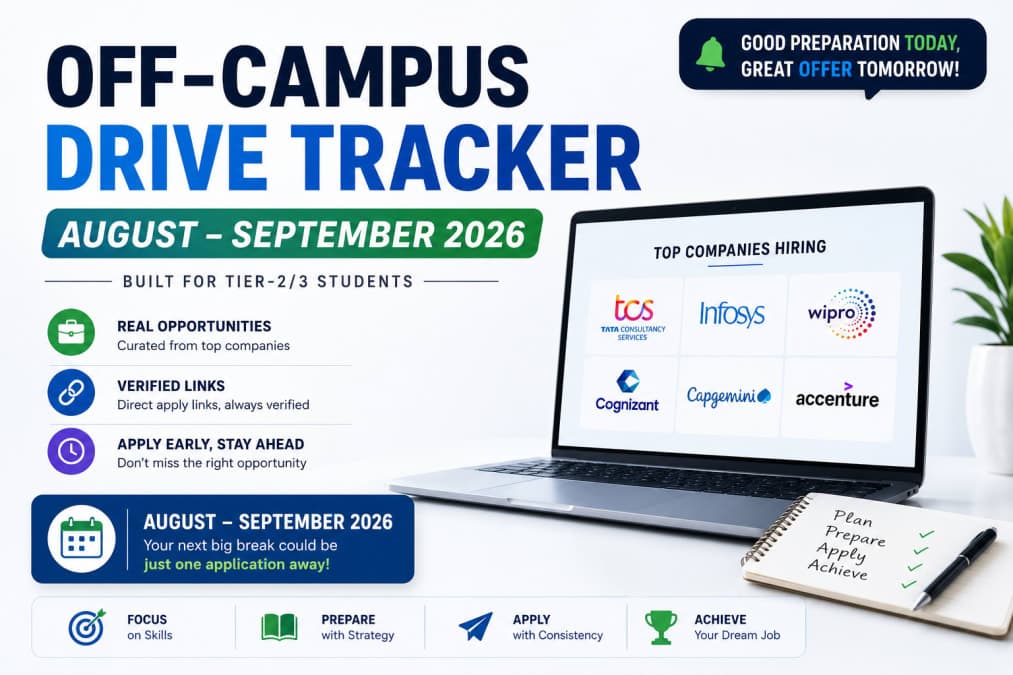
Did your college's placement cell go quiet the moment on-campus season ended? Or maybe it never really showed up for your batch in the first place. Here's the truth: most fresher hiring in India right now isn't happening through campus cells at all — it's happening off-campus, and Tier-2/3 students who track it properly are getting into the same interview rooms as students from bigger names.
This off campus drive tracker breaks down exactly which companies are running recurring off-campus hiring tracks through August and September 2026, what they actually pay, who qualifies, and how to move fast enough to matter. No fluff, no "check the website" — just the system you need.
Why August–September Is the Biggest Off-Campus Window of the Year
Campus placement season for final-year students typically kicks off in October. That single fact explains almost everything about the next eight weeks.
Companies want their fresher headcount locked in before the campus season starts pulling from the same talent pool. So they push hard on off-campus hiring right now — before October — which makes this window the single densest stretch of off-campus activity all year.
Here's why that matters more if you're at a Tier-2 or Tier-3 college:
On-campus visits to smaller colleges have been shrinking. Recent workforce data has shown a meaningful year-over-year drop in on-campus hiring at Tier-2 and Tier-3 engineering colleges, even as overall fresher demand stayed strong.
Off-campus participation from the same colleges is rising sharply, roughly in line with that drop — because it's the channel that's actually open to you.
The industry body NASSCOM projects well over 3 lakh new tech jobs added in this hiring cycle, with freshers making up close to half of all new hires. That demand doesn't check which tier your college belongs to.
Off-campus hiring is not a backup plan for the big IT services companies. For firms like TCS, Infosys, Wipro, Cognizant, and Accenture, off-campus drives regularly account for 30–40% of total fresher intake in a year.
Still think your college tier is the reason you're not getting shortlisted? For off-campus drives, it almost never is. Your resume, your online test score, and your application speed are the three things actually deciding your fate.
The Live Tracker: Off-Campus Tracks to Monitor Right Now
Individual drive postings open and close within days, so instead of chasing one-off dates that go stale fast, track the recurring off-campus programs below. These reopen multiple times a year, and August–September is peak season for nearly all of them.
Company | Track | Typical Fresher Package | Where It's Posted First |
|---|---|---|---|
TCS | NQT — Ninja / Digital / Prime tiers | ₹3.36 LPA (Ninja) and up | TCS iON NextStep |
Infosys | Systems Engineer / Specialist Programmer | Varies by role and stream | Infosys Careers portal |
Wipro | Elite NLTH / Turbo (higher package, stronger coders) | ~₹3.5 LPA (Elite) to ~₹5.5 LPA (Turbo) | |
Wipro WILP | Work Integrated Learning Programme (earn + M.Tech) | Stipend + sponsored M.Tech | |
Cognizant | GenC / GenC Next / GenC Elevate | ₹4 LPA to ~₹6.75 LPA by tier | Cognizant Careers |
Capgemini | GCPE (entry track) / Exceller (higher aptitude track) | Varies by track | Capgemini Careers + AMCAT/HirePro |
CGI | Associate roles across service lines | Standard fresher band | CGI Careers |
Pro Tip: Company career pages post new off-campus openings two to four weeks before job aggregators pick them up. If you're only checking Telegram groups and WhatsApp forwards, you're applying after the smartest applicants already have.
A second, growing lane worth watching: Global Capability Centres (GCCs). India now has well over 2,000 GCCs employing millions of professionals, and this segment is expanding fast — it's less CGPA-obsessed and more skills-and-test-score driven than traditional IT services hiring, which works in your favor if your college tier has held you back before.
Eligibility Rules That Actually Matter for Tier-2/3 Students
Most rejections at the application stage aren't about talent — they're about missing a rule you didn't check. Here's what actually gates you out, and what doesn't.
What Counts Against You
CGPA below the cutoff. IT services drives typically sit at 60–65% or 6.0 CGPA across 10th, 12th, and graduation. Product companies and GCC roles run higher, often 70–75%, though a growing number rely on test scores instead of a hard CGPA bar.
Active backlogs. Nearly every major drive requires zero active backlogs at the time of the test, and some require it again at joining.
A gap year over the limit. Most services companies (TCS, Capgemini, Wipro) enforce a maximum one-year gap. Some MNCs and product companies are more flexible on this.
Reapplying too soon. If you attempted a hiring process for a company within the last six months, you're usually locked out of applying again in the same cycle.
What Doesn't Count Against You
Your college's name or tier. Off-campus registration portals don't have a college-ranking filter. A resume from a Tier-3 college and a resume from a Tier-1 college go through the identical online test.
No internship, if your skills show elsewhere. A couple of solid GitHub projects and a decent LeetCode or GeeksforGeeks track record close that gap for product-adjacent roles.
Your city. Remote-friendly and hybrid fresher hiring has expanded meaningfully into Tier-2/3 cities — you don't need to be in Bengaluru or Pune to be in the applicant pool anymore.
Pro Tip: Before you apply anywhere, pull your 10th, 12th, and graduation percentage/CGPA into one line and check it against the specific drive's stated cutoff — not the "usual" 60%. Wipro has accepted candidates around 55% on some tracks; Infosys has required 65%. Assuming the standard number wastes an application slot.
How to Actually Get Shortlisted (Not Just Apply)
Applying is the easy part. Every fresher role in India routinely pulls hundreds to thousands of applications, so getting seen is the actual competition.
Apply within 48–72 hours of the drive going live. Off-campus openings can fill their applicant quota within two to three days. Speed is a real, measurable advantage — not a cliché.
Build your resume for the ATS first, a human second. Use the exact skill and role keywords from the job description. No creative formatting, no tables inside the resume itself, no graphics.
Register directly on official portals before aggregators. TCS NextStep, Wipro Careers, Infosys Careers — set alerts on all three plus Naukri and LinkedIn for "off campus," "fresher," and your target batch year.
Clear the online assessment with deliberate practice, not last-minute cramming. Daily aptitude and coding practice on platforms like GeeksforGeeks and LeetCode compounds faster than most freshers expect.
Never pay to apply, test, or interview. No legitimate Indian employer charges a fee at any stage of fresher hiring. If a "drive" asks for money, it's a scam — report it and move on.
Pro Tip: Keep one master tracking sheet — company, track, date applied, test date, and result. When five drives are live in the same week, memory alone will make you miss a technical round.
A Realistic 30-Day Action Plan (Aug 27 – Sep 26)
Week | Focus | What You Actually Do |
|---|---|---|
Week 1 | Foundation | Rebuild your resume for ATS, register on all major portals, join 2–3 verified alert channels |
Week 2 | Application sprint | Apply to every eligible drive from the tracker above within 48 hours of posting |
Week 3 | Test prep | Daily aptitude (IndiaBix/PrepInsta) + 1–2 coding problems a day; mock the communication round if you're targeting GenC or Wipro Elite |
Week 4 | Interview prep | Prepare your project explanation, revise OOPs/DBMS basics, run one mock interview on Pramp or with a peer |
Key Tip: Don't wait to be "fully ready" before applying. Apply the moment you're eligible, then prep in parallel — most drives give you days between the online test and the interview round, which is your real prep window.
Where Tier-2/3 Students Actually Have an Edge
The old assumption — that college tier decides your ceiling — is breaking down faster than most placement cells admit.
Skills-based screening is replacing GPA-based filtering at a growing share of companies, which flattens the playing field the moment you clear the online test.
Tier-2/3 city hiring itself is expanding, driven by remote and hybrid roles that no longer require relocation to a metro.
A demonstrated skill stack — solved coding problems, live GitHub projects, a cloud certification — can move a Tier-3 fresher's starting package meaningfully above the typical band, especially through off-campus product-company and GCC applications rather than only services drives.
This is exactly the gap our mentor network exists to close — pairing you with people who've already been through this exact off-campus grind. And once you're closer to interview-ready, our job board tracks live fresher openings alongside guides like this one.
Frequently Asked Questions About Off-Campus Drives 2026
Can I apply for off-campus drives if my college has no placement cell support?
Yes — that's the entire point of off-campus hiring. Registration happens directly on the company's careers portal or through verified platforms, with no college nomination required. Your eligibility is based on your marksheets and test performance, not your college's relationship with the recruiter.
Is there really no CGPA cutoff for some companies?
Some product companies and GCC drives lean on test scores instead of a hard CGPA bar, but most IT services drives still enforce one — typically 60% or 6.0 CGPA. Always check the specific notification; don't assume based on what another company requires.
How many off-campus drives should I apply to at once?
As many as you're genuinely eligible for. There's no penalty for applying broadly, but tailor your resume and prep slightly for each role type — services roles test aptitude and communication heavily, product/GCC roles weight coding and projects more.
What documents do I need ready before I start applying?
Your 10th, 12th, and graduation marksheets, Aadhaar and PAN cards, college ID or provisional certificate, an updated resume, and a passport-size photo. Keep digital copies ready so registration doesn't stall you mid-application.
Do off-campus drives accept a gap year?
Most services companies allow up to one year, and some MNCs are more flexible. If your gap is longer, look specifically at companies known for flexible gap policies rather than assuming rejection.
How do I know if an off-campus drive posting is fake?
Any request for payment at any stage is an automatic red flag — legitimate Indian employers never charge fresher applicants. Cross-check the listing against the company's own careers page before entering personal documents anywhere.
Conclusion: Track It Like a Job, Not a Hope
Here's the bottom line: off-campus hiring isn't the consolation prize for students without a strong campus placement cell — for a huge share of India's fresher hiring, it's the main entrance, and Tier-2/3 students who track it consistently are walking through it.
Start with what you can control today:
Register on TCS NextStep, Wipro Careers, and Infosys Careers this week
Rebuild your resume around ATS keywords, not visual design
Set alerts for "off campus 2026 fresher" on LinkedIn and Naukri
Pick one coding platform and commit to daily practice through September
Build (or finish) one GitHub project you can explain in two minutes flat
Check our community for peer accountability on the 30-day plan above
Every drive you don't clear is data, not defeat — it tells you exactly which round to sharpen next. Keep applying, keep tracking, and let August–September 2026 be the window that gets you off the sidelines.