
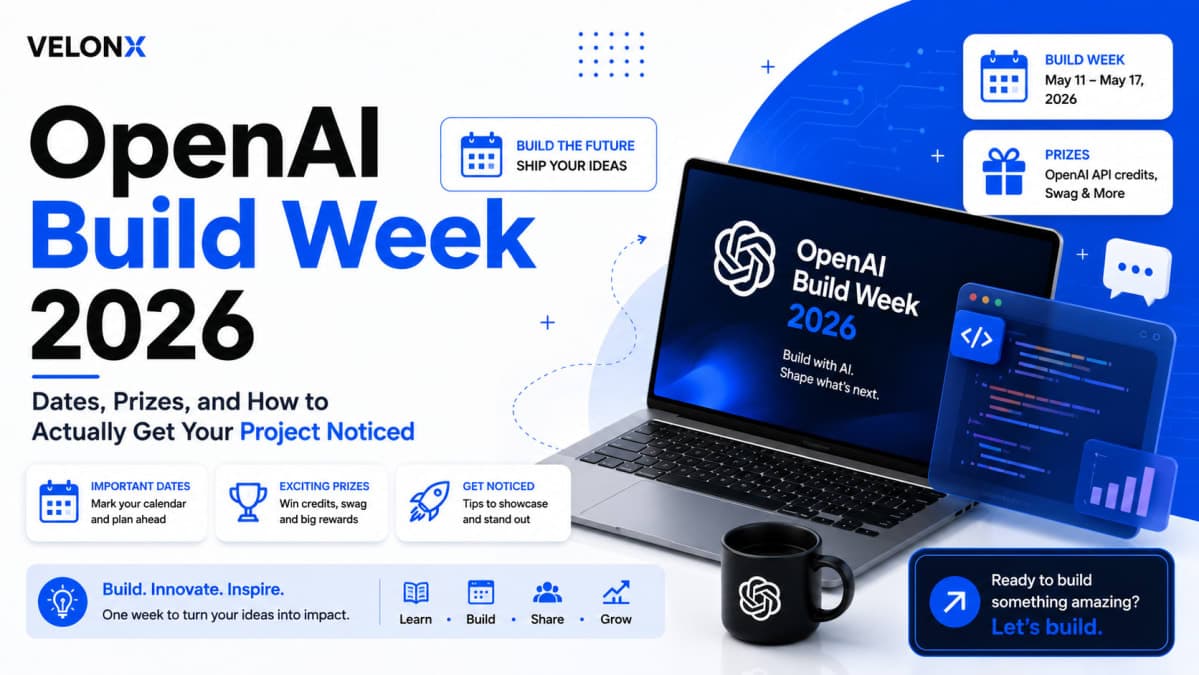
Still have that side-project idea sitting untouched in a notes app somewhere? OpenAI just gave you a very specific reason to stop procrastinating on it. OpenAI Build Week is live right now, running through 21 July, and it's built entirely around one tool: Codex. Whether you're a student who's never shipped a real project or a founder testing a new idea, here's exactly what the event involves, what judges are looking for, and how much runway you actually have left.
What Is OpenAI Build Week?
OpenAI Build Week is a global challenge for developers, creators, founders, and students to experiment with new ideas and bring them to life using Codex, OpenAI's coding agent. It's not a traditional single-day hackathon — it's a full week combining live sessions, community meetups, and a formal submission challenge with real prizes attached.
Here's what makes this edition worth paying attention to:
It's genuinely open to everyone. No experience with Codex is required — OpenAI explicitly states builders of all experience levels are encouraged to participate.
It's bigger than an online-only event. The challenge is running alongside more than 40 in-person and virtual community events across the globe, organized by local ambassadors and community groups.
The prizes are substantial. Winners can receive cash awards, OpenAI credits, DevDay passes, spotlight opportunities, and direct experiences with the OpenAI team.
You get real access to the people building the tools. Judges include OpenAI's Head of Product & Platform, VP of Education, and members of technical staff — not just community moderators.
Pro Tip: Don't confuse this with OpenAI's separate six-week gpt-oss hackathon, co-hosted with Hugging Face, NVIDIA, Ollama, vLLM, and LM Studio, which focuses specifically on open-weight models rather than Codex. Both run on Devpost, but they're different challenges with different rules — check which page you're actually registering on.
OpenAI Build Week 2026: Key Dates
Here's the full timeline, and yes, the submission window is tight.
Milestone | Date |
|---|---|
Challenge opens | 13 July 2026 |
Submission deadline | 21 July 2026, 5:00 PM PDT |
Judging period | 22 July – 7 August 2026 |
Winners announced | 12 August 2026 |
That means, as of today, you have less than a week left to register, build, and submit. This isn't a "sign up now, build over the next month" situation — it rewards a tight, focused sprint.
Key Tip: If you're short on time, don't try to build something from a blank slate. OpenAI explicitly says you can build on an existing project — dust off something half-finished rather than starting completely from zero.
Step 1: Understand Who Can Participate
Eligibility
Open globally to developers, creators, founders, and students
Subject to the official challenge rules and eligibility requirements listed on the Devpost page
No prior Codex experience needed — this is explicitly stated as a non-barrier
Solo or Team?
Both individual and team participation are supported
Full team formation details, including any size limits, are laid out on the official Devpost challenge page — check there before assuming a cap
Pro Tip: If you're weighing solo versus team, remember the submission window is short. A well-coordinated team can split design, build, and demo-video work in parallel — a real advantage when you're working against a hard week-long deadline.
Step 2: Register the Right Way
Registration isn't handled on OpenAI's main site directly — it routes through Devpost.
How to Register
Go to the official Devpost challenge page for OpenAI Build Week
Alternatively, use the Devpost Hackathons Codex plugin if you're already working inside Codex
Review the official rules, challenge tracks, and submission requirements listed there
Create your Devpost account and register your entry (solo or team)
Join the Build Week Discord to access office hours and community support throughout the week
Key Tip: The Devpost page is also where challenge "tracks" and category-specific rules live. Since prize categories can vary by track (as seen in OpenAI's related gpt-oss challenge, which has categories like Best Overall, Wildcard, and For Humanity), don't assume there's a single generic prize pool — read the track structure before you commit to a direction.
Step 3: Get Familiar With Codex Before You Build
Since the entire challenge is centered on Codex, spending even an hour getting comfortable with it before you start building will save you time later.
Where to Learn Fast
Download Codex directly from OpenAI's product page to start experimenting immediately
Watch the livestream sessions — OpenAI is running dedicated Build Week livestreams, including one with Codex and product leadership walking through real use cases
Attend OpenAI Academy sessions — dedicated sessions like "Codex Sites" and "Codex for Creative Building" are scheduled specifically for Build Week participants
Drop into Discord office hours — these run multiple times across the week for live troubleshooting
Pro Tip: The judging criteria explicitly rewards "thoughtful use" of Codex and GPT‑5.6 — not just any project that happens to touch AI. Spend real time exploring what Codex is uniquely good at (agentic coding, working across a codebase, building sites) rather than bolting it onto an idea that doesn't actually need it.
Step 4: Pick a Project That Plays to Codex's Strengths
This is where most entries will differentiate themselves — not in raw ambition, but in fit between the idea and the tool.
What Tends to Score Well
Projects that clearly demonstrate agentic coding — Codex actually doing multi-step work, not just autocompleting snippets
Ideas with a genuinely useful end product, not just a technical demo with no real user
Clean, well-communicated problem framing — judges are explicitly told to weigh how clearly you communicate the problem, solution, and approach
Design and user experience, which is a named judging criterion alongside technical implementation
What to Avoid
Overly broad, unfocused ideas that try to do too much in a one-week build window
Skipping the demo video or a clear project description — both are required submission elements
Ignoring the specific challenge tracks and rules published on Devpost, since requirements can differ by track
Key Tip: With judging based on technical implementation, design/UX, potential impact, and idea quality, a smaller project executed cleanly across all four dimensions will usually beat a bigger, half-finished one that's strong in only one.
Step 5: Prepare Your Submission Properly
Once you've built something you're proud of, the submission itself needs to be as polished as the project.
What Your Submission Needs
A clear project description explaining the problem, your solution, and your approach
A demo video showing the project actually working
A public code repository for judges to review
Any additional materials required for judging, as specified on the Devpost page for your chosen track
Pro Tip: Because judges are reviewing many submissions in a short window, treat your demo video like a pitch, not a screen recording. Open with the problem in one sentence, show the solution working end-to-end, and keep it tight — clarity beats length every time in a batch-judging process like this.
Step 6: Use the Community, Don't Build in Isolation
OpenAI has intentionally built a support system around this event — use it.
Discord is the main hub for asking questions, finding collaborators, and staying updated throughout the week
Local and virtual community events, listed on OpenAI's public events calendar, are run by ambassadors around the world and are a good way to get unstuck or find teammates
Office hours run multiple times during the week specifically for live troubleshooting with the Codex team
Key Tip: If you're stuck on a technical blocker, don't burn hours solo-debugging when live office hours are scheduled that same week. A five-minute conversation with someone who works on the tool daily is often faster than an hour of trial and error.
What You Can Actually Win
OpenAI has confirmed a range of prizes for standout projects:
Cash awards
OpenAI credits
DevDay passes — notable given OpenAI DevDay 2026 is happening 29 September in San Francisco, and general applications for it are already closed
Spotlight opportunities — public recognition from OpenAI
Special experiences with the OpenAI team
Pro Tip: The DevDay pass is worth factoring into your motivation even beyond the cash prize — with DevDay 2026 applications already closed to the general public, a Build Week win could be one of the few remaining ways in for builders who missed that window.
Frequently Asked Questions About OpenAI Build Week 2026
When does OpenAI Build Week 2026 end?
The submission deadline is 21 July 2026 at 5:00 PM PDT. The challenge itself opened on 13 July, and judging runs from 22 July through 7 August, with winners announced on 12 August 2026.
Do I need prior experience with Codex to participate?
No. OpenAI explicitly states that builders of all experience levels are encouraged to participate, and multiple livestreams, Academy sessions, and office hours are scheduled during the week to help newcomers get up to speed quickly.
Can I participate as a team?
Yes, team participation is supported. Specific team size and formation rules are detailed on the official Devpost challenge page, so check there before finalizing your group.
Where do I actually register?
Registration happens through the Devpost challenge page for OpenAI Build Week, or through the Devpost Hackathons Codex plugin — not directly on OpenAI's main website.
How are projects judged?
Judges evaluate technical implementation, design and user experience, potential impact, and the overall quality of the idea, with particular emphasis on thoughtful use of GPT‑5.6 and Codex.
Is this the same as OpenAI's gpt-oss hackathon?
No. OpenAI Build Week centers on Codex and runs through 21 July. The gpt-oss hackathon is a separate six-week challenge co-hosted with Hugging Face, NVIDIA, Ollama, vLLM, and LM Studio, focused on OpenAI's open-weight models rather than Codex.
Conclusion: You Have Days, Not Weeks — Use Them Well
Here's the bottom line: OpenAI Build Week rewards a focused sprint, not a perfect plan, and the deadline is close enough that hesitation is the real risk here.
Start with what you can control right now:
Register on the official Devpost challenge page today, not "later this week"
Download Codex and spend an hour exploring what it's actually good at before you commit to an idea
Pick a project that's small enough to finish cleanly, not just impressive on paper
Join the Build Week Discord so you're not troubleshooting alone
Block time now for your demo video and project write-up — don't leave them for the last two hours
Check the DevDay pass angle if you missed general DevDay 2026 applications — this could be your way back in
The idea sitting in your backlog isn't going to build itself before 21 July. Register, open Codex, and start today.