
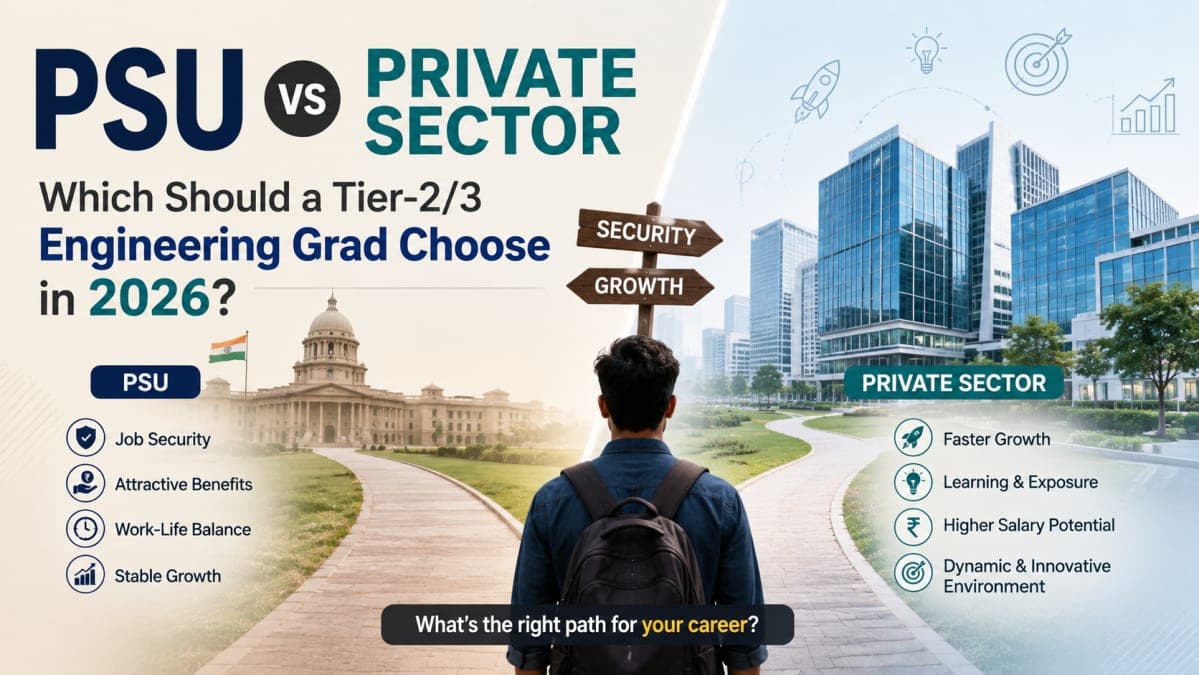
Your batchmate from an NIT just posted a PSU offer letter on LinkedIn — ₹9 LPA, a service bond, and a government stamp on it. You're in your final semester at a Tier-2 college, watching two very different crowds prepare for two very different futures: one grinding GATE mock tests at midnight, the other spamming "open to work" posts and cold DMs. Here's the truth: there is no universally "better" option between a PSU job and a private sector job — there's only the better option for your profile, risk appetite, and timeline. This guide breaks down exactly how to make that call, using real numbers, real mistakes, and a decision framework you can apply today.
What PSU and Private Sector Careers Actually Mean for Engineers
A PSU (Public Sector Undertaking) job means working for a government-owned company — think ONGC, BHEL, NTPC, GAIL, IOCL, Coal India, SAIL, or Power Grid. Most of them recruit engineering graduates through your GATE score, followed by a group discussion or interview round depending on the company. A private sector job covers everything else: IT services giants (TCS, Infosys, Wipro), product companies (Razorpay, Zerodha, Freshworks), and startups (Meesho, Groww, CRED) — hired mostly through campus placements, off-campus drives, or referrals.
Here's why this choice matters more than most students realize:
Volume mismatch: PSUs together hire only a limited number of GATE-qualified engineers each year, filled through individual company notifications — while IT services and product companies collectively absorb freshers at a much larger scale.
Different filters: PSU selection rewards deep fundamentals and a strong GATE score. Private hiring rewards projects, coding ability, and communication.
Different life shapes: One path optimizes for stability and structure; the other optimizes for speed and flexibility.
Irreversible-feeling choice: Many students treat this as permanent, when in reality plenty of people switch lanes later — but the starting choice still shapes your first 3–5 years.
Industry hiring trends tracked by bodies like NASSCOM show that India's technology and services sector alone employs the workforce equivalent of several PSU sectors combined — which tells you where the sheer volume of opportunity sits, even if PSUs still win on other fronts.
PSU vs Private Sector: The Real Numbers on Salary, Security, and Growth
Numbers settle arguments better than opinions. Here's how the two paths actually compare for a fresher in 2026:
Factor | PSU | Private Sector |
|---|---|---|
Starting salary (fresher) | ₹7–12 LPA (basic + generous DA/HRA) | ₹3.5–6 LPA (services); ₹8–20+ LPA (product/startup) |
Salary growth (5 years) | Slow, pay-commission linked | Faster in product/startups; slower in services unless you switch |
Job security | Very high — near-impossible to be laid off | Moderate to low — layoffs happen, especially in services and startups |
Work-life balance | Generally strong, fixed hours | Varies widely — startups can mean 60-hour weeks |
Location control | Low — you go where posted, often smaller towns | Higher — more say once you're experienced |
Retirement benefits | Pension, gratuity, provident fund, medical | Provident fund + gratuity only; no pension |
Promotion speed | Slow, seniority-based | Faster if you perform, especially in product companies |
Skill relevance (10-year view) | Domain-deep, narrower | Broader, more transferable across companies |
Pro Tip: Don't compare "PSU basic pay" to "private CTC" — they're apples and oranges. PSU basic salaries look modest on paper, but dearness allowance, house rent allowance, and non-monetary perks (subsidized housing, medical cover for family, LTC) often push real take-home well above the advertised figure. Always ask for the in-hand + perks breakup before comparing.
How PSU Recruitment Through GATE Actually Works
If PSU is even a maybe for you, this is the section to read twice — because most Tier-2/3 students get this route wrong.
How the Process Actually Works
Most PSUs don't conduct their own written exam anymore. Instead, they:
Ask you to appear for GATE in the relevant paper for your branch
Release their own recruitment notification separately (usually a few months after GATE results)
Shortlist candidates based on GATE score + category-wise cutoff for that specific PSU
Conduct a group discussion and/or personal interview for the shortlisted pool
Release a final merit list and offer letters
GATE 2027, for context, is being conducted by IIT Madras — registration opens on 27 August 2026 and closes without late fee on 27 September 2026, with the exam spread across six days in February 2027. If PSU recruitment is on your radar even as a backup, registering costs you a few hundred rupees and keeps the door open. Skipping it closes that door for an entire year.
Mistakes Tier-2/3 Students Make With the GATE-PSU Route
Assuming GATE = PSU job. Qualifying GATE does not guarantee a PSU offer — each PSU releases its own notification, cutoff, and vacancy count, and you have to apply separately to each one.
Ignoring branch-specific vacancy trends. Circuit and core branches (Electrical, Mechanical, Civil, Instrumentation) generally see far more PSU vacancies than CSE or IT — check last 2–3 years of notifications before assuming your branch has options.
Treating GATE only as an M.Tech gateway. Many students prep for GATE purely for postgrad admission and forget it's simultaneously their PSU application.
Missing application windows. PSU notifications open and close fast after GATE results — miss the window and you wait another year.
Pro Tip: GATE 2027 has made DigiLocker verification mandatory for all Indian candidates. Set this up before registration week — it's a five-minute task that trips up thousands of students every year during the final rush.
Building a Private-Sector Career From a Tier-2/3 College
Not going the PSU route — or hedging with both? Here's what actually gets Tier-2/3 grads hired into private companies, especially off-campus.
What Recruiters Actually Screen For
2–3 solid projects that solve a real problem — not tutorial clones. Host them on GitHub with clean READMEs.
DSA fundamentals — practice consistently on LeetCode, GeeksforGeeks, or CodeChef rather than cramming a week before interviews.
One in-depth internship or freelance gig, found through Internshala, Unstop, or direct outreach — even unpaid, if the work is real.
A LinkedIn profile that reads like a portfolio, not a resume copy-paste.
Common Mistakes That Keep Tier-2/3 Grads Out
Relying entirely on campus placement season and doing nothing between June and December
Sending the same generic resume to every company instead of tailoring it per role
Skipping off-campus and referral routes because "only IITs get referred"
Zero online presence — no GitHub, no LinkedIn activity, nothing a recruiter can verify
Pro Tip: Cold outreach beats blind applications. A short, specific LinkedIn message to an engineer at your target company — referencing their actual work — gets you noticed far more often than another resume disappearing into an ATS. You can browse curated off-campus and referral-friendly openings on the Velonx career board, and pair that with project ideas from Velonx projects if your GitHub needs work.
Which One Fits You? A Decision Framework
Stop asking strangers online "PSU or private, which is better" — the honest answer depends on your profile. Use this table:
Your Situation | Recommended Path |
|---|---|
Core branch (Mechanical/Electrical/Civil), strong fundamentals, values stability over speed | PSU via GATE |
Comfortable with a smaller-town posting and slower promotions in exchange for security | PSU via GATE |
CSE/IT background, enjoys coding, wants faster salary growth | Private sector (product/startup) |
Family pressure for a "government job" but you're unsure | Register for GATE anyway — it keeps the option open at low cost |
Entrepreneurial mindset, wants exposure to building products, comfortable with risk | Private sector, ideally a startup or product company |
Want the best of both and can handle parallel prep | Prep GATE and build coding skills — decide once PSU results and private offers are both in hand |
Key Tip: Run this table against your own risk tolerance and 5-year goals — not your relatives' opinions of what a "good job" looks like. Both paths have produced successful careers; the wrong fit is what makes people miserable, not the path itself.
Frequently Asked Questions About PSU vs Private Sector Jobs
Can I get a good private-sector job without GATE if I'm from a Tier-3 college?
Yes. GATE is only relevant if you're targeting PSUs or an M.Tech. Private companies — especially product firms and startups — care about your projects, DSA skills, and interview performance, not your college tier or whether you appeared for GATE at all.
Is a PSU job really more secure than a private job in 2026?
Broadly, yes. PSU roles come with near-permanent job security, pension benefits, and structured hierarchies that private companies, especially startups and IT services firms during downturns, simply don't offer. That security comes with a trade-off in salary growth speed and location flexibility.
Does qualifying GATE guarantee me a PSU job?
No — this is the single biggest misconception. Qualifying GATE only makes you eligible to apply. Each PSU releases its own recruitment notification with its own cutoff and vacancy count, and you must apply and clear their process separately.
Can I prepare for both PSU and private-sector jobs at the same time?
Absolutely, and it's often the smartest move for undecided students. GATE prep (aptitude, core subjects) and private-sector prep (DSA, projects, resume) overlap less than you'd think, but a disciplined 6-day-a-week split across your final year can cover both without burning out.
Which pays better long-term, PSU or private sector?
Private sector product companies and startups generally win on pure salary growth over 8–10 years, especially if you switch jobs strategically. PSUs win on total compensation stability, benefits, and lower financial risk over the same period. There's no universal winner — it depends on how you define "better."
What if my branch, like CSE, doesn't have many PSU openings?
Some PSUs (BEL, ONGC, Power Grid, BHEL) do recruit for CSE/IT roles, but vacancies are far fewer than for core branches. If you're in CSE, treat PSU as a backup option rather than your primary plan, and invest most of your prep time into coding and projects for the private sector instead.
Conclusion: Stop Asking Which Is "Better" — Ask Which Is Better for You
Here's the bottom line: PSU and private sector jobs aren't competing for the title of "best career" — they're built for different people with different priorities, and pretending otherwise is what keeps Tier-2/3 students stuck in indecision.
Start with what you can control today:
If PSU is even a maybe, register for GATE 2027 before 27 September 2026 — it's a small cost that keeps the door open
Pick 3–5 PSUs that recruit your branch and check their last 2–3 years of cutoffs
Start (or restart) consistent DSA practice this week, regardless of which path you lean toward
Build one project you can actually explain confidently in an interview
Talk to two people — one in a PSU, one in private — before you decide, and ask about their actual day-to-day, not just their salary slip
Every rejected application and every missed cutoff is data, not a verdict on your worth. Tier-2/3 doesn't mean fewer options — it means you have to be more deliberate about choosing the right one. Make the call, commit, and build from there.