
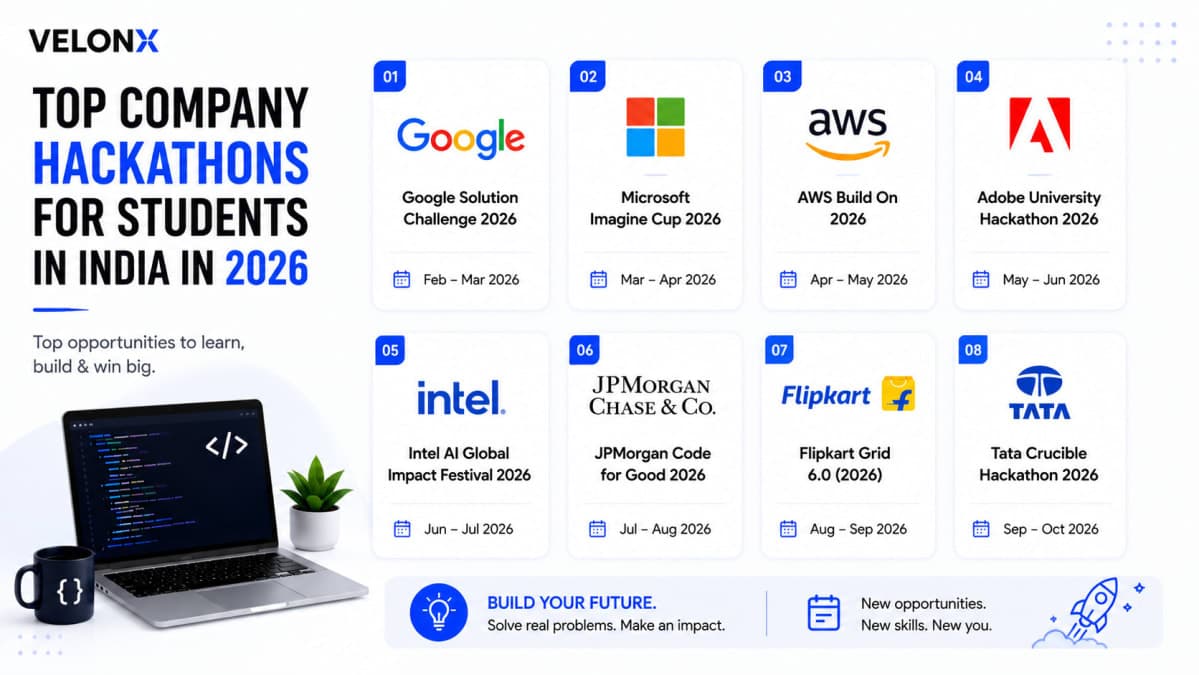
Every year, thousands of students hunt for one more certificate to add to their resume — and skip the one thing that actually gets them hired: a hackathon with a real company's name on it. Here's the truth: recruiters at Flipkart, Amazon, Infosys, and Goldman Sachs don't just scan resumes anymore — they watch how you code under a 48-hour deadline. The top company hackathons for students in India in 2026 aren't side projects. They're direct pipelines to internships, pre-placement interviews (PPIs), and cash prizes that beat most part-time jobs. This guide breaks down which ones are worth your weekend, what they actually pay, and how to get shortlisted.
What Company Hackathons Actually Are (And Why They Beat a Random Certificate Course)
A company hackathon is a timed competition — usually 24 to 48 hours — where a company hands you a real business problem and watches how you and your team solve it live. It's not a webinar. It's not a workshop. It's a working audition.
Here's why they're worth your time:
Direct recruiter visibility: Engineers and hiring managers judge your code in real time, not a filtered resume that an ATS bot might reject first.
Real prize money: Top hackathons now pay anywhere from ₹50,000 to ₹6 lakh in prizes, with some offering internship stipends up to ₹1–1.5 lakh/month for finalists who convert.
Pre-Placement Interviews (PPIs): Several hackathons fast-track top performers straight to an interview, skipping the standard online assessment entirely.
Portfolio proof: A working prototype built under pressure says more on your resume than "completed X course on Y platform."
Fewer CGPA gatekeepers: Many company hackathons (HackWithInfy, SIH) don't apply hard CGPA cutoffs — your Round 1 performance is the real filter.
Industry coverage from bodies like NASSCOM has repeatedly flagged skill-based assessments — hackathons included — as one of the fastest-growing entry points into Indian tech roles, especially as more companies move away from rigid CGPA cutoffs toward demonstrated ability.
Quick Comparison: Best Company Hackathons for Students in India (2026)
Hackathon | Best For | Prize Pool | Eligibility |
|---|---|---|---|
Smart India Hackathon (SIH) | All streams, govt-scale problems | ₹1,00,000 per problem statement | Any Indian college student (UG/PG), Class 6 to postgrad via institution |
Flipkart GRiD | E-commerce, AI, system design | ₹6,00,000 total | B.Tech/M.Tech/M.S./Dual Degree, batch 2026–2029 |
Amazon HackOn | GenAI, scalable systems | ₹2,25,000 | Engineering/MCA (UG/PG), 6.5+ CGPA |
Infosys HackWithInfy | Competitive coding, DSA | ₹5.5 lakh + PPI track | B.E./B.Tech/M.Tech/MCA, pre-final & final year |
Goldman Sachs India Hackathon | Fintech-adjacent coding | PPI opportunity (no large cash prize) | Engineering students graduating 2027/2028 |
Walmart Sparkeon / CodeHers | Women in tech | Stipend ₹1–1.1 lakh/month for converts | Female engineering students, 7+ CGPA |
Key Tip: Don't apply to every hackathon on this list. Pick two or three that match your batch year and CGPA, and go deep on prep for those instead of spreading thin.
1. Smart India Hackathon (SIH) — India's Biggest Student Innovation Challenge
If you want proof that a five-member team of engineering students can out-build a government department's own IT vendor, SIH is where that happens every year.
Run by the Ministry of Education with AICTE, SIH assigns real problem statements from government ministries, PSUs, and industry partners. Teams of six students plus one or two mentors (with at least one female team member mandatory) get a 36-hour non-stop coding sprint for software problems, or about five days for hardware builds. Winners typically take home ₹1,00,000 per problem statement, with ₹75,000 for the runner-up and ₹50,000 for the second runner-up. Registration usually closes in early September, so students should start tracking the official SIH portal by mid-year.
What makes SIH different from most company hackathons on this list: it's genuinely open to every discipline, not just CS/IT. Civil, mechanical, and biotech students have won problem statements that needed their specific domain knowledge.
Pro Tip: Don't chase the flashiest problem statement. Judges consistently reward practical, deployable solutions over ambitious ones no team can realistically finish in 36 hours.
2. Flipkart GRiD — India's Flagship Engineering Challenge
Flipkart doesn't just want engineers who can pass a coding test — GRiD is built to find engineers who can ship something in 24 hours that could realistically go live on Flipkart.com.
Now in its 8th edition, GRiD has evolved from a pure software contest into a three-track AI-accelerator format. Registration for the early screening and coding rounds is individual; only at the grand finale does Flipkart form four-member teams on the spot for a live 24-hour build at its Bangalore HQ. The total prize pool sits at ₹6 lakh, and top performers can land SDE-1 offers with stipends around ₹1 lakh/month during the internship phase. Eligibility covers B.Tech, B.E., M.Tech, M.S., and Dual Degree students, typically batch 2026 onward — and importantly, it's open to third and fourth-year students, not just final-year.
Pro Tip: Register across all three tracks. Shortlisting happens independently per track, so entering all three maximizes your odds of clearing at least one.
3. Amazon HackOn — Build for 300 Million Customers
Amazon isn't testing algorithm skills in isolation — HackOn is designed to check whether you can think like a product owner, not just a coder.
The most recent season put heavy weight on Generative AI and scalable systems architecture. The format runs in stages: a 100-minute proctored coding challenge combined with GenAI-based MCQs (every team member has to clear this individually), followed by a 48-hour build phase, a mentorship round with Amazon engineers, and an in-person grand finale. Total prize pool: ₹2.25 lakh, plus PPI opportunities for standout teams. You'll need to be an undergraduate or postgraduate engineering or MCA student with at least 6.5 CGPA, in teams of two to three.
Pro Tip: The coding round is individually proctored even though it's a team hackathon — every teammate has to personally clear it. Don't carry a weak link into your team.
4. Infosys HackWithInfy — The Coding Marathon That Can Get You Hired Directly
HackWithInfy isn't really a hackathon in the classic "build a startup idea" sense — it's closer to a competitive programming contest with a corporate job offer attached to a strong finish.
Open to pre-final and final-year B.E./B.Tech/M.Tech/MCA students, it runs across three stages: an online coding round on HackerEarth, a Grand Finale (historically a multi-hour onsite hackathon where Infosys itself forms your team, so you might not know your teammates beforehand), and interviews. The total prize pool is ₹5.5 lakh, plus an individual "Champion of Champions" title. Top performers get Pre-Placement Interviews for Specialist Programmer or Power Programmer roles, with offers that have gone as high as ₹9.5–21 LPA. There's no official CGPA cutoff — your Round 1 coding score is the only real filter.
Pro Tip: Registration usually opens around July–August. Get your InfyTQ account and DSA fundamentals ready before the window opens — recent cycles have seen roughly 70,000 registrations competing for around 100 top-tier offers.
5. Goldman Sachs India Hackathon — Wall Street Meets Campus Code
You don't need a finance degree to hack for Goldman Sachs — you need clean code and the ability to explain it under time pressure.
This is a virtual, single-day coding challenge run on HackerRank, with individual (not team) participation. It's typically open to students graduating in specific years — recent cycles targeted the 2027 and 2028 batches — from eligible colleges. It doesn't come with a large cash prize, but top finalists get a shot at interviewing for a Goldman Sachs internship, which makes it one of the highest-ROI hackathons per hour invested if you're eyeing global finance-tech roles.
Pro Tip: This is one of the few hackathons on this list where solid individual HackerRank or LeetCode practice matters more than team dynamics. Grind solo.
6. Walmart Sparkeon / CodeHers — Built to Get More Women Into Tech
If you're a woman in engineering wondering whether hackathons are "not really your scene," this one exists specifically to prove that wrong.
Walmart's women-focused hackathon (branded as CodeHers/Sparkeon) targets female engineering students, typically requiring 7+ CGPA and batch-specific eligibility. It offers a stipend in the ₹1–1.1 lakh/month range for participants who convert to internship roles, along with mentorship and direct networking with Walmart Global Tech engineers.
Pro Tip: Pair your prep with Velonx's mentor community — some past finalists prepped with mentors who've been through Walmart's actual interview loop.
7. Google Solution Challenge & Microsoft Imagine Cup — Build for Social Good, Get Global Visibility
Not every company hackathon wants you to help sell more products — some want you to help fix real problems, and that's the pitch behind Google's and Microsoft's global student programs.
Google's Solution Challenge asks student developer teams to build for the UN's Sustainable Development Goals using Google technology — Firebase, Android, Cloud, and Gemini APIs. Microsoft's Imagine Cup runs a similar global format with regional and national rounds. Both are open to college students worldwide, including India, and both weigh genuine social impact and a working prototype over visual polish. Winners get global stage time, funding, and direct access to product teams.
Pro Tip: These move slower than corporate campus hackathons. Start validating your idea months — not weeks — before the submission deadline.
8. TCS CodeVita & CodeChef SnackDown — For the Purely Competitive Coders
If GRiD and HackOn feel like product hackathons, CodeVita and SnackDown are pure sport — algorithmic problem-solving against the clock, nothing else.
TCS CodeVita is one of the world's largest programming contests, open to students and working professionals, testing DSA depth across multiple elimination rounds. CodeChef SnackDown similarly draws competitive programmers at national and international levels. Neither expects a polished "product" from you — just correct, fast, optimized code.
Pro Tip: If you're more comfortable on LeetCode than in a design tool, these two reward you more directly than a product-hackathon like GRiD or HackOn.
How to Actually Get Shortlisted for a Company Hackathon
Getting an invite email isn't luck — it's usually the result of five or six boring, repeatable habits done consistently.
Build one working full-stack project before you apply. Several hackathons (GRiD, HackOn) filter on resume and portfolio strength before Round 1 even starts.
Practice DSA on arrays, trees, graphs, and DP. Most first-round coding tests sit at LeetCode medium-to-hard difficulty.
Know your CGPA cutoffs cold. Amazon (6.5+), Walmart (7+), and others enforce this strictly — don't waste an application slot on a hackathon you're not eligible for.
Register early, and across multiple hackathons. Shortlisting is independent per hackathon — don't put your entire season on one bet.
Pick teammates by complementary skill, not friendship. One strong backend developer, one strong frontend developer, and one strong presenter beats three generalists.
Treat the final pitch like an interview. Most eliminations after the coding round come down to unclear presentations, not weak code.
Pro Tip: Build a two-minute demo video habit early. Judges in grand finales often watch dozens of pitches back-to-back — the teams with a crisp video pitch are the ones that get remembered.
Need a project to point to before you apply? Browse student project ideas on Velonx that double as hackathon-ready portfolio pieces, or check Velonx's job board for internship openings tied to some of these same companies.
Frequently Asked Questions About Company Hackathons in India
Can I participate in a company hackathon without a CS/IT degree branch?
Yes, for most of them. SIH is explicitly open to all disciplines, including civil, mechanical, and biotech students, and its problem statements often need non-tech skills like UX or business modeling. Company-specific hackathons like Amazon HackOn and Flipkart GRiD generally require an engineering or MCA degree, so check the eligibility document before applying.
Do I need a team to apply, or can I go solo?
It depends on the hackathon. Goldman Sachs India Hackathon and the early rounds of Infosys HackWithInfy are individual. Flipkart GRiD registers you individually and only forms teams at the grand finale. Amazon HackOn and SIH require you to register as a pre-formed team from the start.
Is prior hackathon experience necessary to get shortlisted?
No. Most first rounds are pure coding assessments testing fundamentals, not hackathon history. First-time participants clear Round 1 every single year — what actually matters is consistent DSA practice and one clean project on your resume, not a track record of past wins.
Which hackathon has the best chance of turning into a job offer?
HackWithInfy and Flipkart GRiD have the most direct-to-offer pipelines — both explicitly convert top finishers into paid roles or PPIs. Amazon HackOn and the Goldman Sachs India Hackathon lean more toward PPI shortlisting than a guaranteed offer.
Can second-year or third-year students apply, or is it only for final-year students?
This varies by hackathon. Flipkart GRiD explicitly welcomes third and fourth-year students, not just final-year. Infosys HackWithInfy targets pre-final and final-year students. SIH is open to students from Class 6 through postgraduate level via their institution. Always check the specific batch-year window before assuming you're ineligible.
What happens if my team doesn't win — was it a waste of time?
Rarely. Even non-winning finalists walk away with mentorship exposure, a working prototype for their portfolio, and — in hackathons like GRiD and HackOn — a certificate that recruiters recognize. Several companies also informally track strong non-winning teams for future internship openings.
Conclusion: Stop Waiting for the "Right" Hackathon — Apply to Three This Season
Here's the bottom line: the students who land pre-placement interviews aren't the ones with the most certificates — they're the ones who showed up to build something under a deadline, more than once.
Start with what you can control today:
Pick two or three hackathons from this list that match your batch year and CGPA.
Block your calendar for registration windows — most open months before the actual event.
Start (or finish) one full-stack project this month so you have something to show in Round 1.
Practice one DSA topic a week until your first hackathon's coding round.
Bookmark Velonx Events so you don't miss a registration deadline.
Every hackathon you don't clear is data on exactly where your prep gap is — not proof you don't belong there. Fix that one gap, and apply again next season.