
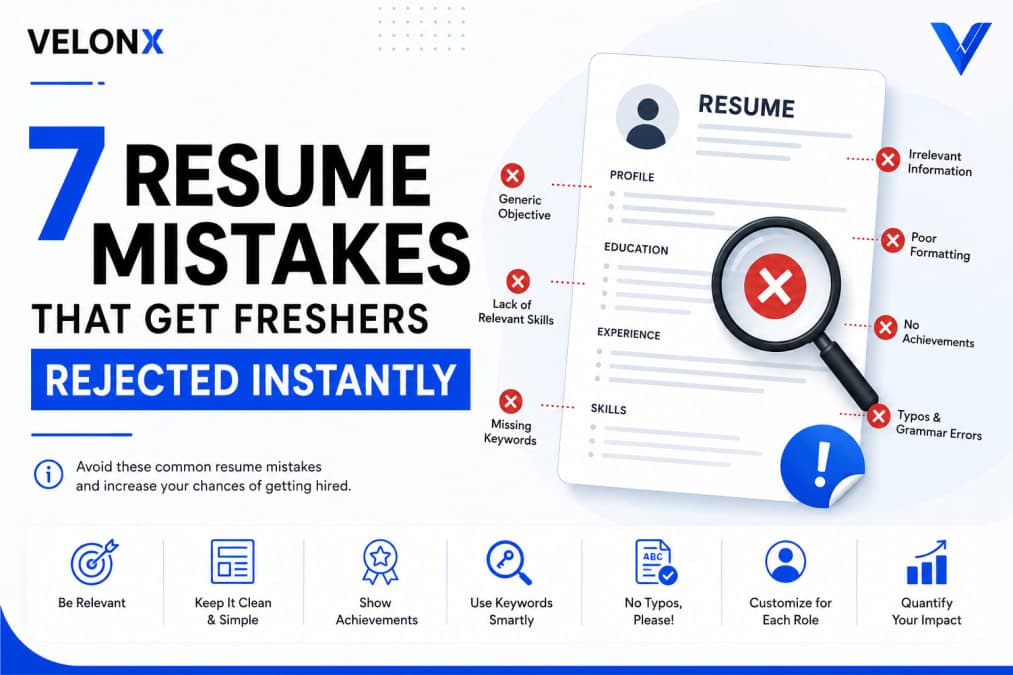
Did your resume go into 40 applications and come back with zero calls? Or maybe you got one interview and still don't know why the other 39 went nowhere. Here's the truth: most freshers don't get rejected because they lack skills — they get rejected because their resume never made it past the first filter.
Resume mistakes for freshers are rarely about content. They're about format, specificity, and proof. This guide breaks down the exact mistakes recruiters and ATS bots flag instantly, and exactly what to do instead — so your resume survives the 6-second scan and the algorithm before it.
Why Your Resume Gets Rejected Before a Human Reads It
A recruiter spends 6–10 seconds on the first pass of your resume. Before that, most mid-size and large companies — think Infosys, TCS, Cognizant, and increasingly Razorpay-style product companies — run your resume through an Applicant Tracking System (ATS) that filters candidates before a human ever opens the file.
Here's why this matters more than students think:
NASSCOM estimates lakhs of engineering graduates enter the job market every year — recruiters aren't short on resumes, they're short on time to read them.
ATS software rejects resumes with broken formatting before a recruiter sees them at all.
A generic resume signals a generic candidate, even if your skills are strong.
Off-campus applications (Naukri, Internshala, Unstop, LinkedIn) get zero human follow-up if the resume doesn't pass automated screening first.
If you're serious about placements, your resume needs to survive two filters: the bot, then the human. Most freshers only optimize for one — if any.
Mistake #1: Sending the Same Resume to Every Company
The Problem
You wrote one resume in third year and you've been mass-applying with it ever since — to product companies, service companies, and startups alike. Recruiters can tell. A resume with no connection to the specific role reads like a form letter.
What to Do Instead
Read the job description and mirror 3–5 keywords from it directly (skills, tools, role title)
Reorder your skills section so the most relevant ones for that job sit at the top
If applying to both service-based (TCS, Wipro) and product-based (Zerodha, Freshworks) companies, keep two resume versions — the emphasis is genuinely different
Pro Tip: Keep a "master resume" with everything you've ever done, then cut it down to a tailored 1-pager for each application. Never work the other way around.
Mistake #2: A Generic Objective Statement That Says Nothing
The Problem
"Seeking a challenging opportunity in a reputed organization where I can utilize my skills and contribute to growth." This sentence could belong to literally any candidate for any job. Recruiters skip it entirely — and it wastes your most valuable resume real estate: the top third of the page.
What to Do Instead
Replace the objective with a 2-line summary that states your specialization, one standout achievement, and what you're targeting
Example: "CSE final-year student specializing in backend development (Node.js, MySQL). Built and deployed 3 full-stack projects; ranked in top 5% on LeetCode contests. Looking for SDE internships."
Pro Tip: If you can't name a single concrete achievement in your summary, that's a sign to build one before your next application cycle — not to pad the sentence with adjectives.
Mistake #3: Listing Duties Instead of Impact
The Problem
"Worked on a project using Python and Flask." "Responsible for testing the application." These lines describe what you were near, not what you did or changed. Recruiters read dozens of these a day and they blur together instantly.
What to Do Instead
Use the format: Action verb + what you built + measurable outcome
Bad: "Worked on a food delivery app project"
Good: "Built a food delivery app using React and Firebase, reducing order-placement time by 30% in user testing with 15 peers"
No real metric available? Use scale instead: number of users, lines of code, features shipped, team size
Pro Tip: Even a rough estimate ("reduced load time from ~4s to ~1.5s") beats a duty-only bullet every time — recruiters trust specificity over vague confidence.
Mistake #4: Formatting That Breaks the ATS
The Problem
Two-column layouts, tables, text boxes, headers/footers with your contact info, icons instead of text, or a resume saved as an image or unusual font — all of these can make an ATS unable to parse your resume correctly. Your perfectly good content becomes invisible.
What to Do Instead
Use a single-column, reverse-chronological layout
Save and submit as PDF (unless the application explicitly asks for .docx)
Keep contact info in the main body, not in a header/footer
Use standard section titles: "Experience," "Projects," "Skills," "Education" — not creative renamed versions
ATS-Safe | ATS-Risky |
|---|---|
Single column, standard sections | Two-column or table-based layout |
Plain text bullet points | Icons or graphics representing skill levels |
Standard fonts (Calibri, Arial, Georgia) | Decorative or script fonts |
PDF export from a text-based tool | Resume built entirely as a Canva image |
Key Tip: If you're unsure whether your resume is ATS-safe, copy-paste the PDF text into a blank document. If it comes out jumbled or out of order, an ATS will read it the same way.
Mistake #5: A Cluttered Resume With No Prioritization
The Problem
Freshers often try to prove worth by cramming in every course, certificate, and mini-project they've ever touched. The result: a 2-page resume where the strongest project is buried under five average ones, and the recruiter never scrolls that far.
What to Do Instead
Keep it to one page unless you have 3+ years of real experience
List only your best 3–4 projects, not all of them
Cut certificates that don't relate to the role you're applying for
Put your strongest, most relevant project first — not chronologically first
Pro Tip: Ask yourself of every line: "Does this make the reader more likely to call me for this specific role?" If not, cut it.
Mistake #6: Typos, Inconsistent Formatting, and Broken Links
The Problem
Inconsistent date formats, mismatched bullet styles, a GitHub link that 404s, or a simple typo in "Achivements" — these are small things, but they signal carelessness on the one document you had unlimited time to perfect. Recruiters read this as a preview of your work quality.
What to Do Instead
Read your resume out loud before submitting — it catches errors silent reading misses
Click every single link (GitHub, LinkedIn, portfolio) right before you submit
Keep date formats, font sizes, and bullet styles identical across every section
Get one person outside your friend group to proofread it — familiarity makes your own eyes skip errors
Pro Tip: Rename your file properly before uploading — "Resume_Final_Final2_USE_THIS.pdf" is a real mistake recruiters see constantly. Use "FirstName_LastName_Resume.pdf" instead.
Mistake #7: Claiming Skills With No Proof Attached
The Problem
Listing "Python, Machine Learning, Leadership" in a skills section means nothing without evidence. Any fresher can write that list. What separates a shortlisted resume from a rejected one is whether those claims are backed by something a recruiter can actually check.
What to Do Instead
Link your GitHub directly under your name, not buried in a "Contact" section
Attach your best project's live demo link or repo link next to that project — not just a general portfolio link
If you led something (a club, a hackathon team, a college fest), name the specific outcome, not just the title "Leader"
Pro Tip: A resume with 2 real, linked, verifiable projects beats a resume with 8 unlinked skill buzzwords — every single time, for both ATS and human review.
Frequently Asked Questions About Resume Mistakes for Freshers
Can I get shortlisted with a low CGPA if my resume is strong?
Yes — most product companies and startups care more about demonstrated skill than CGPA once you're above your college's minimum eligibility cutoff. A resume with strong, proof-backed projects consistently outperforms a resume that only lists a high CGPA with nothing else.
Should my fresher resume be one page or two?
One page, unless you have prior internship experience, research publications, or 3+ years of real work history. Recruiters spend seconds on a first pass — a tighter one-pager forces you to prioritize your strongest material instead of hoping a reader digs for it.
Do I need a different resume for every single application?
Not every single one, but you do need different versions for different job types — one for service-based companies (TCS, Infosys), one for product-based roles, and possibly one for internships versus full-time roles. Within a type, tailoring the top skills section to match each job description takes 5 minutes and meaningfully improves your shortlist rate.
What if I don't have any internship experience to put on my resume?
Lead with projects instead. A well-documented personal or academic project with a live link and clear impact statement can carry the same weight as an internship, especially for entry-level and off-campus applications on platforms like Internshala and Unstop.
How do I know if my resume is ATS-friendly?
Copy the text out of your resume PDF and paste it into a plain text document. If the content comes out in the correct reading order with no jumbled sections, it's likely ATS-safe. Avoid tables, text boxes, and multi-column layouts to stay safe by default.
Conclusion: Fix the Filters Before You Fix the Content
Here's the bottom line: most resume mistakes for freshers aren't about talent — they're about format, specificity, and proof, and every single one of them is fixable this week.
Start with what you can control today:
Strip your resume down to a single, ATS-safe column and re-save it as a PDF
Rewrite your top 3 bullet points using the action + outcome format
Replace your generic objective line with a 2-line, achievement-based summary
Link your GitHub and best project directly under your name
Read the whole thing out loud once before your next application
Every rejection is data, not a verdict. A resume you fix this week can outperform the version that got ignored 40 times last month — the difference isn't luck, it's whether a recruiter and an algorithm can actually read what you've already done.