
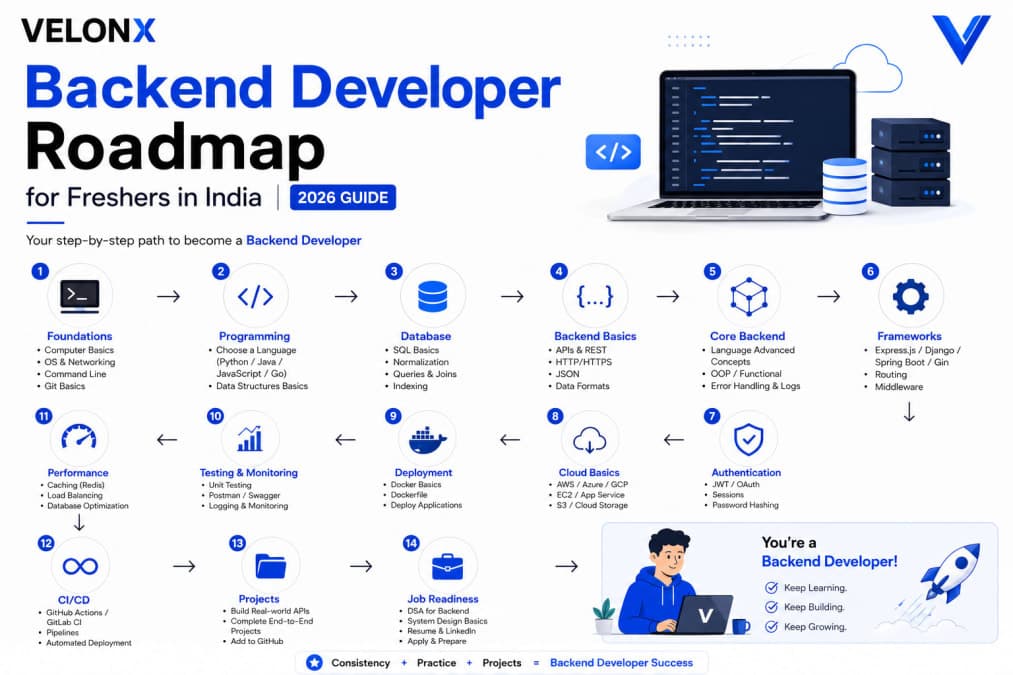
Still adding "proficient in DSA" and "MERN stack" to your resume with nothing to back it up? You're not alone — thousands of CSE grads apply to the same 3 job postings every placement season with an identical skillset. Here's the truth: recruiters at Razorpay, Swiggy, and Freshworks aren't hiring "full stack enthusiasts." They're hiring people who can actually design and ship a backend system.
This backend developer roadmap for freshers in India lays out exactly what to learn, in what order, so you stop collecting half-finished Udemy certificates and start building something a recruiter can test in an interview.
What Is a Backend Developer Roadmap and Why You Need One
A backend developer roadmap is a sequenced learning path — languages, data structures, databases, frameworks, and system design — that mirrors what companies actually test in interviews, instead of a random list of YouTube tutorials.
Here's why following a structured roadmap matters more than binge-learning tech:
Interviews are sequential, not random: A DSA round tests fundamentals before a system design round tests architecture. Learning out of order leaves gaps recruiters spot instantly.
Backend roles pay well, fast: Freshers with solid backend skills land ₹6–12 LPA at product companies like Meesho, CRED, and Groww, compared to ₹3.5–5 LPA for generic "full stack" hires with shallow depth.
Off-campus hiring rewards depth over breadth: NASSCOM has repeatedly flagged a widening skills gap between what colleges teach and what the industry needs — backend fundamentals are squarely in that gap.
Backend skills transfer everywhere: Once you understand APIs, databases, and system design, DevOps, cloud, and even AI infra roles become easier to pivot into.
Pro Tip: Don't learn a framework before you understand what it's abstracting away. Recruiters can tell within two questions whether you understand HTTP and databases or just memorized npm install express.
Step 1: Lock Down One Programming Language and Its Fundamentals
Pick one language and go deep — not Python this week and Go next month. For most Indian freshers, Python, Java, or JavaScript (Node.js) are the safest bets because they dominate hiring at both service-based companies (TCS, Infosys, Wipro) and product companies (Flipkart, PhonePe, Zomato).
What to Master in Your Chosen Language
Core syntax and OOP concepts — classes, inheritance, polymorphism, and how they map to real backend design
File handling and exception handling — used constantly in real backend services
Concurrency basics — threads in Java, async/await in Node.js, or asyncio in Python
Standard library fluency — don't Google basic string or collection operations mid-interview
Mistakes to Avoid
Jumping between 3 languages without finishing any of them
Skipping OOP because "I'll pick it up later" — it shows up in every design round
Learning syntax without writing actual programs (calculator, to-do CLI, file organizer)
Pro Tip: Pick the language your target companies actually use in interviews. Check recent Naukri.com and LinkedIn job postings for your target role — if 80% ask for Java or Node.js, don't spend six months on Go.
Step 2: Master Data Structures & Algorithms (Yes, Even for Backend)
Your resume can say "backend developer" all it wants — if you can't clear the DSA round, you don't get to the backend round. Every major Indian tech hire, from Amazon to Zerodha, still gates candidates through DSA first.
A Realistic 8-Week DSA Plan
Weeks 1–2: Arrays, strings, hashing, two-pointer and sliding window patterns
Weeks 3–4: Linked lists, stacks, queues, recursion
Weeks 5–6: Trees, graphs, BFS/DFS
Weeks 7–8: Dynamic programming, greedy algorithms, and full mock interviews
Use LeetCode for interview-pattern practice and GeeksforGeeks for concept explanations when you get stuck. Aim for 150–200 solved problems before your first serious interview, not 500 solved randomly without pattern recognition.
Pro Tip: Don't just solve problems — re-solve the ones you struggled with a week later. Recognition speed under interview pressure matters more than the total count on your profile.
Step 3: Learn Databases — SQL and NoSQL
Every backend system eventually comes down to how well you can model and query data. This is where most freshers are weakest, and where interviewers dig the deepest.
Relational Databases (SQL)
Learn PostgreSQL or MySQL — both are free, widely used, and asked about in interviews
Master joins, indexes, normalization, and query optimization (
EXPLAIN ANALYZEis your friend)Practice writing queries on realistic schemas, not just SELECT * FROM table
NoSQL Databases
Learn MongoDB for document-based storage and Redis for caching and session management
Understand when to use NoSQL over SQL — this is a common system design interview question
Database Type | Best For |
|---|---|
PostgreSQL / MySQL | Structured data with relationships — orders, users, transactions |
MongoDB | Flexible, evolving schemas — product catalogs, content management |
Redis | Caching, session storage, rate limiting, real-time leaderboards |
Key Tip: In interviews, don't just name the database — justify the choice based on the data's structure, read/write ratio, and scale.
Step 4: Pick a Backend Framework and Build REST APIs
Once your language and database fundamentals are solid, pick one framework and build real, working APIs — not tutorial clones you can't explain.
Framework | Best For |
|---|---|
Node.js + Express | Fast to learn, huge job market, great for startups (CRED, Meesho stack) |
Django (Python) | Batteries-included, strong for fintech and content-heavy apps |
Spring Boot (Java) | Dominant at large enterprises and service-based companies (TCS, Infosys, JP Morgan) |
What to Build While Learning
A REST API with proper CRUD operations, validation, and error handling
Pagination, filtering, and sorting on list endpoints
Proper HTTP status codes — not everything returning 200
Pro Tip: Document every API you build with Postman or Swagger. In interviews, being able to walk through your own API design signals real ownership, not copy-pasted code.
Step 5: Understand Authentication, Security & Caching
This is the step most freshers skip entirely, and it's exactly why their projects look unfinished to recruiters.
Authentication: Implement JWT-based auth and understand the difference between authentication and authorization
Security basics: SQL injection prevention, input validation, rate limiting, and environment variable management for secrets
Caching: Use Redis to cache expensive queries and understand cache invalidation strategies
Pro Tip: Add a rate limiter to at least one project. It's a five-line addition that instantly signals production-awareness in interviews.
Step 6: Learn System Design Basics
System design rounds are no longer reserved for 3+ years of experience — product companies now ask freshers basic system design questions like "design a URL shortener" or "design a rate limiter."
Core Concepts to Cover
Scalability: Horizontal vs. vertical scaling, load balancers
Databases at scale: Sharding, replication, read replicas
Reliability: Caching layers, message queues (Kafka, RabbitMQ basics), CAP theorem at a conceptual level
Pro Tip: You don't need to design Instagram at scale as a fresher. You need to clearly explain trade-offs on a small system — that's what actually gets you the offer.
Step 7: Deploy, Use Git & Basic DevOps
A backend project sitting only on your laptop doesn't count as a portfolio piece.
Git and GitHub: Clean commit history, proper README files, and a public profile recruiters can actually review
Docker basics: Containerize at least one project
Deployment: Deploy on Render, Railway, or AWS free tier — a live link beats a GitHub repo every time
Pro Tip: Put the live API link directly on your resume next to the project title. Recruiters test what's clickable before they read what's written.
Step 8: Build 2–3 Projects That Actually Get You Hired
Skip the fifth to-do list app. Build projects that demonstrate backend depth:
An e-commerce backend with auth, cart, orders, and payment gateway integration (Razorpay's test mode is free)
A URL shortener or rate limiter — small scope, but shows system design thinking
A real-time chat or notification service using WebSockets or a message queue
Browse Velonx Projects for structured project ideas mapped to exactly this roadmap, and check Velonx Mentors if you want a working backend engineer to review your architecture before you list it on your resume.
Frequently Asked Questions About the Backend Developer Roadmap
Can I become a backend developer without a CS degree?
Yes. Recruiters at product companies increasingly care more about your GitHub, projects, and DSA rounds than your degree. Non-CS candidates with strong backend fundamentals regularly clear interviews at companies like Razorpay and Zerodha.
How long does it take to become job-ready as a backend developer?
With consistent effort, 6–9 months is realistic for a fresher starting from scratch — roughly 2 months on language and DSA fundamentals, 2 months on databases and frameworks, and the rest on projects and interview prep.
Is Node.js or Python better for backend freshers in India?
Both are strong choices with heavy hiring demand. Node.js tends to have more startup and product-company openings, while Python (with Django) is common in fintech and data-heavy backends. Pick based on the job postings in your target companies.
Do I need to learn cloud platforms like AWS as a fresher?
Basic familiarity helps — deploying one project on AWS free tier or Render is enough at the fresher level. Deep AWS certification can wait until after your first backend role.
Is DSA really necessary if I only want to do backend development?
Yes, almost universally. Even backend-focused roles at Indian product companies gate candidates through a DSA round before any system design or backend-specific round.
What if I don't get shortlisted through campus placements?
Off-campus hiring is where most backend roles in India actually get filled. Build your GitHub profile, apply directly through Internshala and Naukri.com, and use referrals from Velonx Community to skip the resume black hole entirely.
Conclusion: Stop Collecting Tutorials, Start Shipping Backends
Here's the bottom line: a backend developer roadmap only works if you build while you learn — nobody gets hired for finished courses, they get hired for working systems.
Start with what you can control today:
Pick one language and commit to it for the next 60 days
Start your DSA sheet today — even 2 problems a day compounds fast
Set up PostgreSQL and MongoDB locally this week and practice real queries
Pick one framework and rebuild a REST API from scratch, not from a tutorial
Deploy your next project live instead of leaving it on localhost
Check Velonx Career for backend-focused openings matched to your current skill level
Every rejected application is data, not a verdict. Every project you ship sharpens the one skill recruiters can't fake-detect — whether you can actually build.