
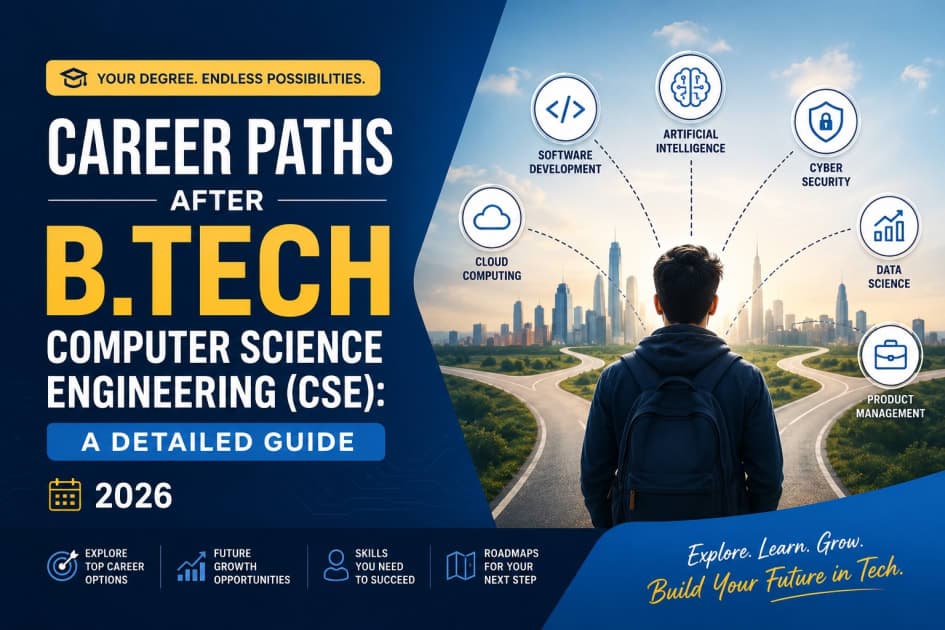
You've just finished four years of coding labs, data structures, DBMS exams, and countless sleepless nights. Now comes the real question: what do you actually do after B.Tech CSE?
It's a question that feels both exciting and overwhelming. The good news? A Computer Science Engineering degree in 2026 is one of the most versatile qualifications in the world. The career paths after B.Tech CSE are broader than ever — from joining a product giant like Google to launching your own AI startup, from cracking GATE to becoming a data scientist at a Fortune 500 company, or even switching to management, law, or civil services.
This guide covers every major career path after B.Tech computer science — with real salary data, required skills, top companies, and actionable roadmaps — so you can make the smartest decision for your future.
Table of Contents
Why a B.Tech CSE Degree Opens So Many Doors
Career Path 1: Software Development & Engineering
Career Path 2: Data Science, AI & Machine Learning
Career Path 3: Cybersecurity
Career Path 4: Cloud Computing & DevOps
Career Path 5: Product Management
Career Path 6: Higher Studies — M.Tech / MS Abroad / MBA
Career Path 7: Government Jobs & PSUs (GATE, UPSC)
Career Path 8: Entrepreneurship & Startups
Career Path 9: Freelancing & Remote Work
Career Path 10: Non-Traditional Careers (Law, Finance, Teaching)
How to Choose the Right Career Path After B.Tech CSE
Salary Comparison: All Career Paths at a Glance
FAQs About Career After B.Tech CSE
Conclusion
1. Why a B.Tech CSE Degree Opens So Many Doors
Before diving into specific career paths after B.Tech CSE, it's worth understanding why this degree carries so much weight in 2026.
The world runs on software. Every industry — banking, healthcare, agriculture, entertainment, defence, education — is digitising at an accelerating pace. This means demand for computer science graduates isn't just confined to IT companies anymore. A CSE graduate today can work at a hospital's tech team, a fintech startup, a government digital mission, a consulting firm, or a media company.
Here's what makes a B.Tech CSE degree so powerful:
Problem-solving foundation: Four years of programming, algorithms, and systems thinking trains your brain to break down complex problems — a skill valued everywhere.
Cross-domain applicability: Whether it's machine learning in healthcare or blockchain in finance, CSE knowledge is horizontally applicable.
High earning potential: CSE consistently ranks among the highest-paying engineering disciplines globally.
Remote work compatibility: Software and data roles are among the most remote-friendly, giving you geographic flexibility.
Strong alumni networks: IITs, NITs, IIITs, and top private universities have strong placement cells and alumni networks spanning global companies.
According to industry data, India alone is expected to need over 1 million technology professionals annually through 2030, making this the right time to enter the field. The challenge isn't finding a job — it's finding the right career path after B.Tech computer science that aligns with your strengths, interests, and long-term goals.
Let's explore each path in depth.
2. Career Path 1: Software Development & Engineering
The most popular career path after B.Tech CSE — and for good reason.
Software development remains the backbone of the tech industry. If you enjoy writing code, building products, and solving logical problems, a software engineering career is a natural fit.
What Do Software Engineers Do?
Software engineers design, develop, test, and maintain software systems. Depending on your specialisation, you could be:
A Frontend Developer building user interfaces using React, Vue, or Angular
A Backend Developer designing APIs and server logic using Node.js, Python, Java, or Go
A Full-Stack Developer handling both ends of the application
A Mobile Developer building iOS (Swift) or Android (Kotlin/Java) apps
An Embedded Systems Engineer working on software for hardware devices
A Systems Programmer working on OS, compilers, or low-level systems
Top Companies Hiring CSE Graduates in 2026
Product Companies (Tier 1): Google, Microsoft, Amazon, Meta, Apple, Flipkart, Swiggy, Zomato, Meesho, PhonePe, Razorpay, CRED
Service Companies: TCS, Infosys, Wipro, HCL, Cognizant, Accenture, Capgemini
MNCs with India offices: JP Morgan, Goldman Sachs (tech), Deutsche Bank, Samsung, Qualcomm, Intel
Typical Salary Ranges (India, 2026)
Role Fresher CTC 3–5 Years Experience Software Engineer (Service) ₹3.5–6 LPA ₹8–15 LPA Software Engineer (Product) ₹12–25 LPA ₹25–50 LPA Full-Stack Developer ₹6–14 LPA ₹18–35 LPA Mobile Developer ₹6–12 LPA ₹15–30 LPA
US/International (via FAANG offers): $130,000–$200,000+ base for new graduates at top companies.
Skills You Need
Core: Data structures & algorithms (DSA), OOP, system design, databases (SQL + NoSQL), REST APIs, version control (Git)
Specialisation skills:
Frontend: HTML/CSS, JavaScript, React/Next.js
Backend: Python/Django, Java/Spring Boot, Node.js, PostgreSQL
Mobile: Flutter, React Native, Swift, Kotlin
Roadmap to Become a Software Engineer
Master DSA — practice on LeetCode, Codeforces, HackerRank (aim for 200+ problems)
Build 3–5 real-world projects on GitHub
Learn system design basics (for interviews beyond fresher level)
Prepare for company-specific interview formats (FAANG vs service companies differ widely)
Apply via campus placements, LinkedIn, Naukri, or referrals
Should You Choose This Path?
✅ Best if you: Love coding, want high salaries early, enjoy building products ❌ Avoid if: You dislike sitting at a desk writing code all day or prefer people-facing roles
3. Career Path 2: Data Science, AI & Machine Learning
The hottest career path after B.Tech CSE in 2026.
Artificial intelligence and machine learning have moved from research labs to production systems. Every major company — from BFSI to agriculture — is embedding AI into its core operations. This has created explosive demand for data science and ML engineers.
Roles in This Domain
Data Analyst: Works with structured data, creates dashboards, derives business insights (SQL, Excel, Power BI, Tableau)
Data Scientist: Builds predictive models and ML pipelines (Python, R, Scikit-learn, TensorFlow)
Machine Learning Engineer: Deploys, scales, and optimises ML models in production (MLOps, Docker, Kubernetes)
AI/NLP Engineer: Works on natural language processing, LLMs, generative AI applications
Computer Vision Engineer: Works on image/video recognition, object detection
Research Scientist: Publishes papers, works at the frontier of AI (usually requires a Master's or PhD)
Why This Path Is Booming in 2026
The global AI market is projected to exceed $1 trillion by 2030
India has emerged as a top destination for AI talent, with companies like Google DeepMind, Microsoft Research, and numerous startups setting up AI centres in Bengaluru, Hyderabad, and Pune
Generative AI adoption has created entirely new job categories around prompt engineering, LLM fine-tuning, RAG systems, and AI product development
Salary Ranges (India, 2026)
Role Fresher CTC 3–5 Years Experience Data Analyst ₹4–8 LPA ₹12–20 LPA Data Scientist ₹8–18 LPA ₹20–40 LPA ML Engineer ₹10–22 LPA ₹25–50 LPA AI Research Scientist ₹15–35 LPA ₹40–80 LPA
Core Skills Required
Fundamentals: Linear algebra, calculus, probability & statistics, Python programming
ML libraries: Scikit-learn, TensorFlow, PyTorch, Keras, XGBoost
Data tools: Pandas, NumPy, Matplotlib, Seaborn, SQL
Big Data / MLOps: Spark, Hadoop, Airflow, MLflow, Docker, AWS SageMaker
Generative AI (2026-specific): LangChain, LlamaIndex, RAG pipelines, fine-tuning LLMs, vector databases (Pinecone, Weaviate)
Learning Roadmap
Complete a solid Python + statistics foundation (Coursera, fast.ai, or Andrew Ng's Machine Learning Specialisation)
Work on Kaggle competitions to build practical skills
Build an end-to-end ML project — from data collection to model deployment
Learn MLOps practices (model monitoring, CI/CD for ML)
Publish a project or paper to establish credibility
For LLM/GenAI: study Hugging Face, build RAG applications, contribute to open-source AI projects
Should You Choose This Path?
✅ Best if: You enjoy maths, statistics, and pattern recognition; you love research and experimentation ❌ Avoid if: You dislike math-heavy work or prefer purely engineering/coding tasks without analytical depth
4. Career Path 3: Cybersecurity
One of the fastest-growing and most underrated career paths after B.Tech CSE.
India is among the top targets for cybercrime globally, and organisations are scrambling to hire security professionals. The cybersecurity talent gap is projected to reach 3.5 million globally by 2027 — making this a field where skilled professionals command premium salaries.
Roles in Cybersecurity
Security Analyst: Monitors networks and systems for threats
Penetration Tester / Ethical Hacker: Legally breaches systems to find vulnerabilities
Security Engineer: Builds and maintains secure systems and infrastructure
Incident Responder: Handles security breaches and forensic investigations
Cloud Security Engineer: Secures cloud infrastructure on AWS/Azure/GCP
Reverse Engineer / Malware Analyst: Analyses malicious software
CISO (Chief Information Security Officer): Senior leadership role (8–15 years experience)
Top Employers
CERT-In (Government), DRDO, Indian Army Cyber Command, Wipro Cyber Defence, Tata Consultancy Services Security, IBM Security, PwC India, KPMG, Deloitte, startups like Sequretek, Lucideus (now Safe Security), CloudSEK
Salary Ranges (India, 2026)
Role Fresher CTC 3–5 Years Security Analyst ₹5–10 LPA ₹15–25 LPA Penetration Tester ₹6–12 LPA ₹18–35 LPA Cloud Security Engineer ₹10–18 LPA ₹25–50 LPA
Key Certifications
CEH (Certified Ethical Hacker) — entry level
CompTIA Security+ — foundational
OSCP (Offensive Security Certified Professional) — highly respected for penetration testers
CISSP — for senior/management roles
AWS/Azure Security Specialty — for cloud security
Learning Roadmap
Build a strong foundation in networking (TCP/IP, DNS, HTTP), Linux, and scripting (Python/Bash)
Practice on platforms like TryHackMe, Hack The Box, PicoCTF
Earn CEH or CompTIA Security+ certification
Contribute to bug bounty programs (HackerOne, Bugcrowd) for real-world experience
Aim for OSCP for advanced penetration testing roles
Should You Choose This Path?
✅ Best if: You're curious, love finding loopholes, interested in law/ethics of technology ❌ Avoid if: You're uncomfortable with continuous self-learning or don't enjoy investigative work
5. Career Path 4: Cloud Computing & DevOps
The engine room of modern tech companies — and a career path with explosive demand.
Every company running digital services needs cloud infrastructure. Cloud computing and DevOps engineers are the people who build, automate, and maintain that infrastructure. With cloud adoption still growing rapidly in India, this is one of the most reliable career paths after B.Tech CSE.
Understanding the Roles
Cloud Engineer: Designs and manages cloud infrastructure (AWS, Azure, GCP)
DevOps Engineer: Bridges development and operations — automates CI/CD pipelines, manages deployments
Site Reliability Engineer (SRE): Ensures the reliability and uptime of large-scale systems (hybrid of software engineering and operations)
Platform Engineer: Builds internal developer platforms and tooling
Cloud Architect: Senior role designing entire cloud strategies for organisations
Why Cloud & DevOps in 2026?
India's cloud market is growing at ~25% annually. Companies like HDFC Bank, Reliance, Zomato, and thousands of startups are migrating workloads to the cloud. AWS, Microsoft Azure, and Google Cloud are investing heavily in Indian data centres, creating both direct and indirect employment.
Salary Ranges (India, 2026)
Role Fresher CTC 3–5 Years Cloud Engineer ₹6–12 LPA ₹18–35 LPA DevOps Engineer ₹7–14 LPA ₹20–40 LPA SRE ₹12–22 LPA ₹30–60 LPA
Core Skills
Cloud platforms: AWS (most in demand), Microsoft Azure, Google Cloud Platform
DevOps tools: Docker, Kubernetes, Terraform, Ansible, Jenkins, GitHub Actions, ArgoCD
Programming/Scripting: Python, Bash, Go
Monitoring: Prometheus, Grafana, Datadog, ELK Stack
Certifications That Boost Your Career
AWS Certified Solutions Architect – Associate (most popular)
Google Associate Cloud Engineer
Certified Kubernetes Administrator (CKA)
HashiCorp Terraform Associate
Should You Choose This Path?
✅ Best if: You enjoy infrastructure, automation, and want a high-paying career without deep algorithm focus ❌ Avoid if: You want to build user-facing products or prefer working with data
6. Career Path 5: Product Management
For CSE graduates who love technology but want to lead, strategise, and build products without writing code full-time.
Product managers (PMs) are the people who decide what to build, why, and for whom. A B.Tech CSE background is one of the best foundations for a PM career because you understand how technology works — something many PMs without engineering backgrounds struggle with.
What Does a Product Manager Do?
Define product vision, strategy, and roadmap
Work closely with engineering, design, marketing, and sales teams
Write PRDs (Product Requirement Documents)
Conduct user research, analyse data, prioritise features
Own product metrics (retention, conversion, revenue, NPS)
Career Progression
Entry Level: Associate Product Manager (APM) → Product Manager → Senior PM → Group PM → Director of Product → VP of Product → CPO
Most CSE graduates join as APMs directly or transition from a software engineering role after 1–3 years.
Top Companies with Strong PM Roles
Flipkart, Amazon, Google, Microsoft, Paytm, PhonePe, Swiggy, Zomato, InMobi, Freshworks, Razorpay, BYJU's, Meesho, Ola, and virtually every major tech startup
Salary Ranges (India, 2026)
Role CTC Range APM (Fresher) ₹12–22 LPA Product Manager (2–5 yrs) ₹20–45 LPA Senior PM (5–8 yrs) ₹40–80 LPA Director / VP of Product ₹80 LPA – ₹2 Cr+
Skills Required
Hard skills: Data analysis (SQL, Excel, analytics tools), wireframing (Figma, Balsamiq), understanding of APIs and system design, A/B testing
Soft skills: Communication, prioritisation, stakeholder management, strategic thinking, user empathy
How to Break Into PM as a Fresh CSE Graduate
Apply to structured APM programs (Google APM, Microsoft PM Fellowship, Flipkart GradPM)
Do a PM internship during B.Tech (platforms like ProductHive, AltMBA, Reforge)
Build a PM portfolio: analyze an existing product, write a teardown, propose improvements
Learn frameworks: RICE, AARRR, Jobs To Be Done, Kano model
Transition from SDE → PM after 1–2 years if preferred
Should You Choose This Path?
✅ Best if: You enjoy strategy, leadership, and cross-functional work; you're curious about business impact ❌ Avoid if: You want to stay purely technical or dislike ambiguity and stakeholder management
7. Career Path 6: Higher Studies — M.Tech / MS Abroad / MBA
For those who want to deepen expertise or pivot strategically before entering the workforce.
Higher education remains one of the most powerful career paths after B.Tech CSE — especially for roles in research, academia, advanced engineering, or business leadership.
Option A: M.Tech in India (via GATE)
GATE (Graduate Aptitude Test in Engineering) is the gateway to M.Tech at IITs, NITs, and IIITs — and also to PSU jobs (more on that in the next section).
Duration: 2 years
Top institutes: IIT Bombay, IIT Delhi, IIT Madras, IIT Kanpur, IIT Kharagpur, IISc Bangalore, NIT Trichy
Specialisations: Computer Science, AI/ML, Data Science, Software Systems, Cybersecurity, Human-Computer Interaction
Stipend: ₹12,400/month (MHRD scholarship) at IITs/NITs
Post M.Tech salary: ₹15–40 LPA at product companies; entry into research/academia
GATE Score is also used by top PSUs like BHEL, ONGC, NTPC, Power Grid for recruitment at ₹9–12 LPA CTC.
Option B: MS / PhD Abroad
Studying abroad — particularly in the USA, Canada, Germany, Australia, or UK — gives you access to world-class research, diverse exposure, and global job markets.
Top destinations and universities:
USA: MIT, Stanford, Carnegie Mellon, UC Berkeley, Cornell, UIUC, Georgia Tech, UT Austin
Canada: University of Toronto, UBC, McGill, University of Waterloo
Germany: TU Munich, RWTH Aachen (often free or low-cost tuition)
UK: Imperial College London, University of Edinburgh, UCL
Australia: University of Melbourne, Australian National University
Typical Costs & Funding:
USA MS: $30,000–$60,000/year (many students get TAships/RAships that cover tuition + stipend)
Germany: Often free with a ~€10,000/year living cost
Scholarships: Fulbright, DAAD, Commonwealth, Inlaks, Tata
Average US MS CS grad starting salary (2026): $120,000–$160,000 base at tech companies; higher at FAANG.
Key Exams:
GRE: Required by most US universities (though some are GRE-optional in 2026)
TOEFL / IELTS: English proficiency tests
GMAT: For MS in Management or MBA programs
Application Timeline:
Start 12–18 months before your target intake
Build a strong SOP (Statement of Purpose), LORs (Letters of Recommendation), and research profile
Option C: MBA
An MBA is a pivot path that takes CSE graduates into business leadership, consulting, investment banking, or product/strategy roles. A B.Tech CSE background + MBA is an extremely powerful combination.
Top MBA destinations in India: IIM Ahmedabad, IIM Bangalore, IIM Calcutta, IIM Lucknow, ISB Hyderabad
Top global MBA programs: Harvard, Wharton, Stanford GSB, INSEAD, London Business School
Entrance exams: CAT (for IIMs), GMAT (for international programs)
Post-MBA salary:
IIM A/B/C average: ₹25–35 LPA (fresher)
Top international MBA: $150,000–$200,000 starting salary
Ideal for: CSE graduates who want to move into product leadership, management consulting, entrepreneurship, or finance
Should You Choose Higher Studies?
✅ Best if: You want to go deeper technically, enter research/academia, access global job markets, or pivot to business leadership ❌ Avoid if: You want to start earning immediately, have a strong startup idea, or don't want to invest 2+ years in education
8. Career Path 7: Government Jobs & PSUs (GATE, UPSC, SSC)
Stability, prestige, and long-term security — a career path many CSE graduates underestimate.
India's government sector actively recruits CSE engineers — and the opportunities are far more exciting and well-paying than most people assume.
Route 1: PSUs via GATE
Public Sector Undertakings (PSUs) like BHEL, ONGC, NTPC, Power Grid, SAIL, Coal India, and BSNL hire engineers through GATE scores.
Benefits of PSU jobs:
Starting CTC: ₹9–14 LPA (including HRA, DA, perks, and allowances)
Job security, no layoffs
Government housing, medical, pension (in some PSUs)
Prestige and social security
How to apply: Crack GATE with a high score → Apply to PSU notifications → Written test + interview
Route 2: UPSC Civil Services
Every year, a significant number of B.Tech CSE graduates crack UPSC and join the IAS, IPS, IFS, or other central services. CSE graduates often perform well in UPSC because of strong analytical thinking and problem-solving skills.
Preparation time: 1–2 years serious preparation
Optional subject: Computer Science & IT (a popular optional for CSE graduates)
Starting salary: IAS/IPS at approx. ₹56,100/month + DA + perks (effective package ₹10–15 LPA equivalent; grows significantly over career)
Non-monetary benefits: Enormous — housing, vehicle, staff, authority
Route 3: UPSC ESE (Engineering Services Examination)
The Engineering Services Exam is for those who want to be gazetted government engineers.
Posts: Assistant Executive Engineer in Central services (Railways, CPWD, Border Roads, CWC, etc.)
Exam: Prelims + Mains + Personality Test
Salary: Grade Pay 4800 (Level 10) — approx. ₹8–12 LPA equivalent
Route 4: SSC JE, RRB JE, and State Government Jobs
State-level exams, ISRO (Scientist/Engineer), DRDO, BARC, and NIC (National Informatics Centre) all have openings specifically for CSE graduates.
NIC (National Informatics Centre): Particularly popular among CSE graduates; works on India's digital government infrastructure including government portals, eGovernance systems.
DRDO (Defence Research & Development Organisation): For those interested in defence technology; offers Scientist-B positions via RAC exam.
ISRO: Technically demanding; recruits through ISRO Centralised Recruitment Board (ICRB).
Should You Choose Government Jobs?
✅ Best if: You value stability, want work-life balance, have family responsibilities, or want to serve the nation through technology policy ❌ Avoid if: You're driven by high private-sector salaries in early career, or want fast-paced startup environments
9. Career Path 8: Entrepreneurship & Startups
The boldest and potentially most rewarding career path after B.Tech CSE.
India is now the third-largest startup ecosystem in the world, with over 100 unicorns and thousands of funded startups. A B.Tech CSE degree gives you the technical foundation to build tech products from scratch — making entrepreneurship an increasingly viable and well-supported path.
Why Now Is a Great Time to Start Up
India has a massive digital consumer base of 800 million+ internet users
Government schemes like Startup India, DPIIT recognition, and tax exemptions support early-stage startups
Angel networks, VC firms (Sequoia, Accel, Peak XV, Blume, Matrix), and incubators (IIT incubators, NASSCOM 10,000 Startups) actively fund student founders
Global remote markets mean an Indian startup can serve global customers from Day 1
What Kinds of Startups Can a CSE Graduate Build?
SaaS (Software-as-a-Service): B2B productivity tools, vertical SaaS for specific industries
EdTech: Learning platforms, coding education, upskilling tools
FinTech: Digital payments, lending, insurance technology, investment tools
HealthTech: Telemedicine, diagnostics AI, hospital management systems
AgriTech: Precision farming, supply chain optimization, crop prediction
AI/ML products: Applying AI to solve domain-specific problems
Open Source / Developer Tools: Building tools for other developers
Realistic Pathways to Entrepreneurship After B.Tech
Path A (Immediate founder): Build during college → Apply to accelerators like Y Combinator, Antler India, 100X.VC, IAN → Raise pre-seed funding
Path B (Work first): Join a startup for 2–3 years → Learn product, operations, and market dynamics → Start your own venture with savings and domain expertise
Path C (Tech co-founder): Partner with a non-technical co-founder who handles business development while you build the product
Support Ecosystems for Student Entrepreneurs
IIT/NIT Incubators: Most top engineering colleges have Technology Business Incubators (TBIs)
NASSCOM 10,000 Startups: Free tools, mentorship, and visibility
iCreate (International Centre for Entrepreneurship and Technology): Government-backed
Atal Innovation Mission: NITI Aayog's platform for student innovators
Risk vs Reward
Entrepreneurship is high-risk and requires resilience. Studies show that most startups fail within 3 years — but the learning, network, and experience you gain are invaluable even if the venture doesn't succeed. Many serial founders succeed on their second or third attempt.
Should You Choose This Path?
✅ Best if: You have a specific problem you want to solve, high risk tolerance, and an entrepreneurial mindset ❌ Avoid if: You need financial stability immediately, or haven't yet identified a specific problem worth solving
10. Career Path 9: Freelancing & Remote Work
Build your own schedule, work from anywhere, and earn in foreign currency — all possible for CSE graduates.
The global remote work boom has opened enormous opportunities for Indian CSE graduates to earn international rates from the comfort of their homes. Freelancing and remote work are not just side hustles anymore — thousands of CSE graduates are building full-time careers this way.
Freelancing Platforms & Opportunities
Global platforms:
Upwork: Best for software development, data science, and web development projects
Toptal: Elite talent marketplace — harder to get in, but premium rates ($60–$200/hour)
Fiverr: Good for structured digital services (website development, automation scripts)
Freelancer.com: Wide variety of tech projects
99designs / Designhill: For those with UI/UX design skills
India-focused:
Truelancer, Pepper Content (for tech writing), Turing (connects developers to US startups at international rates)
What Services Are in High Demand?
Full-stack web development (React + Node.js / Django)
Mobile app development (Flutter, React Native)
AI/ML model development and data analysis
WordPress / Shopify development and customisation
API development and integration
Cybersecurity audits and penetration testing
Technical writing and documentation
No-code/low-code solutions (Webflow, Bubble, Zapier)
Earning Potential
Skill Typical Hourly Rate (USD) Junior Web Developer $15–$30/hour Experienced Full-Stack Dev $40–$100/hour ML Engineer $50–$150/hour Cybersecurity Specialist $60–$150/hour UI/UX Designer (with CSE skills) $30–$80/hour
A mid-level developer earning $50/hour working 160 hours/month earns $8,000/month (~₹6–7 LPA per month) — significantly more than most Indian fresher salaries.
Remote Jobs with Indian Companies & Global Startups
Beyond freelancing, many startups and global companies now hire full-time remote employees in India. Platforms like:
LinkedIn (Remote filter)
AngelList / Wellfound (Startups)
Remote.co, We Work Remotely, Remote OK
Turing.com (Vets Indian developers for US company placements)
Should You Choose This Path?
✅ Best if: You value flexibility, want to earn in USD, have a specific in-demand skill, and are self-disciplined ❌ Avoid if: You need structure, mentorship, or prefer team environments and career ladders
11. Career Path 10: Non-Traditional Careers
B.Tech CSE doesn't lock you into pure tech — the degree opens surprising doors in law, finance, consulting, and education.
A. Technology Law & Legal Tech
The intersection of law and technology is one of the fastest-growing fields globally. Cybercrime law, intellectual property, data privacy (GDPR, India's Digital Personal Data Protection Act 2023), and contract law for software are all areas where CSE backgrounds are extremely valuable.
How to pursue: Enroll in LLB (3-year after graduation) or integrated LLM programs. Many CSE-turned-lawyers work at top law firms specialising in tech law, policy research bodies, or companies as legal tech officers.
B. Investment Banking & Quantitative Finance
Wall Street and Indian investment banks actively recruit CSE graduates for quantitative roles.
Quantitative Analyst (Quant): Uses mathematical models and programming to price derivatives, manage risk, and build trading algorithms
Algorithmic Trader: Builds trading systems
FinTech Engineer: Builds financial products at the intersection of software and finance
Top recruiters: Goldman Sachs, Morgan Stanley, Deutsche Bank, Citadel, Two Sigma, Jane Street (via US MS/MBA routes), Edelweiss, Kotak Securities (India)
Relevant exams/credentials: CFA (Chartered Financial Analyst), FRM, CQF
C. Management Consulting
Firms like McKinsey, BCG, Bain (MBB), and Tier-2 firms like Deloitte and EY-Parthenon actively recruit engineers — especially for technology consulting and digital transformation practices.
CSE graduates can enter as Business Analysts post B.Tech
Post-MBA entry as Associates with significantly higher salaries
Starting salary (BA at Deloitte/KPMG): ₹10–18 LPA Post-MBA at MBB: ₹30–50 LPA
D. Teaching & EdTech Content Creation
If you're passionate about education, a CSE graduate can make a significant impact:
College professor / Lecturer: With M.Tech/PhD, you can join academia at IITs, NITs, or private universities (Assistant Professor salaries at IITs: ₹14–18 LPA + perks)
EdTech content creator: Platforms like Unacademy, Physics Wallah, Coding Ninjas, and GeeksforGeeks pay well for quality instructors
YouTube / Online teaching: Several CSE educators earn ₹5–50 LPA+ from course sales, sponsorships, and platforms
E. UX/UI Design
CSE graduates with an eye for design can transition into UX/UI — combining their technical understanding with design principles.
UX Designer: Conducts user research, creates wireframes and prototypes
UX Engineer: Bridges design and engineering (highly valued)
Tools: Figma, Adobe XD, Principle
Certifications: Google UX Design Certificate (Coursera), Interaction Design Foundation
Salary: ₹6–20 LPA (India), higher at product companies
12. How to Choose the Right Career Path After B.Tech CSE
With so many options, how do you decide? Here's a structured framework to help you choose the right career path after B.Tech computer science:
Step 1: Self-Assessment
Ask yourself honestly:
Question Your Answer → Career Hint Do I love writing code? Software Engineering, Freelancing Am I interested in maths/statistics? Data Science, Quant Finance Do I enjoy finding loopholes & hacking? Cybersecurity Do I want to lead teams and products? Product Management, MBA Do I value stability over high salaries? Government Jobs, PSUs Do I have an idea I can't stop thinking about? Entrepreneurship Do I want to go abroad? MS/MBA abroad Do I want flexibility & independence? Freelancing, Remote work
Step 2: Research Market Demand
Not all paths are equally in demand at all times. In 2026:
High demand: AI/ML Engineers, Cloud/DevOps Engineers, Cybersecurity Professionals, Full-Stack Developers
Steady demand: Software Engineers, Data Analysts, Product Managers
Evergreen: Government jobs, teaching/academia
Step 3: Consider Your Timeline
Timeline Recommended Path Immediate income (< 6 months) Campus placement, freelancing Medium term (1–2 years investment) GATE, M.Tech, certifications Long term (2+ years) MS abroad, MBA, PhD, UPSC
Step 4: Talk to People in Those Roles
Informational interviews are underused in India. Reach out to seniors, alumni, and professionals on LinkedIn. Ask about their day-to-day work, what they enjoy, what they wish they'd known, and whether they recommend the path.
Step 5: Start, Experiment, Iterate
You don't have to make a lifelong decision at 22. Many successful professionals have changed careers 2–3 times. Make an informed decision today, execute it well, and adjust as you learn more about yourself and the market.
13. Salary Comparison: All Career Paths After B.Tech CSE at a Glance
Career Path Fresher Salary (India) 5-Year Salary International Potential Software Engineer (Product) ₹12–25 LPA ₹30–60 LPA $150K–$250K (US) Software Engineer (Service) ₹3.5–6 LPA ₹10–20 LPA $80K–$140K (US) Data Scientist / ML Engineer ₹8–20 LPA ₹25–60 LPA $130K–$200K (US) Cybersecurity Engineer ₹6–12 LPA ₹20–40 LPA $100K–$180K (US) Cloud / DevOps Engineer ₹7–15 LPA ₹22–50 LPA $110K–$180K (US) Product Manager ₹12–22 LPA ₹30–80 LPA $130K–$220K (US) MS Abroad → Tech Job $120K–$160K base (US) $160K–$250K High MBA (IIM A/B/C) ₹25–35 LPA ₹40–80 LPA Varies Government / PSU ₹9–14 LPA ₹15–25 LPA (with promotions) N/A Entrepreneurship Variable (often ₹0–5 LPA initially) Potentially unlimited Global Freelancing (Mid-level) ₹6–15 LPA ₹20–60 LPA ~$8K–$20K/month
Note: Figures are indicative based on 2026 industry data. Actual salaries vary significantly based on college tier, skills, company, location, and negotiation.
14. FAQs About Career After B.Tech CSE
Q1. Which is the best career option after B.Tech CSE in India?
There's no single "best" career — it depends entirely on your interests, strengths, and goals. However, if you're optimising for earning potential in 2026, roles in AI/ML engineering, cloud computing, and software development at product companies offer the highest starting salaries. If you prioritise stability, government jobs via GATE or UPSC are excellent. If you value independence, freelancing or entrepreneurship can be incredibly rewarding.
Q2. Can I switch from a service company (TCS/Infosys) to a product company later?
Absolutely. Thousands of engineers make this switch every year. The key is to upskill aggressively — strengthen your DSA and problem-solving for interviews, build side projects, and apply systematically. The transition typically takes 6–18 months of focused preparation.
Q3. Is an MS in the USA worth it for CSE graduates in 2026?
For most students, yes — if you can get into a Tier-1 school (CMU, UIUC, Georgia Tech, UT Austin, etc.) and land a US job post-graduation. The ROI is strong: the cost of an MS (often $80,000–$150,000 total) can be recovered in 2–3 years given US salaries. However, the OPT/H-1B uncertainty means you should have a contingency plan.
Q4. What is the highest-paying career after B.Tech CSE?
Quantitative finance roles (at hedge funds like Two Sigma or Jane Street), AI research scientists at top labs, and Staff/Principal Engineers at FAANG companies are among the highest-paid roles globally — often exceeding $300,000–$500,000 total compensation with experience. In India, ML engineers at top startups and MNC product teams are among the highest earners.
Q5. Should I do an MBA after B.Tech CSE?
An MBA makes sense if you want to move into business leadership, product strategy, consulting, or entrepreneurship — and you're clear on that goal. Do it at a top-tier institution (IIM A/B/C or equivalent globally) for maximum ROI. An MBA purely for a salary bump without a strategic reason is generally not advisable.
Q6. Which government job is best for B.Tech CSE graduates?
GATE → IIT/IISc M.Tech is the most prestigious academic route. For jobs: NIC (National Informatics Centre), ISRO Scientist-B, DRDO SET exam, and PSU roles via GATE are the most technically relevant and well-compensating government roles for CSE graduates.
Q7. Can I become a data scientist directly after B.Tech CSE?
Yes — many companies hire fresh B.Tech CSE graduates as junior data scientists or data analysts. However, you'll need strong Python, SQL, and statistics skills, plus practical projects (Kaggle, GitHub) to stand out. Many candidates also supplement with a 3–6 month certification course (Coursera, edX, fast.ai) to build domain-specific skills.
Q8. How important is the college tier for placement after B.Tech CSE?
Tier matters for initial placement — IIT/NIT graduates get access to on-campus placements from top companies that don't visit lower-tier colleges. However, tier matters less over time. With strong skills, a good GitHub profile, LeetCode practice, and persistence, graduates from any college can crack top companies. Many engineers at Google, Microsoft, and startups are from Tier-2/3 colleges.
Q9. What certifications are most valuable after B.Tech CSE?
It depends on your path:
Cloud: AWS Solutions Architect, Google Cloud, Azure
Security: CEH, OSCP, CISSP
Data/AI: TensorFlow Developer, AWS ML Specialty
PM: Product School, General Assembly, Stanford online PM courses
DevOps: CKA, Terraform Associate
No certification replaces practical skills — but certifications validate your knowledge and stand out on resumes.
Q10. Is entrepreneurship a viable path straight after B.Tech?
Yes — many successful founders started their ventures during or immediately after college (Zomato, Freshworks, ShareChat, and dozens of others). The key is having a specific problem to solve, a co-founder with complementary skills, and the resilience to handle rejection. If you have a genuine idea, apply to accelerators (Y Combinator, Antler, 100X.VC) — the structured support dramatically increases your chances.
15. Conclusion: Your Career After B.Tech CSE Starts With One Decision
The most important insight from this guide is this: the career paths after B.Tech CSE have never been broader, better-paying, or more exciting than they are in 2026.
Whether you want to become a software engineer at a product giant, build AI systems that change industries, secure critical infrastructure as a cybersecurity expert, lead products as a PM, ace GATE and pursue academic excellence, build the next unicorn, or serve the nation through civil services — your B.Tech CSE degree gives you the foundation for all of it.
Here's what to do right now:
Reflect on what genuinely excites you — not just what pays the most
Research 2–3 paths from this guide that resonated with you
Talk to people already on those paths (LinkedIn is free, and most people are happy to share)
Start one concrete action today — whether it's solving your first LeetCode problem, signing up for an AWS free tier account, registering for GATE coaching, or writing your first freelance proposal
Your career doesn't have to be perfect from Day 1. It has to start. Make that first move, stay curious, keep building, and the right path will reveal itself.
This guide is updated for 2026 with the latest salary data, in-demand skills, and career trends for B.Tech CSE graduates in India and globally.