
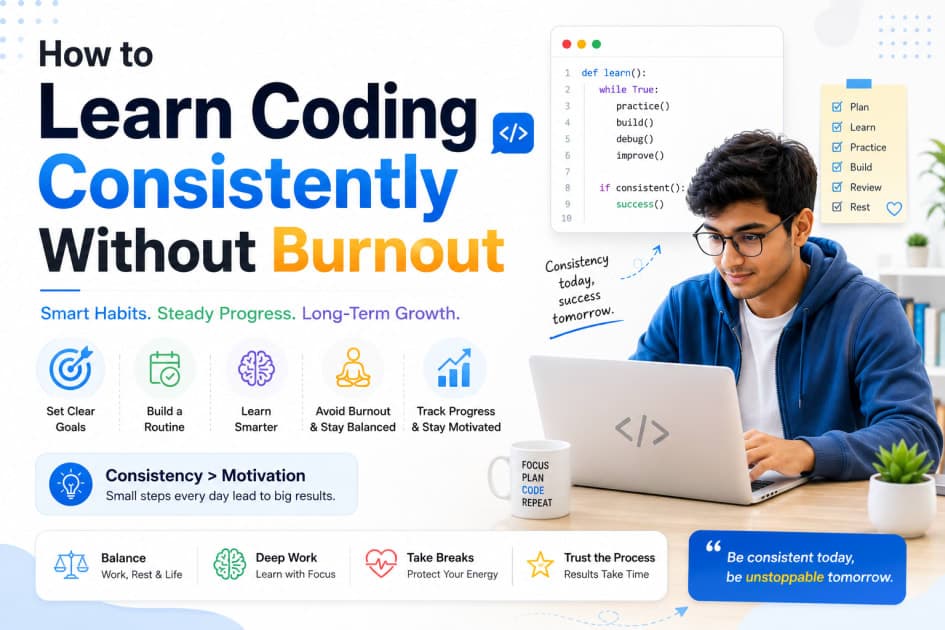
You started with the best intentions — a YouTube playlist, a LeetCode account, maybe a Udemy course on sale for ₹499. Two weeks in, you've missed three days, the guilt piled up, and suddenly the IDE feels like a punishment. Sound familiar? Coding burnout doesn't hit because you're lazy. It hits because nobody teaches students how to learn coding sustainably — only what to learn.
This guide is about fixing that. Here's exactly how to learn coding consistently without burnout — with a schedule that holds, habits that compound, and a mindset that treats setbacks as data instead of failure.
Why Most Students Burn Out While Learning to Code
Burnout isn't a motivation problem. It's a system problem.
Most students approach coding like a sprint — binge-study for 6 hours on Saturday, do nothing for four days, then binge again and wonder why nothing sticks. That pattern isn't sustainable and it isn't effective.
Here's what actually causes coding burnout:
No clear goal: "Learn coding" is not a goal. "Build a working expense tracker in Python by March" is.
Comparing to the wrong people: Watching someone on Twitter post about solving 500 LeetCode problems while you're still on arrays is a motivation killer.
Learning without building: Watching tutorials for weeks without writing a single original line of code creates a false sense of progress — and then a brutal crash when nothing sticks.
Ignoring rest: Students who code 5–6 hours daily for a week almost always vanish for 2–3 weeks after. The math never works out.
Environment friction: An uncomfortable chair, a noisy room, constant phone notifications — these don't cause burnout directly, but they drain the willpower you need to sit down and start.
The fix isn't willpower. It's design.
Step 1: Set a Goal That Actually Drives You
Vague goals produce vague effort. The first thing to fix when learning to code consistently is knowing exactly why you're doing it.
Ask yourself one question: What does "success" look like in 90 days?
Not "be a good programmer." Something specific:
"Get a shortlist call from Internshala in 90 days"
"Build and deploy a portfolio website by the end of this month"
"Solve 60 LeetCode Easy problems before placement season starts"
Your daily consistency will never outrun the clarity of your goal. If the goal is fuzzy, the first bad day becomes an excuse to quit.
Turn Your Goal into a Weekly Target
90-Day Goal | Weekly Milestone | Daily Minimum |
|---|---|---|
Solve 60 LeetCode Easy problems | 5 problems/week | 1 problem/day |
Build a full-stack project | 1 feature per week | 45 min coding/day |
Complete NPTEL Python course | 1 module/week | 1 lecture + 1 exercise/day |
Learn DSA basics (arrays → trees) | 1 topic/week | 30 min study + practice |
Key Tip: Nail the daily minimum every single day — even when motivation is zero. The minimum exists for hard days. On good days, you'll naturally do more.
Step 2: Build a Coding Schedule That Fits Your Real Life
The most common mistake? Building a "perfect" schedule that only works when everything goes right. Real schedules bend — they don't break.
Here's what a sustainable coding schedule looks like for an Indian college student:
The 3-Tier Daily Structure
Tier 1 — Non-Negotiable Block (30–45 min) This happens every day, no exceptions. No internet, phone on DND, one focused task. Even if your college had 6 hours of lectures and you're exhausted, this block still runs — scaled down to 20 minutes if needed. Don't skip; shrink.
Tier 2 — Growth Block (60–90 min) This is your main session — where you actually learn something new, build a feature, or work through a tutorial. This block runs on days when you have energy and time. Target 4–5 days a week.
Tier 3 — Review Block (20–30 min, weekends) Look back at what you built or solved that week. Fix bugs, re-read confusing code, or redo one problem you got wrong. This block does more for retention than three extra hours of new content.
Sample Weekly Schedule for a 2nd or 3rd Year Student
Day | Non-Negotiable | Growth Block | Notes |
|---|---|---|---|
Monday | 1 LeetCode Easy | 60 min — new concept | After college |
Tuesday | Revise yesterday's concept | 60 min — practice problems | — |
Wednesday | 1 LeetCode Easy | 45 min — mini project work | Can merge with free period |
Thursday | Revise + commit to GitHub | 60 min — tutorial or docs | — |
Friday | 1 LeetCode Easy | 30 min — lighter day | Pre-weekend reset |
Saturday | Full project session | 90–120 min | Most productive day |
Sunday | Review + plan next week | 30 min | Prep, not grind |
Pro Tip: Schedule your coding block at the same time every day — right after a fixed event like dinner, or immediately after college. Habit science calls this "temptation stacking." Your brain stops debating whether to start; it just does.
Step 3: Fix the "Tutorial Hell" Trap Before It Burns You Out
Tutorial hell is the single biggest reason students feel busy but make zero progress — and eventually quit.
You know you're in tutorial hell when: you've watched 40 hours of courses, can explain what REST APIs are, but have never actually built one yourself.
How to Break Out
Stop watching. Start building. Immediately.
The formula that works:
Watch 20 minutes of a concept explanation (not a full course — just enough to understand the idea)
Close the video and try to implement it from memory
Get stuck — this is supposed to happen
Google the specific error, not "how to do X" (that takes you back to tutorials)
Commit whatever you built — even if it's broken — to GitHub
This single cycle teaches more than three hours of passive watching. And when you build something — even something ugly — you get a dopamine hit that passive watching never gives you.
Pro Tip: Give yourself a "tutorial budget" — maximum 30 minutes of watching per day. Everything else has to be writing actual code.
Step 4: Handle Burnout Before It Becomes a Break
Here's the uncomfortable truth: burnout doesn't announce itself. It starts as "I'll just skip today" and ends as a three-week gap.
Catch it early with this three-signal check:
Signal 1 — Dread before starting: If opening VS Code feels heavier than usual for more than two days in a row, your brain is asking for rest.
Signal 2 — Diminishing returns: You're putting in the hours but nothing is sticking. New concepts slide off. Old concepts feel rusty. That's fatigue, not stupidity.
Signal 3 — Comparison spiral: You've spent 20 minutes scrolling LinkedIn reading about other people's internships instead of working. That's avoidance dressed as inspiration.
What to Do When You Feel Burnout Coming
Don't take a full break. That's the worst thing you can do — because the longer the break, the harder the restart.
Instead, switch modes:
If you're burned out on… | Switch to… |
|---|---|
LeetCode grind | Build something fun — a mini game, a meme generator, anything |
Tutorial courses | Read documentation instead — it uses a different part of your brain |
Backend logic | Work on CSS/UI — more visual, less mentally heavy |
Solo coding | Join a hackathon or pair with a friend on velonx.in/events |
Heavy projects | Solve 3 easy problems just to feel movement |
The goal is to keep the streak alive — even in maintenance mode.
Step 5: Use the Right Platforms — Not All of Them
One major source of burnout is platform overload. Students sign up for LeetCode, GeeksforGeeks, HackerRank, Codeforces, a Coursera course, two YouTube channels, and a Discord server — all in the same week. Then they feel behind on all of them simultaneously.
Pick one platform per goal. Stick to it for at least 30 days before adding another.
Platform Map for Consistent Learning
Goal | Primary Platform | Why |
|---|---|---|
DSA practice | Best problem quality + company tags | |
Concept theory (CS fundamentals) | GeeksforGeeks | Thorough, India-focused content |
Structured learning (free, credited) | NPTEL | Excellent for OS, DBMS, algorithms |
Competitive coding | CodeChef / Codeforces | When you're ready for contests |
Placement aptitude | IndiaBix / PrepInsta | India-specific mock tests |
Project inspiration | Real student projects + mentor feedback |
Key Tip: You don't need all of these right now. For most students in Year 1–2, LeetCode + GeeksforGeeks + one structured course is more than enough to build momentum without overwhelm.
Step 6: Build Accountability That Doesn't Let You Ghost Yourself
Willpower runs out. Accountability doesn't.
The students who learn to code consistently without burning out aren't more disciplined than everyone else. They've just built systems that make quitting harder than continuing.
Accountability Moves That Actually Work
1. Public commitment — even small ones. Post on LinkedIn: "I'm going to solve 20 LeetCode Easy problems in 20 days — here's Day 1." That one post creates enough social pressure to show up for at least a week. And a week of showing up often becomes a month.
2. A coding buddy with a shared goal. Find one person — a classmate, a college junior, someone from velonx.in/community — who's at a similar level. Share your daily minimum with them every evening. Even a WhatsApp message: "Done ✅ / Skipped ❌" works.
3. The GitHub streak. Make one commit every day — no matter how small. A README update. A comment added. One function refactored. The green squares on your GitHub profile are more motivating than any productivity app. Recruiters look at them. That makes it real.
4. A mentor check-in. If you're serious about a specific goal (placement, internship, specific tech track), a monthly 30-minute call with someone who's been there changes everything. Connect with working professionals through velonx.in/mentors — honest feedback from a senior beats a month of solo grinding.
Pro Tip: Don't track "hours coded." Track "tasks completed." Hours can be faked with a tab open and a distracted brain. Tasks can't.
Step 7: Protect Your Focus Like Your CGPA Depends on It
The reason you can't sit for 45 uninterrupted minutes isn't attention span — it's environment. Your phone is designed by billion-dollar companies to pull your focus away. You're not going to out-willpower it.
The Setup That Protects Focus
Phone in another room during your Non-Negotiable block — not face-down on the desk
One browser tab open while coding — just your IDE and the one docs page you need
Headphones on — even if you're not playing music; it signals "I'm unavailable"
Use Forest, Cold Turkey, or DF YouTube to block distractions during your session
Tell your roommates / family what your coding window is — one conversation saves weeks of interrupted sessions
The best debugger for burnout is not a new technique or a better playlist. It's protecting the 45 minutes you already have.
Frequently Asked Questions About Learning Coding Consistently Without Burnout
How many hours a day should a student code to avoid burnout?
For sustainable progress, 1–2 focused hours per day beats 6-hour marathon sessions. Research on deliberate practice shows that 90 minutes of high-focus work produces better learning outcomes than 4 hours of distracted studying. Consistency over intensity — always.
Is it normal to feel like you're not making progress even when you're coding every day?
Yes — and it's called the "plateau effect." Learning curves in coding are not smooth. You'll have flat weeks where nothing feels new, followed by days where everything suddenly clicks. The fix is to keep logging completions (problems solved, features built, commits pushed) rather than tracking how you "feel." Progress is often invisible until it's obvious.
What should I do when I miss a day or fall off my coding schedule?
Miss one day, not two. That's the rule. One missed day is a rest. Two missed days is the start of a pattern. When you miss a day, don't try to "make up" the hours — that's how binge cycles start. Just show up the next day with your smallest possible minimum and rebuild from there.
How do I stay motivated to learn coding when placements feel far away?
Don't rely on placement pressure as your only fuel — that's a recipe for panic-studying in Year 4. Instead, tie your daily coding to something visible: a project taking shape on GitHub, a streak of solved problems, a skill that lets you build something you actually use. Intrinsic motivation outlasts deadline pressure by months.
Is it okay to take weekends off from coding?
Partial rest, yes. Full blackout, risky. Weekends are ideal for your review block and lighter project work — not a grind, but not a complete stop either. Think of it as maintenance mode: one hour on Saturday and one on Sunday keeps the habit warm without exhausting you.
Which is better — solving LeetCode problems or building projects to stay consistent?
Both — but at different stages. In Year 1, short LeetCode sessions give you daily wins and build the streak. From Year 2 onwards, projects give you the deeper motivation because you're building something real. Alternate: grind DSA for 3–4 weeks, then spend 2 weeks purely on a project. This cycle prevents boredom and covers both the skills employers care about.
Conclusion: Consistency Is a System, Not a Personality Trait
Here's the bottom line: the students who learn to code consistently without burning out aren't the most talented or the most motivated — they're the ones who built a system and defended it.
Start with what you can control today:
Set your 90-day goal right now — write it down in a note, a doc, anywhere that makes it real
Block your 30-minute Non-Negotiable slot in your calendar — same time tomorrow, no exceptions
Create or clean up your GitHub and make one commit today, however small
Pick one platform — LeetCode or GeeksforGeeks — and close every other tab
Find one accountability partner in velonx.in/community or your own batch and share your daily goal tonight
Book a 30-minute call with a mentor at velonx.in/mentors if you're stuck on what to learn — direction saves months of wasted effort
Every skipped day is not a failure. It's a signal. Figure out what made you skip — environment, overload, the wrong goal — and fix that one thing. That's the debugging mindset applied to your own learning.
Code a little. Build something. Rest deliberately. Repeat.