
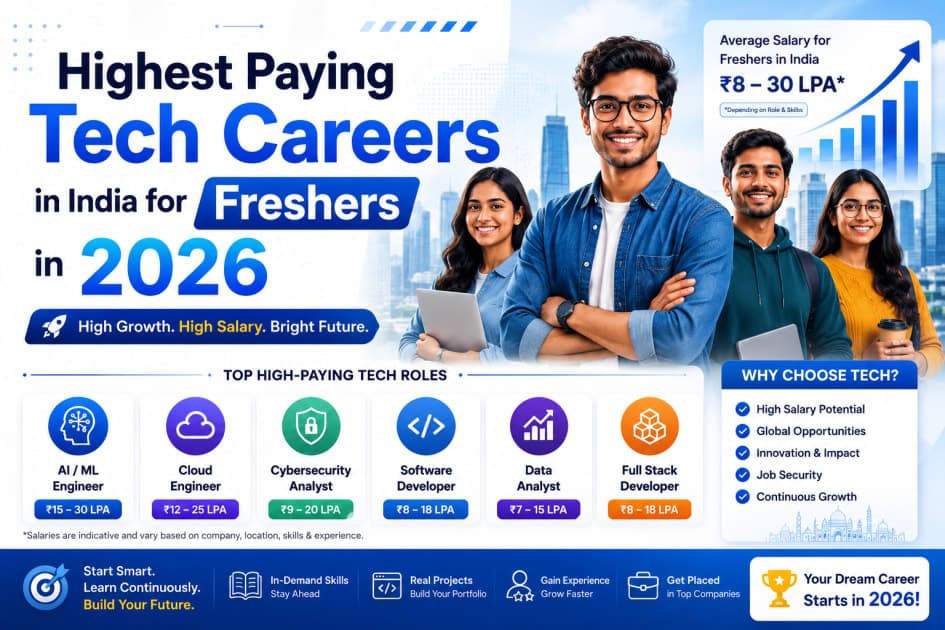
The average fresher salary in India right now is ₹3.5–4.5 LPA. But a small group of freshers — no smarter, no luckier, just better prepared — are walking out of campus with ₹12, ₹15, even ₹20 LPA offers. The gap isn't talent. It's career choice made 2–3 years too late. Picking the right role early — and preparing for it specifically — is the single highest-leverage decision you'll make in college.
This is your updated guide to the highest paying tech careers in India for freshers in 2026 — with salary figures drawn from current market data, the skills each role actually demands, and exactly what to start doing now.
What the 2026 Market Tells Us About Fresher Salaries
The Indian tech job market in 2026 looks nothing like it did five years ago. Here's what's shifted and why it matters for you:
AI has split the market in two. Freshers with AI/GenAI skills are commanding salaries 30–50% higher than peers with traditional software skills, and companies are openly advertising this premium in job postings.
The service vs product gap is wider than ever. Mass-hire IT services companies (TCS, Infosys, Wipro) are paying ₹3.5–6 LPA. Product companies and well-funded startups are paying ₹8–20 LPA for the same job title — "software engineer."
Skills beat marks — officially. According to LinkedIn India data, employers at product companies now filter candidates on GitHub portfolios, internship experience, and coding assessment scores ahead of CGPA. Tier-2 and tier-3 college students with strong projects are breaking into top companies consistently.
The Bangalore premium is real. Freshers joining product companies in Bengaluru are starting at ₹8–15 LPA. The same role in Hyderabad and Pune pays ₹6–12 LPA. Chennai GCC offices are pushing toward ₹8–12 LPA.
Salaries for freshers in India in 2026 vary from ₹3.5 LPA for generic IT roles to over ₹40 LPA for AI/ML roles at leading product companies — and that gap is getting bigger each quarter. Your career path decision matters more in 2026 than it ever did before.
1. Agentic AI Developer — ₹8–20 LPA (The 2026 Breakout Role)
This is the highest-growth, most-underserved fresher role in India right now — and most students haven't even heard of it.
An agentic AI developer builds AI systems that don't just respond to prompts but autonomously plan, reason, and take multi-step actions using tools like web search, code execution, and API calls. Think AI systems that can book a meeting, research a topic, and draft an email — all without human hand-holding at each step.
LinkedIn India data shows that job postings requiring LangChain, CrewAI, or "AI agent" skills grew by over 300% between January 2025 and March 2026. NASSCOM projects that India will need over 50,000 specialised agentic AI professionals by 2027 — and the supply of trained talent today is a fraction of that.
Skills You Need to Land This Role
Skill Area | What to Learn |
|---|---|
Core language | Python — non-negotiable |
LLM foundations | OpenAI API, Hugging Face, prompt engineering |
Agent frameworks | LangChain, LangGraph, CrewAI |
RAG pipelines | Vector databases (Pinecone, ChromaDB), embeddings |
Deployment | FastAPI or Flask, Docker basics, cloud (AWS/GCP) |
Bonus | Fine-tuning open-source LLMs, MLOps basics |
What the Salary Data Says for 2026
For freshers with strong portfolio projects in GenAI, starting salaries at product companies and startups frequently range from ₹8–15 LPA, while candidates without real project exposure start nearer ₹5–6 LPA. The project gap — not the degree gap — is what separates the two groups.
A fresher with 2–3 solid agentic AI projects on GitHub and a credible certification will get interviews at well-funded startups and MNC R&D centres — the market is too undersupplied to wait for candidates with years of experience.
Pro Tip: Build one end-to-end agentic AI project — a deployed agent that uses at least two tools (e.g., web search + email draft) — and document every architectural decision in the README. Most candidates have Colab notebooks; almost no fresher has a live, callable agent. That gap is your offer.
2. Machine Learning / AI Engineer — ₹6–15 LPA
AI/ML engineering is the role everyone knows about — and for good reason. It remains one of the highest paying tech careers in India for freshers in 2026, with consistent demand across every sector from fintech to healthtech to e-commerce.
The distinction from agentic AI: ML engineers focus on building, training, and deploying models (classification, recommendation, NLP, computer vision). Agentic AI developers focus on orchestrating those models into autonomous workflows. Both pay well; ML/AI engineering has more entry-level roles and a more established hiring track.
The Real Salary Picture in 2026
AI engineer fresher salary in India ranges from ₹5 LPA to ₹9 LPA at IT services companies. Freshers with strong GitHub portfolios joining product companies or startups can start at ₹8–12 LPA. IIT graduates joining FAANG India directly can receive ₹15 LPA and above.
Here's what actually moves you up that range:
GenAI specialisation adds 25–40% over generalist ML skills — companies are paying a scarcity premium right now
Cloud AI skills (AWS SageMaker, GCP Vertex AI) boost salary by 30–40% for any AI role
A deployed model (not a Kaggle notebook — an actual API someone can call) is the single strongest portfolio signal
Target Companies and Where to Find Roles
Freshworks, Flipkart, Swiggy, Ola, Nykaa, Zepto, and virtually every Series B+ startup now have dedicated ML roles. MNCs including Microsoft, Google, and Amazon hire AI/ML freshers at their Bengaluru, Hyderabad, and Pune offices. Browse roles specifically tagged for freshers at velonx.in/career — many startups post directly there.
3. Software Development Engineer at Product Companies — ₹10–25 LPA
SDE at a product company is the most widely available high-paying fresher role in India — but "SDE" at TCS and "SDE" at Razorpay are not the same job, same skill bar, or even close to the same salary.
Product company SDEs own features, argue about architecture, and ship code used by millions. Product-based companies pay freshers 3 to 5 times more than service-based companies for the same role. The key differentiator is where you land your first job. That one decision — product vs. service — shapes your next five years of compensation and career trajectory.
The 2026 SDE Salary Map
Company Type | Examples | Fresher Range (2026) |
|---|---|---|
FAANG / top MNCs | Google, Microsoft, Amazon, Meta India | ₹15–40 LPA |
Top unicorns | PhonePe, Swiggy, Zepto, CRED | ₹12–22 LPA |
Growth-stage startups | Razorpay, Groww, Meesho, BrowserStack | ₹10–18 LPA |
Mid-tier product | Freshworks, Zoho, InMobi, Postman | ₹8–14 LPA |
IT services | TCS, Infosys, Wipro, HCL | ₹3.5–6 LPA |
What Separates ₹10 LPA Offers from ₹4 LPA Offers
Three things — and CGPA is not one of them:
DSA depth: Product companies run 2–3 coding rounds. 200–300 LeetCode problems (mix of Easy/Medium, some Hard) is the realistic bar for mid-tier product roles. FAANG needs more.
A deployed project: A live, working application — not a local demo — on GitHub with clean commits and a proper README
Basic LLD (Low Level Design): Class design, design patterns, OOP principles — even fresher rounds at PhonePe and Swiggy test this
Pro Tip: Don't wait for your college placement drive to target product companies. Apply directly to their careers pages and through referrals from Day 1 of your preparation. Most product companies never visit tier-2 or tier-3 colleges on campus — but they hire from them off-campus constantly.
4. Data Engineer — ₹7–16 LPA
Data engineering is the most underrated high-paying fresher career in India in 2026. Because fewer students specifically target it, the competition is meaningfully lower than SDE or ML roles — with comparable pay.
Every company that runs AI runs on data pipelines. No pipeline, no model. No model, no product. The people who build and maintain those pipelines are data engineers — and there are never enough entry-level ones.
Core Skills for a Fresher Data Engineer
SQL — not just SELECT queries; complex joins, window functions, query optimisation
Python for ETL scripting and pipeline automation
Big data tools: Apache Spark (basics), Airflow for orchestration, Kafka fundamentals
Cloud data platforms: AWS Redshift + S3, Google BigQuery, Azure Synapse
Data modelling: Star schema, dimensional modelling, normalisation basics
Where Freshers Get Hired at ₹10 LPA+
Analytics-heavy companies are the best entry points: Flipkart, Amazon India, Juspay, Clevertap, MoEngage, and any fintech or e-commerce platform with significant data volume. GCCs at JP Morgan, Goldman Sachs Technology, and Walmart Global Tech also run structured data engineering tracks for freshers.
Pro Tip: Build a portfolio project that simulates a real pipeline — ingest data from a public API, clean it, load it into a cloud warehouse (BigQuery Free Tier), and visualise the output in Looker Studio or Metabase. This is the data engineering equivalent of a deployed app, and almost no fresher applicant has one.
5. Cloud and DevOps Engineer — ₹7–14 LPA
Every company running software in 2026 runs it on cloud. Every cloud deployment needs infrastructure — built, automated, and maintained. That's the cloud/DevOps engineer's job, and there are never enough freshers who genuinely know the stack.
Most CS students ignore cloud entirely, treating it as "ops work" rather than engineering. That's a mistake that leaves a well-paying path dramatically under-competed. Full stack and cloud roles pay ₹40,000–75,000/month for freshers in India — significantly above basic coding roles at IT services companies.
The Core Stack to Learn
Cloud platform: AWS (most in-demand in India), Azure (BFSI sector), GCP
Containers: Docker — non-negotiable; Kubernetes — strong bonus
CI/CD: GitHub Actions, Jenkins, GitLab CI
Infrastructure as Code: Terraform or AWS CloudFormation
Linux + scripting: Bash, cron jobs, basic Python automation
Monitoring: Prometheus, Grafana, AWS CloudWatch
Certifications That Move the Needle for Freshers
Certification | Provider | Cost (approx.) | ROI for Freshers |
|---|---|---|---|
AWS Cloud Practitioner | Amazon | ~₹8,000 | Strong entry signal, fast to earn |
AWS Solutions Architect Associate | Amazon | ~₹12,000 | Best ROI for cloud-specific roles |
Google Associate Cloud Engineer | ~₹16,000 | Strong for GCP-heavy companies | |
Azure Fundamentals (AZ-900) | Microsoft | ~₹13,000 | High value in BFSI and enterprise |
Key Tip: Get AWS Cloud Practitioner in Year 3, then build a project that uses EC2, S3, Lambda, and RDS together — and deploy it with a CI/CD pipeline. That combination of cert + deployed architecture puts you ahead of 90% of fresher applicants.
6. Full Stack Developer — ₹7–16 LPA
Full stack development remains the most accessible high-paying fresher career path in India in 2026. The skill set is learnable from zero, the entry points span from tiny startups to MNCs, and the demand from product companies and funded startups has not slowed.
A full stack developer builds both the frontend (interface) and the backend (server, database, API logic). Startups love full stack freshers because one developer can ship a complete feature without cross-team coordination overhead.
The 2026 Stack That Pays Most in India
Layer | Most In-Demand Technologies |
|---|---|
Frontend | React.js (dominant), Next.js for SSR, TypeScript |
Backend | Node.js + Express, Python (FastAPI/Django), or Java Spring Boot |
Database | PostgreSQL or MySQL (relational), MongoDB (NoSQL) |
Cloud/Deployment | AWS basics, Vercel/Render for fast deployment |
Tools | Git, Docker basics, REST API design, basic testing |
Where Full Stack Freshers Land ₹10 LPA+ Offers
Series A and B startups are the sweet spot. Companies like BrowserStack, Postman, Hasura, Setu, and hundreds of funded startups in Bengaluru, Hyderabad, and Pune consistently hire full stack freshers at ₹8–16 LPA — often with less DSA pressure than pure SDE roles at larger companies.
Browse open roles at velonx.in/career — many growth-stage startups post off-campus openings there that don't appear on mass job portals.
Pro Tip: Deploy a full stack project with auth (JWT or OAuth), a real database, at least one third-party API integration, and a proper error-handling layer. Recruiters don't care that you can explain JWT in an interview — they care that you've implemented it in a working application someone can actually use.
The 2026 Decision Framework: Which Role Is Right for You?
With six strong paths on the table, the real question isn't "which pays most in theory?" It's "which one can I realistically land given where I am right now?"
If your strongest asset is… | Best starting path | What makes the entry realistic |
|---|---|---|
Python + curiosity about LLMs | Agentic AI Developer | Supply gap is massive; projects beat experience |
Python + maths foundations | ML / AI Engineer | Strong demand, clear certification + portfolio path |
Algorithms + CS fundamentals | SDE at product company | DSA prep is the gate — learnable with a plan |
SQL + data handling instincts | Data Engineer | Lower competition, cloud platforms have free tiers |
Linux + systems thinking | Cloud / DevOps | Certs move fast; architecture project is the differentiator |
UI curiosity + API building | Full Stack Developer | Most accessible; widest range of entry-level openings |
Pick one. Go deep for six months. Build something deployed. Then branch out.
Connect with mentors already working in your target role at velonx.in/mentors — a 30-minute conversation with someone who cleared those exact interviews saves months of misdirected prep.
Frequently Asked Questions About the Highest Paying Tech Careers in India for Freshers in 2026
Which tech job has the highest salary for freshers in India in 2026?
Agentic AI Developer and GenAI Engineer roles are emerging as the highest-paying fresher roles right now — with strong project portfolios fetching ₹12–20 LPA at product companies and funded startups. Traditional ML/AI engineering and SDE roles at FAANG follow closely at ₹15–25 LPA for top candidates. The catch: all of these require specific, demonstrable skills — not just a degree.
Can a fresher from a tier-2 or tier-3 college get ₹10 LPA in 2026?
Yes — and it's happening more than campus placement stats suggest. Skills beat marks in 2026. Employers at product companies prioritize practical abilities, real-world exposure, and problem-solving skills over academic credentials. A strong GitHub portfolio, one solid internship, 200+ LeetCode problems, and one deployed project puts a tier-2 student ahead of IIT freshers who have none of these. Apply off-campus — most product companies don't visit tier-2 colleges but actively hire from them through referrals and direct applications.
Is CGPA important for high-paying tech jobs in India in 2026?
For mass recruiters like TCS, Infosys, and Wipro, CGPA cutoffs (60–65%) still apply during campus drives. For product companies and startups — the ones paying ₹10 LPA+ — CGPA is largely a non-issue beyond the initial screen. Razorpay, CRED, Groww, and similar companies evaluate GitHub portfolios, coding round performance, and problem-solving ability. A 7 CGPA with three deployed projects will out-interview a 9.5 CGPA with none.
How long does it take to be ready for a ₹10 LPA+ role as a fresher?
With focused preparation starting in Year 2, most students can be genuinely competitive for ₹8–15 LPA roles by Year 4 placements. The fastest path: pick one tech track in Year 2, complete one paid internship in Year 3, and use Year 4 for serious DSA prep and project polish. Students who start in Year 1 and secure a PPO (Pre-Placement Offer) often skip the placement race entirely.
Should I learn GenAI or stick with traditional software development in 2026?
The honest answer: learn both, but sequence them. Build your CS fundamentals and software development skills first — DSA, OOP, databases, APIs. These are the foundation. Then layer GenAI skills on top: Python for LLMs, LangChain, RAG pipelines. GenAI salaries in India are running a significant premium over traditional roles right now, and the window to ride that scarcity premium is specifically a 2026 opportunity — before the supply of trained engineers catches up with demand.
Do I need an M.Tech or MS degree to get a high-paying tech job as a fresher in India?
Not for most roles. Skills are more important than degrees for freshers in 2026. Students should ideally start preparing during their undergraduate years — early skill-building, internships, and projects significantly increase the chances of securing high-paying jobs immediately after graduation. For research roles or academia, a postgraduate degree helps. For industry roles in India, a strong portfolio and a clean interview performance consistently beat an M.Tech with no practical work.
Conclusion: The 2026 Salary Gap Is a Skills Gap — Fix It Now
Here's the bottom line: the highest paying tech careers in India for freshers in 2026 are not reserved for IITians, toppers, or people who got lucky on campus. They're available to anyone who picks a specific lane, builds real and demonstrable skills, and shows up to interviews with deployed proof.
Start with what you can control today:
Pick one career from this list — write it down and commit to it for six months before second-guessing
Map the skill gap honestly — compare what the role requires against what you can currently demonstrate, not what you've watched tutorials about
Start one project this week in your chosen stack — deploy it publicly before you call it done, however rough it is
Open LeetCode now and solve five Easy problems today — if you're targeting SDE or ML roles, this habit compounds faster than anything else
Book a 30-minute session with a mentor already in your target role at velonx.in/mentors — skip six months of guesswork with one well-targeted conversation
Find peers building toward the same goal at velonx.in/community — accountability is the differentiator nobody puts on their resume but everyone needs
Every ₹15 LPA fresher offer that gets announced in your college group chat started with a decision made two years earlier. The students collecting those offers now made that call in their second year.
You can still make it today. The gap between your current skills and a high-paying tech role is not fate — it's a project. Treat it like one.