
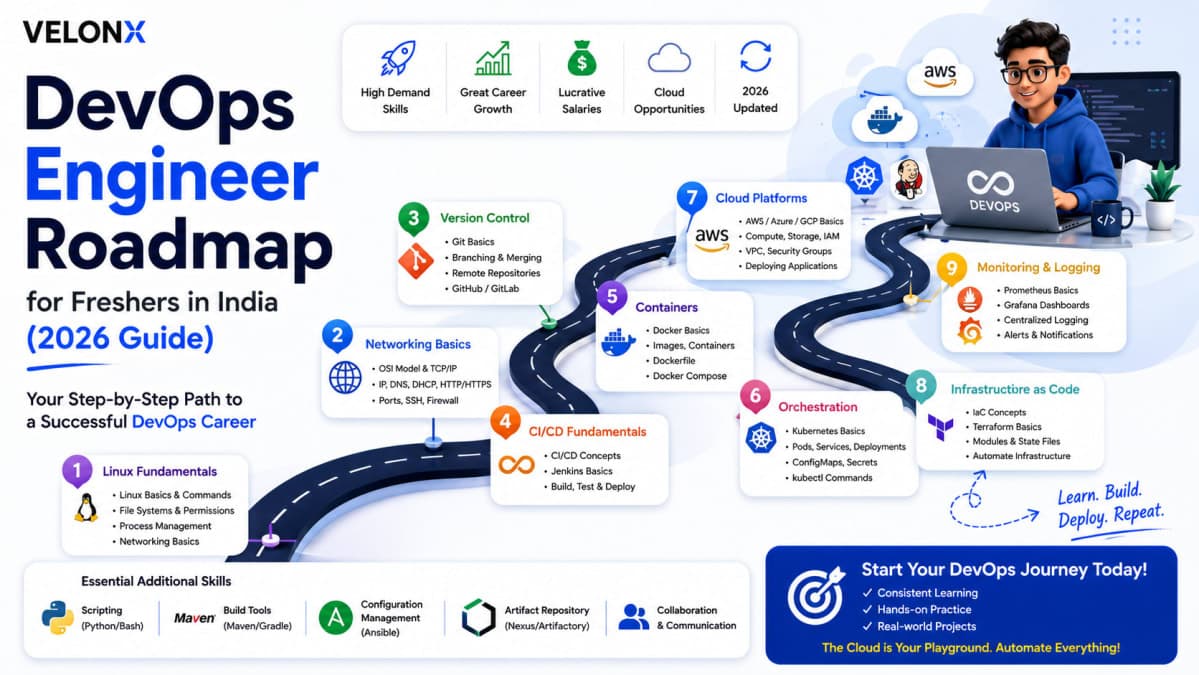
Think DevOps is just "knowing Docker and a bit of AWS"? That's exactly why most freshers get filtered out in the first interview round. DevOps roles test whether you actually understand how code moves from a developer's laptop to a live server serving real users — reliably, repeatedly, and without 2 AM downtime calls. A clear DevOps engineer roadmap is what separates freshers who can talk pipelines and infrastructure with confidence from freshers who just list tool names on a resume. This guide walks you through the exact DevOps engineer roadmap for freshers in India — from Linux basics to your first production deployment.
What Is a DevOps Engineer Roadmap and Why It Matters
DevOps sits at the intersection of development and operations — the discipline of automating how software gets built, tested, deployed, and monitored. A roadmap matters here more than in most tech roles because DevOps is inherently broad: without structure, freshers either go too deep into one tool (like only Docker) or stay too shallow across everything and can't actually operate a system end-to-end.
Here's why following a structured path matters:
High demand, limited supply: Most computer science graduates learn to code, but far fewer learn to deploy and operate what they build — this gap is exactly where DevOps freshers get hired.
Cross-functional value: DevOps skills make you useful to both development and infrastructure teams, which widens your job options beyond a single team or stack.
Cloud-first hiring: Nearly every Indian product company and startup now runs on AWS, Azure, or GCP, so cloud fluency alone puts you ahead of most fresher applicants.
Clear skill signals: Unlike some roles where "experience" is hard to prove, DevOps skills are easy to demonstrate through a live pipeline, a deployed app, or a public infrastructure repo.
According to industry hiring trend reports like NASSCOM's talent surveys, cloud and infrastructure roles have remained among the fastest-growing hiring categories in Indian IT — and DevOps sits right at the center of that demand.
Step 1: Build Your Linux, Networking, and Scripting Fundamentals
Every DevOps tool you'll eventually touch — Docker, Kubernetes, Terraform, cloud CLIs — runs on top of Linux. Skipping this step is the single biggest reason freshers struggle in DevOps interviews.
What to Learn First
Linux basics: File systems, permissions, process management, and essential commands (
grep,awk,systemctl,chmod)Networking fundamentals: DNS, HTTP/HTTPS, TCP/IP, load balancers, and how ports and firewalls work
Shell scripting: Writing basic Bash scripts to automate repetitive tasks
Python basics: Enough to write automation scripts and interact with cloud APIs
Mistakes to Avoid
Jumping straight into Kubernetes before you're comfortable navigating Linux from the terminal
Treating networking as "not real coding" and skipping it — it shows up constantly in interviews
Learning commands by memorization instead of understanding what's actually happening under the hood
Avoiding the command line in favor of GUI tools, which won't scale to real DevOps work
Pro Tip: Set up a free-tier Linux virtual machine (AWS EC2 or Oracle Cloud) and do everything — file management, user permissions, basic scripting — through the terminal only for two weeks straight. This single habit builds more real confidence than any tutorial series.
Step 2: Learn Git, Version Control, and Basic Cloud Concepts
Once Linux feels natural, layer in the collaboration and cloud fundamentals every DevOps workflow depends on.
Git and GitHub Basics
[ ] Branching, merging, and resolving conflicts confidently
[ ] Understanding pull request workflows used in real teams
[ ] Writing clear, structured commit messages
[ ] Using
.gitignoreand basic repo hygiene
Cloud Concepts to Understand Early
Virtual machines, storage, and networking basics in the cloud
IAM (Identity and Access Management) — who can access what, and why it matters
Regions, availability zones, and basic high-availability concepts
Pricing models — understanding why cost optimization is a real DevOps responsibility
Pro Tip: Create a free-tier account on AWS or GCP now, not later. Reading about cloud concepts without touching the console is the #1 reason freshers freeze up when asked cloud questions in interviews.
Step 3: Master a Cloud Platform
You don't need to learn all three major clouds — pick one and go deep. In the Indian job market, AWS currently dominates hiring demand, but here's how the major platforms compare:
Platform | Best For |
|---|---|
AWS | Widest job demand in India, most startups and product companies (Swiggy, Razorpay, Flipkart) run on it |
Azure | Common in enterprise and MNC environments, especially companies already using Microsoft's ecosystem |
GCP | Strong in data-heavy and AI-focused companies, smaller share of fresher job listings in India |
Key Tip: If you're unsure where to start, learn AWS first — it gives you the widest range of fresher and internship opportunities, and most of the core concepts (IAM, networking, compute, storage) transfer directly to Azure or GCP if you switch later.
Focus on core services first: EC2 (compute), S3 (storage), VPC (networking), and IAM (access control). Reference official documentation like AWS Documentation as you go — it's the most reliable source for how services actually behave in production.
Step 4: Learn Containers, CI/CD, and Orchestration
This is where DevOps starts to feel like DevOps — automating builds, packaging applications consistently, and deploying them without manual steps.
Core Tools to Learn
Docker: Containerizing applications so they run identically everywhere
CI/CD pipelines: Jenkins or GitHub Actions for automating build, test, and deployment steps
Kubernetes basics: Pods, deployments, services, and how orchestration manages containers at scale
Common Fresher Mistakes
Learning Kubernetes commands without understanding why orchestration is needed in the first place
Writing a CI/CD pipeline once and never actually breaking and fixing it yourself
Ignoring Docker networking and volumes, which come up constantly in real debugging scenarios
Pro Tip: Containerize one of your own applications with Docker, then build a simple CI/CD pipeline using GitHub Actions that automatically deploys it on every push. This single project demonstrates more real skill than listing "Docker" and "Kubernetes" on your resume ever will.
Step 5: Build Real Projects for Your DevOps Portfolio
Tutorials teach you syntax; projects teach you how systems actually break and get fixed. This step is what makes your resume credible to a hiring manager.
Dockerized multi-container app — a frontend, backend, and database running together with Docker Compose
CI/CD pipeline project — automated build, test, and deploy flow using GitHub Actions or Jenkins
Infrastructure-as-Code setup — provision a basic cloud environment using Terraform instead of the console
Kubernetes deployment — deploy a small application on a local cluster using Minikube or Kind
Monitoring dashboard — set up Prometheus and Grafana to track basic metrics for one of your apps
Automated deployment script — a Bash or Python script that automates a repetitive infra task end-to-end
Pro Tip: Document every project on GitHub with a clear README explaining your architecture decisions, not just setup steps. Recruiters and interviewers read READMEs to judge whether you understand why you built something a certain way — not just that it works. You can also share these projects on the Velonx projects page to get feedback before you apply anywhere.
Step 6: Learn Infrastructure as Code and Monitoring Tools
Being job-ready in DevOps means going beyond "it works on my machine" and understanding how infrastructure is managed and observed at scale.
Terraform: Provisioning and managing cloud infrastructure through code instead of manual clicks
Configuration management: Basic exposure to Ansible for automating server configuration
Monitoring and logging: Prometheus, Grafana, and basic log aggregation concepts
Security basics: Secrets management, least-privilege IAM policies, and basic vulnerability awareness
Pro Tip: Rebuild one of your cloud projects twice — once manually through the console, and once entirely through Terraform. Feeling that difference firsthand is what makes "Infrastructure as Code" click as a concept instead of just a buzzword on your resume.
Step 7: Crack DevOps Interviews and Land Your First Job
Once you have a few solid projects and hands-on cloud experience, shift into applications and interview prep in parallel — don't wait until you feel fully ready.
Timeline | Focus | Milestone |
|---|---|---|
Month 1–2 | Linux, networking, scripting | Comfortable working entirely from the terminal |
Month 3 | Git + cloud fundamentals | Free-tier AWS/GCP account actively used |
Month 4–5 | Docker, CI/CD, Kubernetes basics | 2 automated deployment projects built |
Month 6 | Terraform, monitoring, interview prep | Applying daily, mock interviews done |
For applications, use Internshala, Naukri, Unstop, and LinkedIn — DevOps freshers roles are often listed under "Cloud Engineer," "Site Reliability Engineer," or "Infrastructure Engineer" as well, so widen your search terms. For technical prep, expect scenario-based questions ("a deployment just failed in production, walk me through your debugging steps") alongside tool-specific questions on Docker, Kubernetes, and your cloud platform of choice.
Pro Tip: Before every interview, be ready to explain one project's failure — a pipeline that broke, a container that wouldn't start, a permission error you had to debug. Interviewers care far more about your debugging process than a project that worked perfectly on the first try. If you want a second opinion on your project depth, get a review from a mentor on the Velonx mentors page before you start applying widely.
Frequently Asked Questions About Becoming a DevOps Engineer
Can I become a DevOps engineer directly as a fresher?
Yes, though it's less common than starting as a developer and transitioning later. Freshers with strong Linux, cloud, and containerization project experience do get hired directly into junior DevOps, Cloud Engineer, or Site Reliability roles — the key is proving hands-on experience through projects, not just certifications.
Do I need a coding background to become a DevOps engineer?
Basic scripting (Python or Bash) is essential, but you don't need deep software development experience like a full-stack developer would. DevOps leans more on automation, infrastructure, and systems thinking than on building application logic from scratch.
Which cloud certification should I get first as a fresher?
The AWS Certified Cloud Practitioner or AWS Solutions Architect – Associate are strong starting points for the Indian job market, since AWS has the widest fresher hiring demand. That said, a certification without hands-on projects rarely gets you shortlisted — pair it with real deployed work.
Is Kubernetes necessary for a fresher DevOps role?
Basic Kubernetes knowledge helps you stand out, but many fresher roles focus more on CI/CD, cloud fundamentals, and Docker before expecting deep Kubernetes expertise. Understanding core concepts — pods, deployments, services — is usually enough at the entry level.
How is DevOps different from a regular software developer role?
A software developer primarily builds application features, while a DevOps engineer focuses on how that application gets built, deployed, scaled, and kept running reliably. Many DevOps engineers write code too, but the focus shifts from features to systems, automation, and reliability.
What's a realistic timeline to become job-ready in DevOps as a fresher?
Most consistent learners can reach a job-ready level in 5–7 months by following a structured path — Linux and networking first, then cloud, then containers and CI/CD, then projects and interview prep. Rushing straight to Kubernetes without fundamentals usually backfires in interviews.
Conclusion: Your DevOps Journey Starts With Your First Terminal Session
Here's the bottom line: a DevOps engineer roadmap only works if you actually operate systems — reading about Kubernetes won't get you hired, deploying and breaking things will.
Start with what you can control today:
Spin up a free-tier Linux VM and work entirely from the terminal this week
Create a free AWS or GCP account and provision your first resource
Containerize one of your existing projects with Docker
Build one CI/CD pipeline that deploys automatically on every push
Apply to 5 DevOps or cloud-focused internships this week using Internshala or Unstop
Get one project reviewed by a mentor before your next interview
Every failed deployment teaches you something a tutorial never will — so stop reading about pipelines and start breaking one on purpose.