
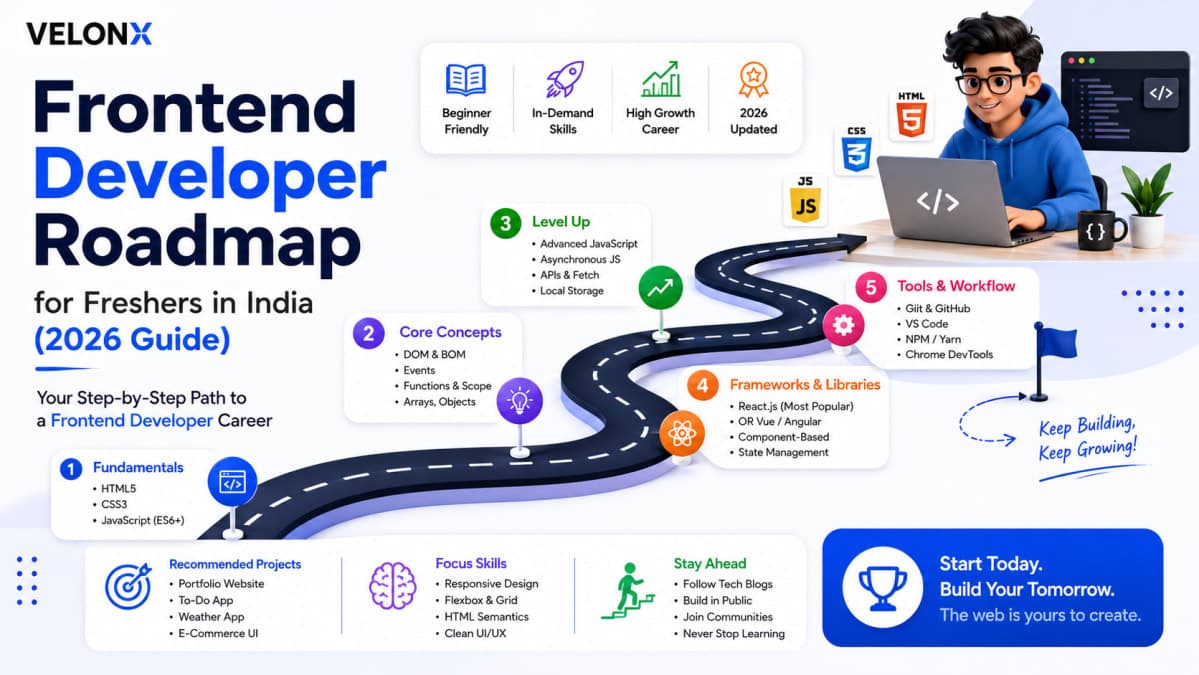
Still writing "proficient in HTML and CSS" on your resume with zero projects to back it up? Here's the truth: recruiters at Indian product companies skim frontend resumes in under 10 seconds, and buzzwords without proof get rejected instantly. A clear frontend developer roadmap is what separates freshers who land real interview calls from freshers who apply to 200 companies and hear nothing back. This guide walks you through the exact frontend developer roadmap for freshers in India — from your first line of HTML to your first job offer.
What Is a Frontend Developer Roadmap and Why It Matters
A frontend developer roadmap is a structured sequence of skills — markup, styling, scripting, frameworks, and tools — that takes you from "I know some coding" to "I can ship a production-ready web interface." Without one, most students bounce between YouTube tutorials, never build anything real, and end up with a resume that says a lot but proves nothing.
Here's why following a roadmap (instead of random tutorials) matters:
Faster hiring cycle: Frontend roles often move quicker than backend or core CS roles because companies can evaluate your work by simply looking at your live projects.
Lower entry barrier: You don't need a Tier-1 college tag or a perfect CGPA — you need a working portfolio and clean fundamentals.
High demand, low competition at the fresher level: Most freshers chase DSA-only prep and ignore frontend depth, which means a genuinely skilled frontend fresher stands out fast.
Remote-friendly: Frontend skills translate directly into freelance work, remote internships, and contract gigs — even before you land a full-time offer.
According to industry hiring trend reports like NASSCOM's talent surveys, demand for web and application developers has stayed consistently strong across Indian IT and product companies — and frontend is usually the fastest-growing sub-skill within that demand.
Step 1: Build Your Web Fundamentals (HTML, CSS, JavaScript)
Your resume can wait. Right now, your only job is to get genuinely comfortable with the three languages every browser understands — no framework, no shortcuts.
What to Learn First
HTML5: Semantic tags, forms, accessibility basics (
alt,aria-label), and document structureCSS3: Box model, Flexbox, Grid, positioning, and responsive design with media queries
Vanilla JavaScript: Variables, functions, DOM manipulation, events, and array/object methods
Browser DevTools: Learn to inspect elements, debug console errors, and use the Network tab
Mistakes to Avoid
Jumping straight into React before you can center a div without Googling it
Copy-pasting CSS from tutorials without understanding why it works
Ignoring responsive design — most Indian recruiters test on mobile view first
Skipping accessibility basics, which is now a common interview screening question at product companies
Pro Tip: Rebuild 3–4 real websites (a Swiggy landing page, an Amazon product card, a Netflix login screen) from scratch using only HTML and CSS — no frameworks. This single exercise teaches you more layout intuition than 10 tutorials combined.
Step 2: Learn Modern JavaScript and Version Control
Once your fundamentals are solid, go deeper into JavaScript and get comfortable with Git — the two things every technical interviewer will assume you already know.
Modern JavaScript (ES6+)
Arrow functions, destructuring, spread/rest operators
Promises,
async/await, and the Fetch API for calling real APIsmap,filter,reduce, and array/object manipulation patternsBasic understanding of the event loop and asynchronous behavior
Git and GitHub Basics
[ ] Initialize a repo and understand
add,commit,push,pull[ ] Work with branches and resolve a merge conflict at least once
[ ] Write clean, readable commit messages
[ ] Keep your GitHub profile active — recruiters check contribution graphs
Pro Tip: Push every single project to GitHub, even the ugly ones. A messy but real GitHub history beats an empty profile with a polished resume — recruiters notice consistency over perfection.
Step 3: Master a Frontend Framework
Once vanilla JavaScript feels natural, pick one framework and go deep instead of learning three shallowly. In the Indian job market, React currently has the widest hiring demand, but here's how the major options compare:
Framework | Best For |
|---|---|
React | Widest job demand in India, huge community, most product companies (Swiggy, Zomato, Razorpay, Flipkart) hire for it |
Vue | Easier learning curve, good for smaller startups and agencies, fewer job listings in India |
Angular | Common in enterprise and MNC service-based companies (TCS, Infosys, Cognizant), steeper learning curve |
Key Tip: If you're unsure where to start, learn React first — it gives you the most interview opportunities as a fresher, and its concepts (components, state, props) transfer easily if you switch frameworks later.
Focus on: components, props vs. state, hooks (useState, useEffect, useContext), conditional rendering, and basic routing with React Router. Reference documentation like MDN Web Docs as you go — it's the most reliable source for how JavaScript and web APIs actually behave.
Step 4: Build Real Projects for Your Portfolio
This is the step most freshers skip or half-do — and it's the one that actually gets you shortlisted. Don't just follow along with tutorials; rebuild the project on your own afterward without the video paused next to you.
Personal portfolio site — showcases your projects, resume, and contact info
E-commerce UI clone — product listing, cart, filters (no backend needed initially)
Weather app using a public API — teaches you
fetch, async data, and error handlingTodo app with local state management — demonstrates your grasp of state and component design
Markdown blog renderer — shows you can handle dynamic content rendering
Admin dashboard with charts — signals you can build "real" business-facing UI, not just toy apps
Pro Tip: Deploy every project live using Vercel or Netlify and link the live URL — not just the GitHub repo — on your resume. Recruiters are far more likely to click a live demo than clone a repository. You can also list these projects on your Velonx projects page to get visibility and peer feedback before you apply anywhere.
Step 5: Learn the Tools of the Trade
Being job-ready means knowing the ecosystem around your code, not just the code itself.
Package managers: npm or yarn for managing dependencies
Build tools: Vite (faster and now more common than Create React App)
Testing basics: Jest or React Testing Library — even basic unit test knowledge stands out
Deployment: Vercel, Netlify, or GitHub Pages for hosting your projects
Performance basics: Run a Lighthouse audit and understand what "good" scores look like
Pro Tip: Add one testing file and one performance optimization (like lazy loading images) to your best project. Most freshers never do this, and it's an easy way to sound more experienced than you technically are in an interview.
Step 6: Crack Frontend Interviews and Land Your First Job
Once you have 3–4 solid projects and a working GitHub, shift your energy toward applications and interview prep in parallel — don't wait to feel "100% ready."
Timeline | Focus | Milestone |
|---|---|---|
Month 1–2 | HTML, CSS, responsive design | 3 static websites built |
Month 3 | JavaScript + Git/GitHub | Solid GitHub commit history |
Month 4–5 | React fundamentals | 2 React projects deployed |
Month 6 | Portfolio + interview prep | Applying daily, mock interviews done |
For applications, use Internshala, Naukri, Unstop, and LinkedIn — don't rely on campus placements alone, since most frontend hiring for freshers happens off-campus and through referrals. For technical prep, mix frontend-specific questions (rendering behavior, event delegation, CSS specificity) with light DSA practice on LeetCode or GeeksforGeeks, since many companies still run one logic round even for frontend roles.
Pro Tip: Before every interview, be ready to explain one of your projects line-by-line — why you chose that state structure, what you'd refactor now. Interviewers care far more about your reasoning than your final UI polish. If you're unsure how your projects hold up, get a review from a mentor on the Velonx mentors page before you start applying widely.
Frequently Asked Questions About Becoming a Frontend Developer
Can I become a frontend developer without a CS degree?
Yes. Frontend hiring, especially at the fresher and startup level, is skill-first — a strong portfolio and GitHub profile often matter more than your degree. Many working frontend developers in India come from non-CS branches or even non-engineering backgrounds through self-study.
Is frontend development harder than backend development?
Neither is objectively harder — they test different skills. Frontend demands strong UI/UX intuition, layout precision, and JavaScript depth, while backend leans more on databases, system design, and server logic. Most freshers find frontend faster to get visibly good at because the results are immediately visual.
What's the best time to start applying for frontend internships?
Start applying once you have 2–3 deployed projects, even if you don't feel "fully ready" — waiting for perfection costs you months. Internship demand is fairly steady through the year, unlike core placement season which is concentrated around December to February.
Do I need to learn TypeScript to get hired?
Not for your first internship, but it's increasingly expected at product companies for full-time roles. Learn strong vanilla JavaScript first, then add TypeScript basics once you're comfortable with React — most transitions from JS to TS take just a couple of weeks.
How do I find frontend internships without prior experience?
Apply through Internshala, Unstop, and LinkedIn using your portfolio projects as proof of skill instead of "experience." Cold outreach to startup founders on LinkedIn, along with a live project link, often works better than portal applications alone for freshers with no formal experience.
What happens if I don't know DSA well as a frontend developer?
You can still get hired — most frontend interviews weigh project depth and JavaScript fundamentals more heavily than DSA. That said, knowing basic array, string, and object manipulation problems helps, since a light logic round is still common even in frontend-focused interviews.
Conclusion: Your Frontend Journey Starts With Today's Commit
Here's the bottom line: a frontend developer roadmap only works if you actually build things — reading about React won't get you hired, shipping projects will.
Start with what you can control today:
Rebuild one real website layout using only HTML and CSS
Push your first project to GitHub, even if it's incomplete
Pick React and commit to it instead of framework-hopping
Deploy one project live and add the link to your resume
Apply to 5 internships this week using Internshala or Unstop
Get one project reviewed by a mentor before your next interview
Every rejected application is data, not a verdict on your ability. Every project you ship sharpens the exact skills recruiters are actually looking for — so stop planning the roadmap and start committing code.