
Did you open five different YouTube playlists on JavaScript and still don't know where to start? Or maybe you finished a "30 Days of JS" course and still froze in your first interview. Here's the truth: JavaScript isn't hard to learn — it's hard to learn in the right order, and most freshers never get that order right.
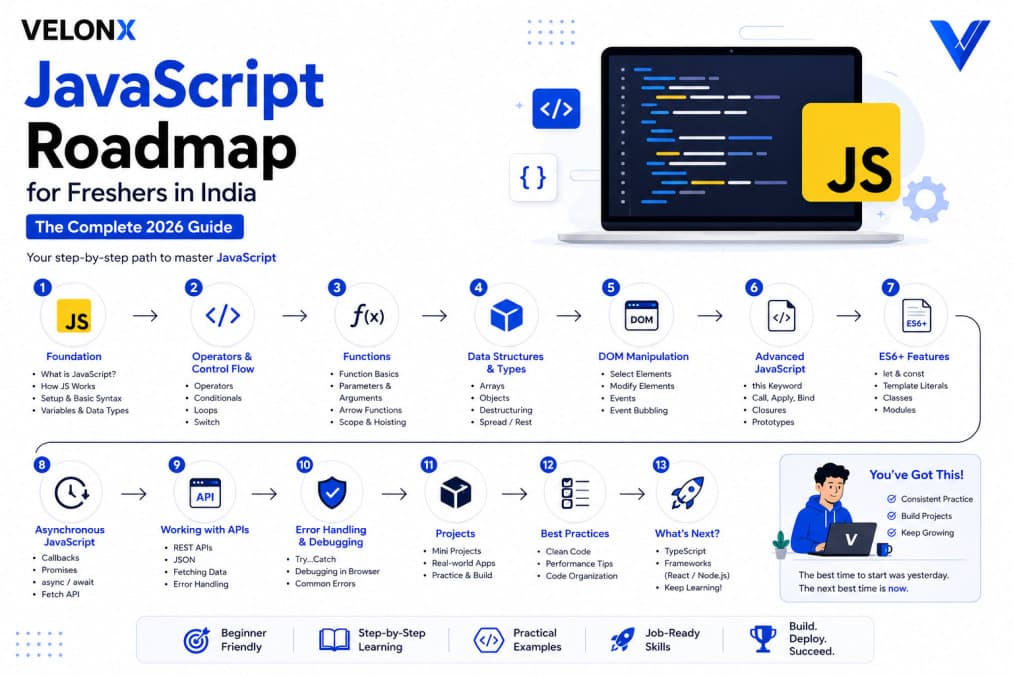
This JavaScript roadmap for freshers in India lays out exactly what to learn, in what sequence, and what to build — so you go from "I know some JS" to "I can ship a working project and defend it in an interview" in about 24 weeks.
What Is JavaScript and Why It Still Rules in 2026
JavaScript is the programming language that runs in every browser and — thanks to Node.js — on servers too. It's the one language you can use to build the frontend, backend, and even mobile apps of a single product.
Here's why it's still worth your time in 2026:
Demand hasn't slowed down: JavaScript remains one of the most in-demand skills across Indian startups (Razorpay, Zerodha, Freshworks, Meesho) and MNCs (Google, Amazon, Flipkart) hiring for frontend, backend, and full-stack roles.
One language, three jobs: Learn JS once and you can build frontend (React), backend (Node.js/Express), and even cross-platform mobile apps (React Native).
Low entry barrier, high ceiling: You can start with just a browser and a text editor — no complex setup — but the depth (closures, async patterns, event loops) keeps you learning for years.
Massive open-source ecosystem: npm has millions of packages, meaning you rarely build from scratch.
According to LinkedIn India's Talent Trends reports, full-stack and frontend developer roles consistently rank among the top hired tech profiles for freshers at product-based companies, with starting packages typically in the ₹4–10 LPA range depending on the company tier.
Step 1: Master the Fundamentals (Weeks 1–4)
Skipping fundamentals is the #1 reason freshers freeze up in interviews. You can copy-paste a working app off YouTube, but if you can't explain why it works, no interviewer will hire you.
What to Include
Variables and data types —
var,let,const, and the actual difference between themFunctions — declarations, expressions, arrow functions, default parameters
Control flow — loops, conditionals, switch statements
Arrays and objects — methods like
map,filter,reduce, destructuringScope and hoisting — this alone is asked in almost every fresher JS interview
Mistakes to Avoid
Jumping straight to React before understanding plain JavaScript
Memorizing syntax without writing your own small programs (calculator, to-do list, number guessing game)
Ignoring the browser console — it's your debugging best friend, use it constantly
Pro Tip: Recreate 5–6 classic JS mini-projects (calculator, digital clock, quiz app) from scratch without tutorials. If you can build these blind, your fundamentals are solid.
Step 2: Get Comfortable with the DOM and Browser APIs (Weeks 5–6)
Your JavaScript needs to actually do something on a webpage — that's the DOM (Document Object Model).
What to practice here:
Selecting and manipulating elements (
querySelector,addEventListener)Handling form inputs and validating them
Working with
localStorageto persist dataFetching data from an API using
fetch()Handling events — clicks, keypresses, form submissions
Build a simple weather app or a movie search app using a free public API. This is usually the first project freshers can show off that actually feels "real."
Pro Tip: Recruiters scanning your GitHub in 10 seconds care more about interactivity than code volume. A working live demo link beats 500 lines of untested code every time.
Step 3: Learn ES6+ and Modern JavaScript (Weeks 7–8)
Modern JavaScript (ES6 and beyond) is what every real codebase uses today. Interviewers specifically probe this to check if you learned JS recently or from an outdated 2015 tutorial.
Old Way | Modern Way (ES6+) |
|---|---|
|
|
Callback functions | Promises / |
| Arrow functions |
String concatenation | Template literals |
|
|
Key Tip: If you only remember one thing from this section, make it async/await — asynchronous JavaScript (Promises, async-await, the event loop) is the single most commonly asked JS interview topic for freshers.
Step 4: Pick a Framework — React vs Vue vs Angular (Weeks 9–12)
You don't need to learn all three. Pick one and go deep — depth beats breadth in interviews and in real hiring.
Framework | Best For |
|---|---|
React | Highest job demand in India; huge ecosystem; used by Flipkart, Swiggy, Meesho |
Vue | Gentler learning curve; fewer job listings in India compared to React |
Angular | Common in enterprise/MNC projects (finance, healthcare); steeper learning curve |
Key Tip: If you're unsure, choose React. It shows up in the vast majority of frontend and full-stack fresher job postings on Naukri and Internshala, which means your project experience directly maps to what recruiters are screening for.
Once you pick React, focus on:
Components, props, and state
Hooks (
useState,useEffect,useContext)React Router for multi-page apps
Basic state management (Context API before jumping to Redux)
Step 5: Backend with Node.js and the MERN Stack (Weeks 13–16)
This is where you go from "frontend fresher" to "full-stack candidate" — and full-stack roles typically get more interview calls and better starting packages.
Node.js basics — modules, npm, the event loop on the server side
Express.js — building REST APIs, routing, middleware
MongoDB — storing and querying data with a NoSQL database
Authentication — JWT-based login systems, password hashing with bcrypt
Together, MongoDB + Express + React + Node.js form the MERN stack, one of the most commonly asked-for stacks in Indian startup job postings.
Pro Tip: Most freshers stop at "I can build a CRUD app." Add authentication and deployment to your project, and you're already ahead of 70% of other applicants with similar experience.
Step 6: Build Real Projects for Your Resume (Weeks 17–20)
Courses prove you can follow instructions. Projects prove you can build. Aim for 2–3 solid, deployed, full-stack projects — not ten half-finished ones.
Strong project ideas that map directly to real hiring use cases:
E-commerce app — product listing, cart, checkout, auth (shows full CRUD + auth)
Job/internship board — like a mini version of a Velonx-style job board, with filters and applications
Real-time chat app — using WebSockets (Socket.io), shows you understand real-time systems
Personal finance/expense tracker — with charts, shows data handling skills
Deploy every project (Vercel, Netlify, Render are all free) and link them on your resume and LinkedIn — a dead GitHub repo with no live link rarely gets clicked.
Pro Tip: Write a short README for each project explaining why you built it and what problem it solves — recruiters skim READMEs before they skim code.
Step 7: Prepare for Interviews and Apply Strategically (Weeks 21–24)
Building projects gets you noticed. Interview prep gets you hired.
Prep Area | What to Practice | Platform |
|---|---|---|
DSA basics | Arrays, strings, recursion | LeetCode, GeeksforGeeks |
JS-specific rounds | Closures, event loop, | GfG, PrepInsta |
System design (light) | How your project scales | Mock interviews |
Behavioral | STAR-format answers | Practice with peers |
Key Tip: Use this table to track your applications, not just your prep — apply to 10–15 roles a week during placement season and year-round via off-campus drives on Unstop, Internshala, and Velonx's career page.
Don't ignore mentorship here — a 30-minute mock interview with someone who's cleared the exact round you're prepping for (available via Velonx Mentors) can catch mistakes weeks of solo practice won't.
For deeper structured prep, MDN Web Docs remains the most reliable free reference for JavaScript fundamentals, and freeCodeCamp is a solid free path for full project-based practice.
Frequently Asked Questions About the JavaScript Roadmap
Can I get a JavaScript developer job without a CS degree?
Yes. Most companies hiring freshers for JS/frontend roles care more about your GitHub projects and problem-solving ability than your degree. A strong portfolio of 2–3 deployed projects often matters more than your branch of engineering.
Is React necessary, or can I get hired with just plain JavaScript?
Plain JS gets you interviews for basic frontend roles, but React is what most Indian startups and product companies actually ask for in job descriptions. Learning React significantly widens the roles you're eligible for.
How long does it actually take to become job-ready in JavaScript?
With consistent daily practice (2–3 hours), 5–6 months is realistic to go from fundamentals to a full-stack MERN project you can confidently discuss in interviews. Rushing this timeline usually shows up as shallow interview answers.
Do I need to learn TypeScript too?
Not at the fresher stage. Get comfortable with plain JavaScript and one framework first. TypeScript is a strong second skill to add once you have a job or are further along, since many mid-to-large companies use it in production.
What if I don't get shortlisted anywhere during placement season?
Off-campus hiring runs year-round in India — placement season isn't your only shot. Keep applying via Internshala, Unstop, LinkedIn, and platforms like Velonx's job board, while continuing to build and ship projects in the meantime.
Conclusion: Stop Collecting Tutorials, Start Shipping Projects
Here's the bottom line: a JavaScript roadmap only works if you build while you follow it — watching tutorials without typing code is the single biggest reason freshers stall out at month three.
Start with what you can control today:
Pick one JavaScript fundamentals resource and finish it in 4 weeks, not 4 months
Build one small project every 2 weeks — no exceptions, even if it's ugly
Commit to React (not all three frameworks) and go deep
Deploy every project with a live link, not just a GitHub repo
Apply to 10+ roles a week once you have 2 solid full-stack projects
Every rejection is data, not a verdict. Every project you ship sharpens the next one. The freshers who get hired aren't the ones who knew the most JavaScript — they're the ones who kept building while everyone else kept watching tutorials.
Explore more resources on Velonx — from live projects and mentorship to hackathons and events to help you go from learning to hired.