
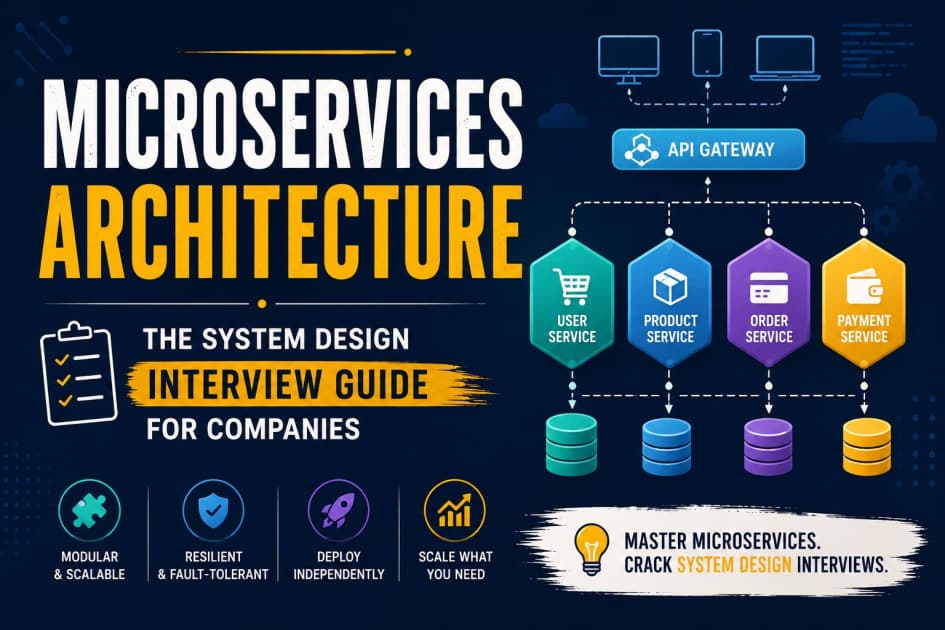
System design rounds eliminate more candidates than coding tests at fast-growing unicorns. Not because the problems are impossibly hard — but because most engineers walk in with no mental framework for microservices architecture, answer in vague generalities, and leave the interviewer with no confidence that they could actually build and own a scalable system.
This guide gives you a visual, pattern-by-pattern breakdown of microservices architecture for system design interviews — the kind of depth that makes a Swiggy or Razorpay interviewer lean forward and say, "Yes, tell me more."
Why Microservices Dominate System Design Interviews at Unicorns
Before you can master microservices architecture for interviews, you need to understand why fast-growing companies care about it so intensely.
Unicorns — companies valued at $1B+ — aren't just asking about microservices because it's a trendy buzzword. They've lived the consequences of getting architecture wrong at scale. Swiggy processes millions of orders daily. Razorpay handles payment transactions that cannot afford even milliseconds of downtime. Zepto's dark store network requires sub-10-minute delivery coordination across hundreds of micro-fulfillment centers.
At this scale, a monolithic system doesn't just slow you down — it becomes a liability. Every code deployment risks bringing the entire product down. Every team steps on every other team's work. Horizontal scaling becomes a nightmare because you can't scale just the checkout service independently from the product catalog.
Microservices architecture solves these problems by breaking a large application into small, independently deployable services — each responsible for a specific business capability, communicating over well-defined APIs. When you walk into a system design interview at a unicorn and demonstrate you understand why this matters, not just what it is, you immediately separate yourself from the pack.
Monolith vs Microservices: The Foundation You Must Nail
Every microservices system design interview starts implicitly — or explicitly — with this tradeoff. Know it cold.
The Monolithic Architecture
In a monolithic application, all business logic lives inside a single deployable unit. The UI layer, business logic layer, and data access layer are all tightly coupled.
┌─────────────────────────────────────────┐
│             MONOLITHIC APP              │
│                                         │
│  ┌──────────┐  ┌──────────┐  ┌───────┐ │
│  │   User   │  │  Orders  │  │  Pay  │ │
│  │ Service  │  │ Service  │  │ment   │ │
│  └──────────┘  └──────────┘  └───────┘ │
│                                         │
│         Shared Single Database          │
└─────────────────────────────────────────┘
              │
         Single Deploy
Advantages: Simple to develop initially, easy to test end-to-end, low operational overhead.
Disadvantages at scale: A bug in the payment module can bring down the user profile feature. You can't deploy a hotfix to just the search service. The entire app must scale together, even if only one part is under load.
The Microservices Architecture
Microservices decompose the monolith into independently deployable services, each with its own database and clearly defined interface.
         ┌─────────────────────────────┐
         │         API GATEWAY         │
         └────────────────────────────-┘
               │         │         │
      ┌────────┘    ┌─────┘    ┌───┘
      ▼             ▼          ▼
┌──────────┐  ┌──────────┐  ┌──────────┐
│  User    │  │  Order   │  │ Payment  │
│ Service  │  │ Service  │  │ Service  │
│  [DB]    │  │  [DB]    │  │  [DB]    │
└──────────┘  └──────────┘  └──────────┘
      │               │
      └──── Message ──┘
             Broker
         (Kafka/RabbitMQ)
Advantages: Independent deployability, fault isolation, granular scalability, team autonomy.
Tradeoffs to mention in interviews: Higher operational complexity, distributed tracing challenges, eventual consistency, network latency overhead.
Interview tip: Always acknowledge tradeoffs. An interviewer who hears you say "microservices solve everything" will immediately distrust your judgment. The best answers sound like: "Microservices make sense here because we need independent scaling of the payment and order services, but we'd pay the cost of distributed tracing and eventual consistency — here's how I'd handle that…"
The Core Building Blocks of Microservices Architecture (Visual Breakdown)
These are the components every system design interview at a unicorn expects you to place correctly and justify confidently.
1. API Gateway
The API Gateway is the single entry point for all client requests. It handles routing, authentication, rate limiting, SSL termination, and request aggregation — so individual services don't need to handle these concerns themselves.
  Client Request
       │
       ▼
┌──────────────────────────────────┐
│           API GATEWAY            │
│  • Auth / JWT validation         │
│  • Rate limiting                 │
│  • Request routing               │
│  • Load balancing                │
│  • SSL termination               │
│  • Response caching              │
└──────────────────────────────────┘
    │         │         │
    ▼         ▼         ▼
Service A  Service B  Service C
Real-world examples: Netflix Zuul, AWS API Gateway, Kong, NGINX.
When to bring it up: Any time the problem involves multiple client types (mobile app, web app, third-party) accessing different backend services. Lead with the Gateway — it shows architectural maturity.
2. Service Discovery
In a microservices architecture, service instances are dynamic — they scale up and down constantly. Service discovery solves the problem of how services find each other at runtime without hardcoded IP addresses.
There are two models:
Model | How It Works | Example |
|---|---|---|
Client-Side Discovery | Client queries a service registry directly and picks an instance | Netflix Eureka |
Server-Side Discovery | Load balancer queries the registry on the client's behalf | AWS ALB + ECS |
3. Message Broker (Async Communication)
Not all inter-service communication should be synchronous (HTTP/REST). When a service needs to trigger an action in another service without waiting for an immediate response — and especially when that action is not time-critical — asynchronous messaging via a broker is the right choice.
Order Service ──── publishes ────▶ [Kafka Topic: order.created]
                                          │
                    ┌─────────────────────┼─────────────────┐
                    ▼                     ▼                  ▼
            Notification           Inventory           Analytics
              Service               Service             Service
When orders are placed on Swiggy, the order service doesn't wait for the notification service to confirm it sent the SMS. It publishes an event. The notification service consumes it asynchronously. This decoupling is what makes the system resilient — if the notification service is temporarily down, the order still completes.
Key tools: Apache Kafka (high-throughput event streaming), RabbitMQ (traditional message queuing), AWS SQS.
4. Service Mesh
As the number of microservices grows, managing service-to-service communication — observability, retries, timeouts, mutual TLS — inside each service's code becomes unsustainable. A service mesh moves this concern to a dedicated infrastructure layer.
Each service gets a sidecar proxy (like Envoy). All traffic flows through these proxies, giving you centralized control over:
Traffic management (load balancing, canary deployments)
Security (mutual TLS between services)
Observability (distributed tracing, metrics)
Key tools: Istio, Linkerd, Consul Connect.
Interview tip: Mention service mesh when the interviewer asks "how would you handle observability and security at scale?" It's a differentiated answer most candidates don't reach.
5. Distributed Database Strategy
Microservices own their data — each service has its own database. This is called the Database-per-Service pattern. It enables independent deployability and prevents tight coupling at the data layer.
Service | Database Choice | Reason |
|---|---|---|
User Service | PostgreSQL | Relational, transactional user data |
Product Catalog | Elasticsearch | Full-text search, read-heavy |
Session Store | Redis | Ultra-low latency key-value access |
Order History | Cassandra | Write-heavy, time-series, high scale |
Notification Logs | MongoDB | Flexible schema, document-oriented |
This is a table you should be able to draw from memory. It shows you understand that choosing the right database is a design decision, not a default.
6 Microservices Patterns You Must Know for Technical Interviews
1. Circuit Breaker Pattern
When Service A calls Service B, and Service B is failing, Service A shouldn't keep hammering a broken service. The Circuit Breaker pattern detects failures and "trips" — stopping calls to the failing service for a defined period, returning a fallback response instead.
CLOSED ──── failure threshold exceeded ──▶ OPEN
  ▲                                          │
  │         after timeout period             │
  └──────── HALF-OPEN ◀────────────────────-┘
            (test one request)
States: Closed (normal operation), Open (failing — return fallback), Half-Open (test if service recovered).
Real-world use: Razorpay's payment service using a circuit breaker to a downstream bank API — if the bank's API is flaky, the breaker trips and returns a graceful error instead of cascading failures.
2. Saga Pattern (Distributed Transactions)
ACID transactions don't work across microservices because each service has its own database. The Saga pattern manages distributed transactions as a sequence of local transactions, each publishing an event to trigger the next step.
Order Service          Payment Service        Inventory Service
     │                       │                       │
  Create Order ──────▶  Charge Customer ──────▶  Reserve Item
     │                       │                       │
  [Success]             [Success]              [Success → Done]
     │                       │
  [Failure]    ◀─── Compensate: Refund ◀─── Compensate: Cancel Order
If any step fails, compensating transactions roll back the previous steps. This is how Swiggy, Meesho, and Flipkart handle complex order fulfillment workflows across services.
3. CQRS (Command Query Responsibility Segregation)
In high-read systems, your read and write workloads have very different requirements. CQRS separates them into two distinct models:
Command side: Handles writes (create, update, delete) — optimized for consistency
Query side: Handles reads — optimized for performance, often with a denormalized read database
User Action
    │
    ├──── Write ──▶ Command Handler ──▶ Write DB (normalized)
    │                                        │
    │                                  Event Published
    │                                        │
    └──── Read ◀── Query Handler ◀── Read DB (denormalized,
                                     updated by event handler)
When to use it: Any system with a large disparity between read and write volumes — product catalog searches, social feed generation, analytics dashboards.
4. Event Sourcing
Instead of storing the current state of an entity, event sourcing stores the log of all events that led to that state. The current state is derived by replaying the event log.
Event Log:
  [order.created] → [payment.completed] → [order.dispatched] → [order.delivered]

Current State = replay all events from the beginning
Why unicorns love it: Complete audit trail, ability to rebuild read models, natural fit with event-driven architectures. It's the default pattern at financial companies like Groww or CRED where every transaction must be traceable.
5. Strangler Fig Pattern
This is the migration pattern. You can't rewrite a monolith overnight. The Strangler Fig pattern lets you incrementally replace parts of it with microservices, routing traffic progressively until the monolith is gone.
      All Traffic
          │
          ▼
   ┌─────────────┐
   │    Proxy    │──── New Feature ──▶ Microservice
   └─────────────┘
          │
          ▼
     Legacy Monolith
     (shrinking over time)
Mention this when an interviewer asks how a company should migrate from a legacy system. It shows systems thinking beyond greenfield design.
6. Bulkhead Pattern
Isolate resources for different services so that a failure in one doesn't exhaust shared resources and bring down others. Named after the watertight compartments in a ship's hull — if one compartment floods, the ship stays afloat.
Implementation: Use separate thread pools, connection pools, or even separate service instances for critical vs non-critical workloads.
How to Structure Your Answer in a System Design Interview
When you get a prompt like "Design Swiggy's order management system" or "Design a payment processing system for 10M daily transactions," use this framework:
Step 1 — Clarify Requirements (3–5 minutes)
Ask explicitly: read-heavy or write-heavy? Expected QPS? Latency SLA? Consistency requirements? Geographic distribution? Don't assume — asking is itself a green flag.
Step 2 — Define the High-Level Architecture (5 minutes)
Sketch the main components: clients, API Gateway, core services, databases, message broker. Narrate as you draw. Show you see the system holistically before diving in.
Step 3 — Deep-Dive on Core Services (10–15 minutes)
Pick the 2–3 services most critical to the problem. Walk through their internal design, API contracts, database schema, and failure modes. This is where microservices patterns like CQRS, Saga, and Circuit Breaker should appear naturally.
Step 4 — Address Scalability and Fault Tolerance (5 minutes)
How do you scale the bottlenecks? What happens if the message broker goes down? What's the retry strategy? This is where your knowledge of caching (Redis), CDNs, and database sharding shows up.
Step 5 — Discuss Observability (2–3 minutes)
Mention distributed tracing (Jaeger, Zipkin), centralized logging (ELK stack), and metrics/alerting (Prometheus + Grafana). At unicorns, observability is not an afterthought — it's infrastructure.
What Unicorn Interviewers Are Actually Evaluating
Here's what senior engineers at fast-growing companies are scoring you on — and it's not "did they use the right buzzwords."
Signal | What It Looks Like |
|---|---|
Problem decomposition | Can you break a vague problem into clear service boundaries? |
Tradeoff awareness | Do you acknowledge consistency vs availability? Sync vs async? |
Failure-first thinking | Do you design for failure before designing for success? |
Operational maturity | Do you think about deployment, monitoring, and rollbacks? |
Communication | Can you narrate your thinking clearly while drawing? |
The single biggest differentiator: designing for failure before designing for happy-path flow. Most candidates design the system assuming everything works. The best candidates start by asking "what breaks first and how do we contain it?"
Common System Design Interview Mistakes to Avoid
Even experienced engineers make these mistakes in microservices system design interviews:
Jumping to solutions before clarifying requirements. Always ask about scale, SLA, and consistency before drawing anything.
Over-microservicing. Breaking every feature into a micro-service creates operational hell. Justify your service boundaries by business domain, not technical whim.
Ignoring data consistency. Distributed systems make ACID guarantees hard. Explain how you handle eventual consistency — don't pretend it doesn't exist.
No failure handling. Every service call can fail. If you don't mention circuit breakers, retries with exponential backoff, and dead-letter queues, the interviewer fills that gap with doubt.
Missing the non-functional requirements. Logging, monitoring, alerting, and deployment strategy are part of the system design. Skipping them signals you've only worked on greenfield features, not production systems.
Frequently Asked Questions About Microservices System Design Interviews
When should I propose microservices vs a monolith in an interview?
Default to microservices when the system has clearly separable business domains, multiple teams that need to deploy independently, or parts with wildly different scaling requirements. If the interviewer describes a small, early-stage product, starting with a monolith and noting when you'd break it apart actually shows better judgment.
How deeply should I know Kafka for a system design interview?
Understand what Kafka does (durable, distributed event streaming), when to use it (async decoupling, high-throughput event pipelines), and key concepts: topics, partitions, consumer groups, offsets. You don't need to know JVM tuning — but you should know the difference between at-most-once, at-least-once, and exactly-once delivery semantics.
Is microservices knowledge relevant for roles at early-stage startups?
Yes — because fast-growing startups are actively migrating to microservices or building with them from day one. Even if the company is pre-scale, demonstrating you understand when to introduce microservices and why shows architectural maturity beyond your experience level.
What's the difference between a service mesh and an API gateway?
An API Gateway sits at the edge — it's the entry point for external traffic. A service mesh handles east-west traffic — communication between services inside the cluster. They solve different problems and are often used together.
How do I handle transactions that span multiple microservices?
Use the Saga pattern — either choreography-based (services react to events from each other) or orchestration-based (a central saga orchestrator calls each service step and handles rollbacks). Mention ACID at the single-service level and BASE (Basically Available, Soft state, Eventually consistent) at the distributed level.
Conclusion: System Design Is a Skill You Build, Not Luck You Encounter
Mastering microservices architecture for system design interviews is not about memorizing a stack of patterns and hoping one fits the prompt. It's about building the mental model of how scalable systems behave under pressure — and communicating that model clearly under interview conditions.
The engineers who consistently ace system design rounds at Zepto, CRED, Groww, and Meesho are not necessarily the most experienced. They're the ones who think in systems, speak in tradeoffs, and design for failure before they design for success.
Walk into your next interview with these patterns internalized. Draw the microservices architecture diagram before they ask. Bring up the Circuit Breaker before they ask how the system handles failures. Mention CQRS when read-write disparity comes up.
That's the difference between a candidate who knows microservices — and one who thinks in them.