
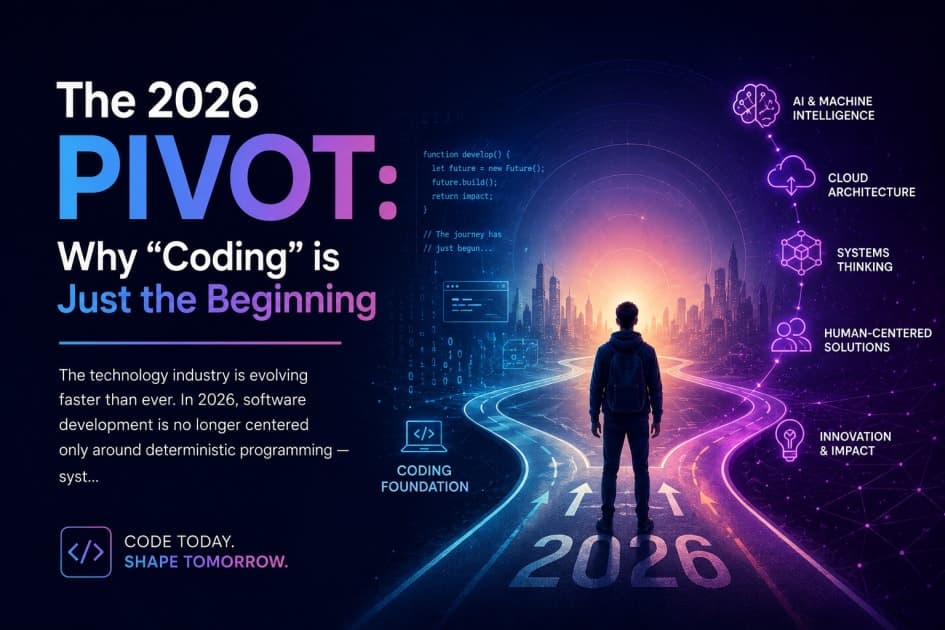
The technology industry is evolving faster than ever. In 2026, software development is no longer centered only around deterministic programming — systems built entirely on fixed rules and predictable outputs.
Instead, the industry is shifting toward probabilistic, AI-driven systems capable of reasoning, decision-making, and autonomous execution.
This shift is changing what companies expect from developers.
Knowing how to write code is no longer enough. The most valuable engineers today understand how to build, manage, and scale intelligent systems powered by AI.
Beyond Prompt Engineering
AI tools have made it easy for almost anyone to generate code or content using prompts. But companies are now looking for developers who understand the infrastructure and engineering behind these systems.
The future belongs to builders who can create reliable AI-powered products — not just interact with them.
1. The New Must-Have Skills
Agentic AI
Modern AI applications are moving beyond simple chatbots.
In 2026, one of the most in-demand skills is building AI agents — systems capable of:
Planning tasks
Using external tools
Accessing APIs and databases
Making decisions autonomously
Executing multi-step workflows
These agents can automate real business processes instead of simply responding to questions.
Developers who understand agent architectures are becoming increasingly valuable across startups and enterprise companies alike.
Model Context Protocol (MCP)
The Model Context Protocol has emerged as a major standard for connecting large language models with external systems and tools.
MCP allows AI models to:
Access structured data
Interact with APIs
Use external applications
Maintain richer contextual understanding
Engineers who know how to build MCP-compatible servers and integrations are already ahead of much of the current developer market.
As AI ecosystems become more connected, interoperability skills will become essential.
MLOps
Building an AI model is only the beginning.
The real challenge lies in:
Deploying models reliably
Monitoring performance
Detecting model drift
Managing infrastructure
Scaling systems in production
This field — known as MLOps — has become one of the highest-value areas in AI engineering.
Companies are actively searching for engineers who can move AI projects from experimental demos into production-ready systems.
2. Your Portfolio Is Your Proof of Work
In 2026, degrees still matter — but portfolios matter more.
Recruiters increasingly want to see real systems, real projects, and real problem-solving abilities.
Instead of building another generic to-do app, students and developers should focus on projects that demonstrate AI integration and automation.
For example:
An AI assistant that prioritizes tasks using your calendar
A meeting summarizer that drafts follow-up emails automatically
A customer support agent using retrieval-augmented generation
A coding assistant integrated with documentation systems
Practical AI projects demonstrate both technical skill and product thinking.
Open Source Contributions Matter More Than Ever
The AI ecosystem in 2026 is heavily driven by open-source collaboration.
Contributing to projects involving:
RAG (Retrieval-Augmented Generation)
Vector databases
AI orchestration frameworks
Multi-agent systems
can significantly improve both your skills and visibility.
Technologies like Pinecone and Weaviate are becoming core infrastructure for modern AI applications.
Participating in these ecosystems can help developers stand out in a highly competitive market.
3. The Rise of Hybrid AI Careers
Some of the fastest-growing tech roles are emerging at the intersection of AI and traditional engineering disciplines.
Robotics AI Specialists
Combining robotics, embedded systems, and computer vision to create autonomous machines and intelligent automation systems.
AI Data Engineers
Designing and managing the large-scale, high-quality datasets needed to train and improve modern AI systems.
Ethical AI Auditors
Ensuring AI systems remain transparent, fair, secure, and resistant to issues like prompt injection attacks or harmful outputs.
As AI adoption increases, trust, safety, and governance are becoming critical priorities for organizations worldwide.
Why the Opportunity Is Bigger Than Ever
The 2026 tech market increasingly rewards developers who can create measurable impact using AI.
Companies are no longer experimenting with AI just for innovation headlines. They now want systems that:
Save time
Reduce operational costs
Improve productivity
Automate workflows
Generate business value
If you can demonstrate that your AI solution saves a company 20 hours of manual work every week, you are no longer just another applicant.
You become a strategic investment.
Final Thoughts
The future of software engineering is no longer just about writing code line by line. It’s about designing intelligent systems that can reason, automate, and adapt.
The developers who thrive in 2026 will be the ones who:
Understand AI infrastructure
Build real-world AI systems
Combine engineering with product thinking
Continuously learn emerging tools and protocols
AI is not replacing engineers.
It is redefining what great engineers look like.