
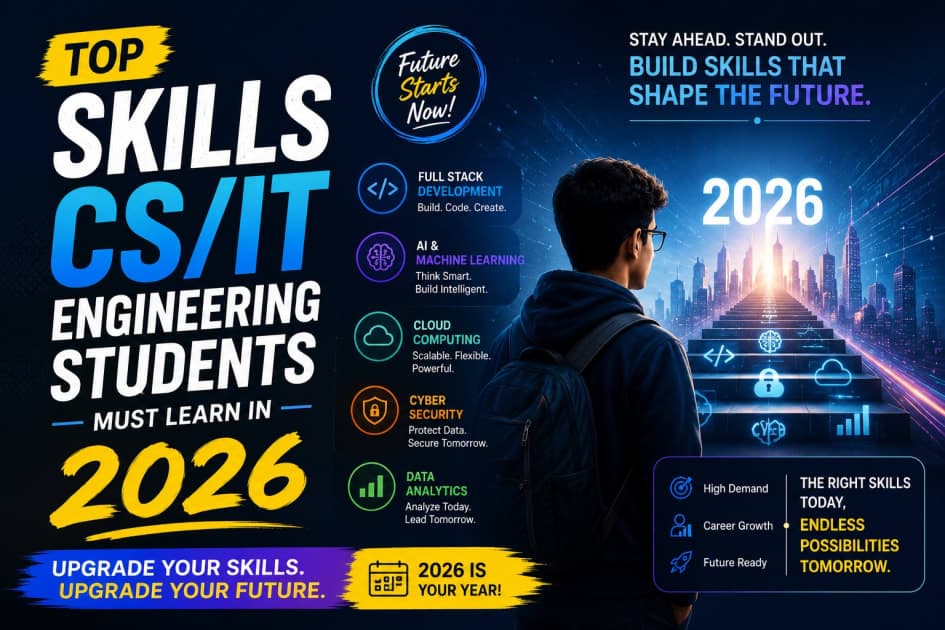
The tech job market in 2026 looks nothing like it did three years ago. AI has automated entire job categories. Companies are hiring fewer people — but paying much more for the ones they do hire. And the bar for what counts as an "employable" CS/IT graduate has quietly moved up.
Knowing the right skills for CS/IT engineering students in 2026 isn't just a nice-to-have. It's the difference between a ₹3 LPA offer and a ₹12 LPA one — or between landing your target internship and watching the batch topper walk away with it.
This guide breaks down exactly which skills matter, what level you need, and where to build them — no fluff, no filler.
1. Data Structures & Algorithms (DSA) — Still the King
If there's one skill that CS/IT engineering students absolutely cannot skip, it's DSA. Every product-based company — from Google to Razorpay to a 20-person SaaS startup — tests DSA in their hiring process.
Why it matters in 2026: Companies use DSA problems to measure logical thinking, not just memorization. An AI can write code. A strong DSA foundation shows you can think in code.
What to focus on:
Arrays, Strings, Linked Lists, Stacks & Queues
Recursion & Backtracking
Trees (Binary Tree, BST, Segment Tree basics)
Graphs (BFS, DFS, Dijkstra's)
Dynamic Programming (the most feared, but pattern-based)
Where to learn:
Striver's A2Z DSA Sheet — the most structured roadmap for Indian students
LeetCode (aim for 100 solved problems: 60 Easy + 35 Medium + 5 Hard)
GeeksForGeeks for concept explanations
📌 Reality check: 45 minutes of DSA practice per day for 3 months will put you in the top 15% of CS engineering students applying for internships.
2. Python — The Language That Runs 2026's Tech Stack
If you're a CS/IT student who doesn't know Python yet, start today. Python isn't just a language — it's the entry point to AI, data science, web scraping, automation, and backend development.
Core Python skills to build:
Data types, functions, OOP in Python
Libraries:
NumPy,Pandas(for data),Requests,Flask/FastAPI(for APIs)Working with files, APIs, and JSON
Why Python specifically:
It's the #1 language in job postings for intern roles in 2026
It bridges multiple domains — one language, infinite possibilities
AI/ML, the hottest skill category, is almost entirely Python-based
For absolute beginners: The free CS50P by Harvard or Automate the Boring Stuff (free online) are excellent starting points.
3. AI & Machine Learning Basics — The Skill Nobody Can Ignore
You don't need to become an AI researcher. But every CS/IT engineering student in 2026 should understand how AI works — and ideally, be able to build something with it.
The two levels:
Level 1 — AI Literacy (Minimum Requirement)
Understanding how LLMs, image models, and recommendation systems work
Using APIs like OpenAI, Gemini, or Anthropic to build simple tools
Prompt engineering — knowing how to get precise outputs from AI models
Level 2 — ML Practitioner (Internship-Ready)
Scikit-learnfor classical ML models (regression, classification, clustering)TensorFloworPyTorchbasics for neural networksBuilding and deploying a model — even a simple one on Hugging Face Spaces
Project idea that impresses recruiters: A simple sentiment analysis tool for tweets, or a resume parser that extracts skills from a PDF. Small, working, deployed beats big, theoretical every time.
4. Web Development — Full Stack Still Pays the Bills
Web development remains one of the highest-demand skill sets for CS/IT engineering students seeking internships. The good news? You don't need to know everything — just the right stack.
The 2026 full-stack roadmap for students:
Layer | What to Learn |
|---|---|
Frontend | HTML, CSS, JavaScript → React.js |
Backend | Node.js + Express or Python + FastAPI |
Database | MySQL/PostgreSQL + MongoDB basics |
Tools | Git, GitHub, Postman, VS Code |
Deployment | Vercel (frontend), Render/Railway (backend) |
You don't need to master all of this before applying. 2 solid layers — say, frontend + backend — is enough to land a web dev internship at a startup.
Bonus in 2026: Learn to use AI coding tools like GitHub Copilot or Cursor while you develop. Companies now expect interns to code with AI, not just without it.
5. Cloud Computing & DevOps Basics — The Backbone of Every Company
Cloud is no longer just for senior engineers. Even entry-level roles in 2026 expect CS/IT students to understand how modern applications are deployed and maintained.
What to learn as a student:
Cloud platforms: AWS Free Tier is the industry standard. Create an account and deploy a simple project — even a static website on S3 counts.
Docker: Understand containers. Being able to "dockerize" your project is a huge differentiator.
Git & GitHub: Version control is non-negotiable. Every project you build should live on GitHub.
CI/CD Basics: GitHub Actions lets you automate testing and deployment — and learning it shows real-world awareness.
Certifications worth getting:
AWS Cloud Practitioner (free practice resources, ₹9,000 exam — often waived through student programs)
Google Cloud Skills Boost (free learning paths)
You don't need to be a DevOps engineer. But knowing this layer makes you 3x more hireable than a student who only knows coding.
6. SQL & Databases — Underrated, Always in Demand
Here's a skill almost every CS/IT engineering student underestimates: SQL. Yet almost every company — tech or non-tech — uses databases, and almost every internship role touches data.
What to know:
SELECT,JOIN,GROUP BY,WHERE,HAVING— the core 80%Subqueries, window functions (bonus for data-heavy roles)
Basic schema design and normalization concepts
MongoDB basics for NoSQL understanding
Where to practice:
SQLZoo — free, interactive, perfect for beginners
Mode Analytics SQL Tutorial — more realistic, business-oriented queries
HackerRank SQL challenges — great for resume credibility
A student who can write a complex JOIN query and explain indexing will stand out in 90% of CS internship interviews.
7. Communication & Soft Skills — The Multiplier Nobody Talks About
Two candidates with identical technical skills walk into a room. One explains their project clearly, answers "why" questions confidently, and asks sharp questions at the end. The other freezes up. The first one gets the offer every single time.
Soft skills that matter for CS/IT students in 2026:
Technical communication: Explaining what your code does in plain English
Documentation habit: Writing README files, code comments, project write-ups
Collaboration: Using GitHub for team projects, Slack/Notion for coordination
Presentation: Being able to do a 3-minute demo of your project without notes
How to build this:
Join your college's technical fest organization team
Present at least one project at a hackathon — the crowd doesn't matter, the practice does
Write one LinkedIn post per week about something you learned
Recruiters spend 30 seconds on a resume but 5 minutes in an interview. Soft skills decide the last mile.
Bonus: Open Source & GitHub — Your Public Portfolio
Your GitHub profile is your second resume. A well-maintained GitHub with 3–4 real projects, regular commits, and a clean README signals that you're serious about engineering — not just grades.
To stand out:
Contribute to beginner-friendly open source projects (look for
good first issuelabels on GitHub)Pin your best 6 repositories on your profile
Write a strong GitHub bio with your skills and what you're building
Even one merged pull request to a real open-source project is a conversation starter in any interview.
Frequently Asked Questions
Q: Which programming language should a CS/IT student learn first in 2026? Python is the best starting point in 2026 — it's versatile, beginner-friendly, and directly applicable to AI, web development, and data science roles. Learn C++ alongside it if you're targeting DSA-heavy companies.
Q: Is web development still a good skill for CS students in 2026? Absolutely. Despite AI tools assisting with code generation, companies still need engineers who understand web architecture, APIs, and debugging. Full-stack developers remain among the most in-demand profiles for internships.
Q: Do I need a cloud certification to get an internship? Not mandatory, but it helps. Even completing free cloud learning paths (like AWS Educate or Google Cloud Skills Boost) and listing them on your resume adds credibility — especially for roles at IT services or cloud-first companies.
Q: How many skills should I focus on at once? Pick one core skill (DSA or Python) and one applied skill (web dev or AI basics) and go deep before spreading wide. Trying to learn everything at once is the fastest path to learning nothing well.
Conclusion: The Right Skills for CS/IT Students Will Always Have a Job
The tech world is changing faster than any syllabus can keep up with. But the in-demand skills for CS/IT engineering students in 2026 follow a clear pattern: strong fundamentals + modern applied knowledge + the ability to communicate your work.
Here's your priority roadmap:
DSA — master the foundation
Python — your Swiss Army knife
AI/ML basics — because every company is AI-first now
Web development — build things people can actually use
Cloud + DevOps basics — understand how real products work
SQL — underrated, always needed
Communication — the skill that multiplies all others
You don't need to be an expert in all of them before your internship search begins. Pick two. Go deep. Build something real.
The students who land the best opportunities aren't the ones who know the most — they're the ones who started earliest and built consistently.